
In heavy equipment and construction machinery, hydraulic system failure rates directly affect uptime, repair costs, and job site safety. Excavators, wheel loaders, mining trucks, hydraulic breakers, and concrete pump trucks operate under high pressure, pulsation, vibration, dust, and temperature cycling. Among hydraulic failures, leaks, fitting loosening, seal failure, hose pull-off, and contamination ingress account for a large share. Many problems do not come from the pump, valve, or cylinder itself, but from the connection points. One-piece hydraulic fittings reduce connection interfaces at the source, offering an effective way to lower failure rates.
Traditional multi-piece fittings consist of a body, nut, sleeve, O-ring, and other parts. Every thread and sealing face is a potential leak path. One-piece hydraulic fittings use integral forging or precision machining to combine multiple functions into a single body. There are no weld seams or extra assembly interfaces. Leak paths are reduced, and the chance of external contamination entering is also lowered. For mining and construction equipment, this means less oil consumption, lower fire risk, and shorter downtime.
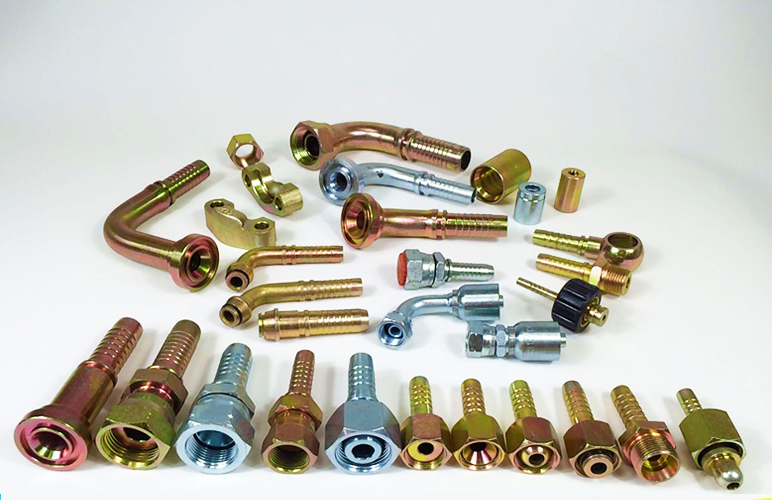
Vibration and pressure spikes are major causes of fitting loosening and fatigue cracks. Hydraulic breakers, boom sections, arms, and pump ports endure high-frequency impact. A one-piece fitting has high overall rigidity and continuous material flow. Threads and sealing faces are less likely to loosen under vibration. With installation practices such as SAE J2593, using a torque wrench and the recommended torque, pulse fatigue life can be significantly improved. For high-pressure circuits, SAE J516 states that the rated working pressure of a hose assembly is the lower of the fitting and hose ratings. SAE J1926-2 and GB/T 2878.1 also set clear working pressure limits for stud ends, with non-adjustable stud ends reaching up to 63 MPa. A one-piece forged structure has no weld defects and is better suited to high-pressure and pulse conditions.
In field service, more parts mean a higher chance of wrong assembly, missing parts, and inconsistent torque. One-piece fittings reduce assembly steps and dependence on technician experience. Pre-assembled structures also help avoid hose twisting and insufficient bend radius. Routing becomes more compact, the number of fittings is reduced, and interference and abrasion risks are lowered. For aftermarket operations, fewer inventory SKUs improve response speed.
Hydraulic fluids are increasingly diverse. Mineral oil, synthetic esters, and phosphate esters require different seal materials. NBR suits mineral oil, while FKM and EPDM suit special fluids. One-piece fittings can flexibly match seal materials and reduce external contamination ingress by cutting interfaces. Carbon steel with zinc-nickel plating and stainless steel bodies can handle mining, coastal, and corrosive environments.
One-piece fittings are not a universal cure. Selection must check pressure rating, temperature, fluid, thread, and sealing method. Installation should follow SAE J2593 and avoid over-tightening. The rated pressure of a hose assembly is the lower of the two ratings. Only correct selection and installation can turn structural advantages into a lower failure rate.
One-piece hydraulic fittings reduce hydraulic system failure rates at the system level by cutting connection interfaces, improving vibration and pulse resistance, simplifying installation and maintenance, and enhancing seal compatibility. Standards set the minimum. Operating conditions set the upper limit. Correct selection and installation determine service life. For heavy equipment users pursuing high reliability and low total cost of ownership, one-piece hydraulic fittings deserve priority consideration.
