
In the construction machinery industry, the hydraulic system is the core power network of the equipment, and hose assemblies are critical components connecting hydraulic pumps, valves, cylinders, motors, and actuators. Excavators, wheel loaders, cranes, concrete pump trucks, rotary drilling rigs, hydraulic breakers, and mining trucks all rely on hydraulic transmission, but their working pressure, flow rate, temperature, installation space, movement mode, and external environment vary greatly. Standard hose assemblies often cannot fully fit every machine model. Therefore, customized hose assemblies have become an important solution for improving machine reliability and reducing maintenance costs.
The first step in customization is requirement diagnosis. Buyers or technical engineers need to define maximum working pressure, continuous pressure, peak pressure, pulse frequency, flow rate, oil temperature, ambient temperature, fluid type, and installation position. For high-pressure main circuits, the hose assembly must have sufficient pressure rating and safety factor. For pilot control, return, and suction lines, inner diameter, vacuum resistance, and pressure loss are more important. If the equipment operates under frequent pressure shocks, a spiral wire reinforced structure should be preferred over a standard braided structure. Only after working conditions are clearly confirmed can customization be meaningful.
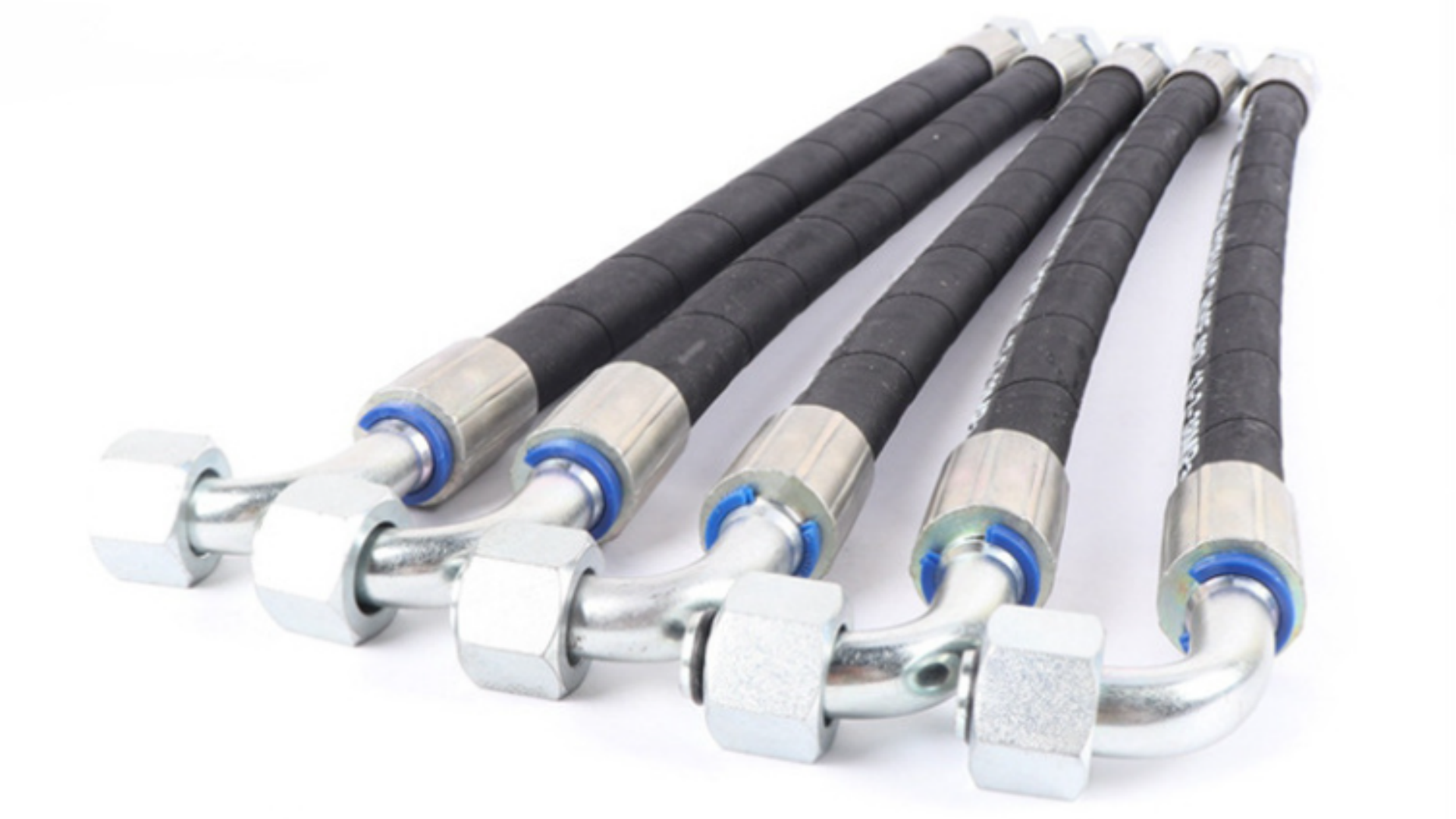
The second step is structure and material customization. The inner tube of the hose assembly must be compatible with hydraulic oil, emulsion, water-glycol, or biodegradable hydraulic fluid. The outer cover should provide abrasion resistance, ozone resistance, weather resistance, UV resistance, and certain flame retardancy. Construction machinery often works in dust, mud, high temperature, low temperature, and vibration environments. Therefore, high-temperature hoses, abrasion-resistant sleeves, flame-retardant mining hoses, or cold-resistant hydraulic hoses can be selected according to actual needs. The reinforcement layer can be one or two layers of wire braid, or four or six layers of wire spiral. Standards such as SAE, EN, and ISO should be referenced to confirm impulse life, burst pressure, and minimum bend radius.
The third step is fitting and dimension customization. Hose assembly failure is often caused not by the hose itself but by incorrect fitting selection or unstable crimping. During customization, confirm thread standard, sealing method, installation angle, and space limits. Common options include JIC, BSP, ORFS, metric, flange, 90-degree elbow, 45-degree elbow, and adjustable angle fittings. Length measurement should consider movement allowance, bend radius, and routing direction to avoid twist, stretching, or rubbing after installation. For narrow spaces, special-shaped hose assemblies, non-standard hose assemblies, or combined routing solutions can make installation smoother.
The fourth step is adapting to different construction machines. Excavators require pulse-resistant and flexible boom and arm hoses. Wheel loaders frequently steer and lift, so hose assemblies must be wear-resistant and high-pressure resistant. Cranes have high requirements for length accuracy and safety. Concrete pump truck hose assemblies need high pressure resistance, vibration resistance, and outdoor aging resistance. Rotary drilling rigs and hydraulic breakers pay more attention to impact resistance, pulse resistance, and fitting locking. Mining equipment also needs flame retardancy, wear resistance, and harsh environment adaptability. By building a selection file by machine model, pressure, temperature, fitting, and length, replacement efficiency can be significantly improved.
The fifth step is sampling, testing, and batch production. Customized hose assemblies are usually sampled first according to drawings or samples to confirm crimping dimensions, fitting angles, length, and marking. Then impulse testing, burst testing, leakage testing, and low-temperature bending testing are carried out. Stable crimping processes and batch traceability are key to ensuring batch consistency. For multi-variety and small-batch requirements, suppliers should have rapid changeover, flexible production, and inventory management capabilities, and should provide clear labels, packaging, and installation instructions.
Finally, customization is not only a product issue but also includes installation and after-sales service. Hose assemblies should be installed without twist, over-bending, or rubbing against sharp edges. Clamps, protective sleeves, and guides should be used when necessary. Daily maintenance should check whether the outer cover is cracked, bulged, or worn, whether fittings leak, and whether the hose hardens or softens. Abnormal assemblies should be replaced in time. Through requirement diagnosis, material selection, fitting customization, testing verification, and installation guidance, customized hose assemblies can truly meet the needs of different construction machinery and provide more practical and reliable solutions for high-pressure systems.
