
Hydraulic supports in fully mechanized coal mining faces operate under combined high-pressure emulsion, dust, moisture, falling rock impact, and frequent advancing movements. The raising, lowering, pushing, side-shielding, and telescopic actions of the support all rely on the high-pressure hydraulic system, and the high-pressure hose is the “blood vessel” connecting the pump station, valve group, legs, and rams. Whether hose selection matches the hydraulic support operating conditions directly determines whether the support can act reliably, and it also affects underground safety.
The first is pressure. The pump station pressure of a hydraulic support main supply system typically ranges from 25 to 31.5 MPa, and some large mining height supports have even higher main supply line pressure. The legs and rams also generate pressure spikes during initial support and load-bearing phases. The second is pulsation. During advancing, fluid flow switches on and off frequently, and the hose endures cyclic pressure surges. Pulse fatigue is one of the main causes of hose failure. The third is environment. Underground space is narrow, hoses must bend repeatedly at small radii, and they face falling rock, friction against support structures, and outer layer abrasion.
The combination of these three pressures means that hose selection for mining hydraulic supports cannot simply follow the standards used for general construction machinery.
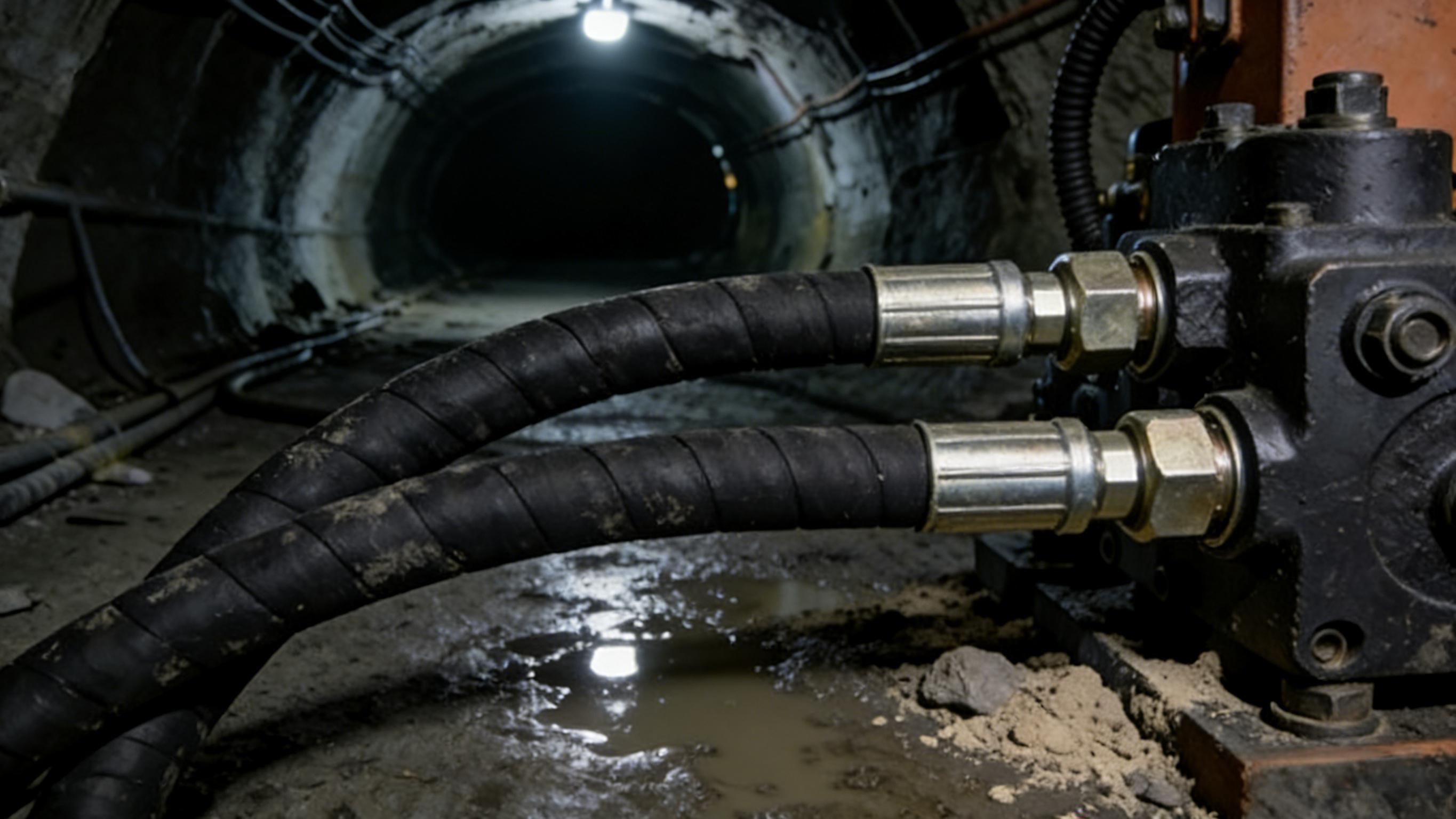
Hydraulic support hoses are divided into wire braided and wire spiral types by reinforcement structure. Wire braided hoses commonly have one, two, or three layers and are suitable for medium and low pressure circuits, such as inter-support pilot lines and some ram control lines. Wire spiral hoses, mainly with four or more layers, have higher pressure capability and are suitable for main supply lines and high-pressure leg circuits.
The core principle of selection is that the rated working pressure of a hose assembly is the lower of the hose body rating and the fitting rating. Even if the hose body burst pressure reaches four times the working pressure, if the fitting crimp strength is insufficient or the sealing structure does not match, the safety limit of the assembly is still determined by the fitting. A common mistake in mining procurement is checking only the hose pressure parameters while ignoring crimp quality and sealing face condition.
Pulse performance must be evaluated separately. GB/T 5568 specifies the non-flexing hydraulic impulse test method for rubber hose assemblies, with high-pressure test pressure above 3 MPa and low-pressure test pressure between 1.5 and 3 MPa. MT/T 98-2006 also has clear requirements for impulse testing of hydraulic support hoses and hose assemblies. Selection should confirm that the hose assembly has passed the relevant impulse test, not just a static burst value.
Two-layer wire braided hoses typically have a working pressure range of 20 to 40 MPa and good flexibility, making them suitable for frequent small-radius bending inside the support, such as connections to legs and push rams. However, their pulse resistance is limited, and they are not suitable for ultra-high pressure or extremely high-pulse main supply lines. Four-layer wire spiral hoses can reach working pressures above 28 MPa with burst pressures exceeding 70 MPa. The reinforcement wires are spiraled in alternating directions, giving significantly better pulse fatigue resistance than braided structures, making them suitable for main supply and return lines in large mining height supports.
Multi-layer spiral hoses have another easily overlooked selection variable: bend radius. The more spiral layers, the greater the hose stiffness and the larger the allowable minimum bend radius. If underground installation space cannot meet the bend radius requirement, forced bending will deform the reinforcement wires and create an early failure point. Bend radius should be verified as a parameter of equal importance to pressure rating.
The fittings at both ends of hydraulic support hoses are mainly KJ series, DN series, and U-pin quick couplings. MT/T 986-2006 specifies the technical requirements for mining U-pin quick couplings and accessories, applicable to piping systems using mineral oil and high-water-content hydraulic fluid. KJ series fittings are widely used in domestic standard supports, with KJ25 for main supply lines, KJ32 for main return lines, and KJ10 and KJ13 for inter-support hoses.
Fitting crimping is the most critical process in manufacturing mining hose assemblies. Excessive crimp force damages the inner rubber layer, allowing media to penetrate the reinforcement layer and causing wire corrosion. Insufficient force may lead to fitting pull-off under pulse conditions. Among common hose failure modes in mining, leakage at crimped fittings and fitting pull-off account for a significant proportion. Procurement should require suppliers to provide crimping process parameter records and impulse test reports.
The goal of underground routing is not to “connect the hose,” but to keep the hose in a safe state throughout repeated support movements. Bend radius should be controlled at six to eight times the hose outer diameter or more, with sharp-angle bending strictly prohibited. Hoses should be secured to support structures using mining flame-retardant antistatic clamps at intervals of 0.5 to 0.8 meters, avoiding wire ties.
At canopy, shield beam hinge points, and areas exposed to falling rock impact, hoses should be fitted with wear-resistant sleeves. The connection between fitting and hose should remain straight, and the hose must not be twisted during installation. When the angle is incorrect, use elbows or adapters rather than forcing the hose to twist. Supply and return hoses should use different color markings to prevent misconnection.
Working backward from failure prevention allows more precise matching. The main failure modes of mining hydraulic support hoses include inner rubber aging and cracking, reinforcement wire corrosion, outer rubber abrasion, and fitting leakage and pull-off. For inner layer failure, confirm hose material compatibility with the emulsion medium. For wire corrosion, focus on crimp quality and outer layer integrity. For outer abrasion, control friction through sleeves and clamps. For fitting failure, strictly verify crimping process and impulse performance.
The endpoint of matching is not selecting a hose with “qualified parameters,” but building a piping system that can operate reliably and continuously under mine conditions. Standards set the minimum. Operating conditions set the upper limit. Installation and maintenance quality determine how long the system remains reliable.
