
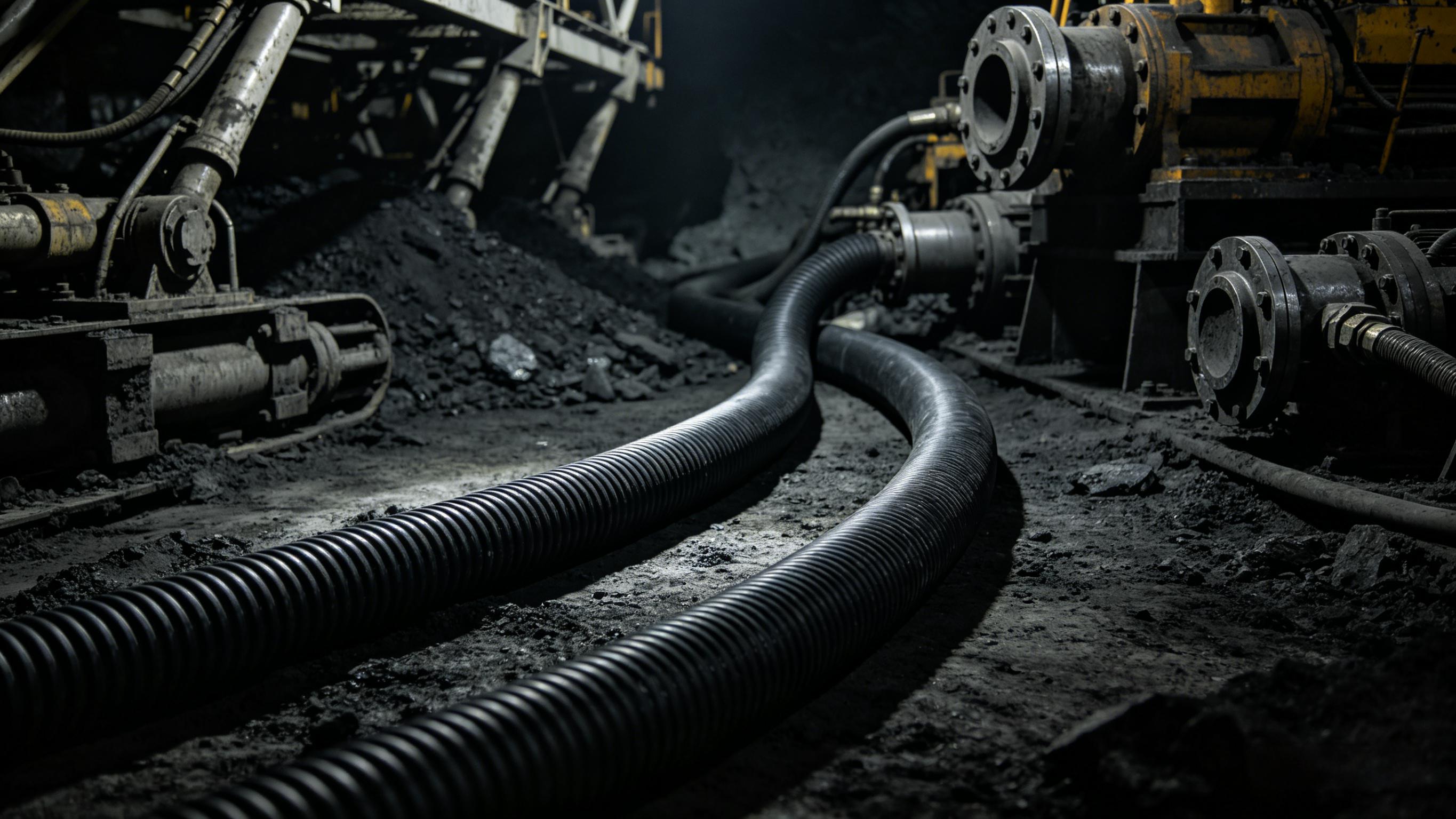
Underground coal mines present extremely hazardous conditions, with methane gas and coal dust creating ever-present explosion risks. Hydraulic hoses serve as the circulatory system of mining equipment such as shearers, roof supports, and roadheaders. During high-pressure fluid transmission, friction between the hose layers and hydraulic oil can generate static electricity accumulation. Additionally, ordinary rubber can become a fire accelerant when exposed to flames. Therefore, selecting mining hydraulic hoses that comply with MSHA certification and flame retardant/anti-static requirements is essential for underground operational safety. This article provides a detailed analysis of MSHA certification requirements, flame retardant specifications, anti-static standards, and selection guidelines.
1. MSHA Certification Overview
MSHA certification is a mandatory safety certification for equipment used in mines within the United States. It must be obtained through testing, evaluation, and approval by independent laboratories recognized by MSHA. The legal foundation is Title 30 of the Code of Federal Regulations (30 CFR), which imposes mandatory requirements for explosion-proof/fire protection design, material flame retardancy, anti-static performance, and structural strength of hydraulic hoses, ensuring they do not become ignition sources in underground hazardous environments.
CFR 30 Part 18.65, the Standard Flame Test Procedure for Hose, is the core assessment for hose flame retardancy: specimens are subjected to a specified Bunsen burner flame for a defined period, then observed for afterflame and afterglow duration. The average afterflame duration of four specimens must not exceed 1 minute, and the average afterglow must not exceed 3 minutes. A distinguishing feature of MSHA certification is its "product testing + factory inspection" dual model. Even after certification, unannounced factory inspections and market sampling tests are conducted to ensure ongoing compliance and consistency between mass-produced products and approved samples.
2. Flame Retardant Performance Requirements
Flame retardancy is one of the most critical safety indicators for mining hydraulic hoses, designed to prevent the hose from sustaining combustion and spreading flames when exposed to external fire sources. Both MSHA and MT/T98 standards impose strict requirements in this regard.
MSHA flame retardant testing follows 30 CFR Part 18.65, using a standard flame test apparatus with a Bunsen burner. After the flame is removed, the average afterflame duration must not exceed 1 minute. Additionally, some MSHA certifications based on ASTM E662 require a flame propagation length of less than 15cm under 1.5MW/m² heat radiation, and flame retardancy verification must be conducted in a simulated mine environment with 9.8% methane concentration.
China‘s MT/T98 standard employs an alcohol spray lamp combustion test: flame height 150mm, temperature not less than 900°C, flame application for 12 seconds. After flame removal, afterflame duration must not exceed 3 seconds, afterglow duration not exceed 10 seconds, damaged length not exceed 50mm, and no flaming droplets that could ignite underlying materials are permitted. From a materials perspective, mining flame-retardant hose covers are typically made of chloroprene rubber (CR) blended with flame retardant additives such as antimony trioxide, achieving an oxygen index exceeding 28% and meeting V-0 flame retardant standards for rapid self-extinguishing upon flame removal.
3. Anti-Static Requirements
In underground environments, continuous friction between hoses and coal dust/rock generates static electricity. If static charges cannot be dissipated in a timely manner, accumulated charges may produce sparks that could ignite methane gas or coal dust. Thus, anti-static performance is a mandatory requirement for mining hydraulic hoses.
MSHA requires hose surface resistance not to exceed 10⁶Ω, and anti-static performance must be verified in a 9.8% methane concentration environment. The static accumulation test requires friction on the hose surface in a 30% humidity environment, ensuring charge density below 3μC/m².
MT/T98 requires surface resistance not to exceed 1×10⁸Ω·cm, volume resistance not to exceed 1×10⁸Ω·cm, and continuity resistance between the fitting and the steel wire reinforcement layer not to exceed 1Ω. This ensures that static charges can be quickly conducted from the hose surface through the wire reinforcement and fittings into the ground, forming a complete static dissipation pathway. In terms of material design, the inner tube is formulated with conductive carbon black or metal fibers to create conductive pathways, while the cover also incorporates conductive carbon black to control surface resistance within 1×10⁶Ω.
4. Structural Design & Material Support
The safety of mining flame-retardant anti-static hydraulic hoses stems from systematic material innovation from inner to outer layers. Taking the SAE 100R13 MSHA specification as an example, the three-layer structure comprises an inner tube of HNBR with thickness not less than 2.5mm, resistant to petroleum-based hydraulic fluids and acidic mine water; a reinforcement layer of multiple high-tensile steel wire spirals achieving burst pressure at least 4 times working pressure; and a cover of flame-retardant chloroprene rubber compound with anti-static properties.
5. Selection & Maintenance Recommendations
When selecting hoses, priority should be given to those with both MSHA and MT/T98 dual certification. Dual-certified hoses exhibit burst rates below 0.5% and service lives of 12 to 18 months, significantly outperforming non-certified products. Choose appropriate pressure ratings and specifications based on equipment operating pressures and specific underground environmental conditions, and ensure that fittings and accessories also meet MSHA certification requirements.
For regular maintenance, periodically inspect the hose cover for cracks or exposed steel wires, ensure fittings are leak-free and properly tightened, and implement scheduled replacement every 12 to 18 months to prevent aging-related risks. Verify equipment grounding systems are intact to ensure static charges can be properly conducted to ground. Additionally, note that MSHA-certified hoses generally are not suitable for fluids containing castor oil, esters, or HFD R, HFD S, HFD T hydraulic fluid types; verify media compatibility before use.
Conclusion
Mining hydraulic hose safety standards are anchored by MSHA certification as the international benchmark, with flame retardancy and anti-static performance as the two core technical requirements. Through rigorous flame testing and surface resistance control, combined with multi-layer composite structural design, these hoses ensure safe operation in underground explosive environments. Whether for equipment procurement or daily maintenance, MSHA certification and flame-retardant/anti-static performance must remain the primary considerations — they are the baseline for protecting miner lives and ensuring continuous mine production.
