
Hydraulic systems are widely used in construction machinery, industrial equipment, marine applications, and more. Hydraulic hose fittings, as critical components connecting hoses to pumps, valves, and actuators, directly determine the system’s sealing integrity, safety, and service life. There are many types of hydraulic fittings on the market. This article covers mainstream types from ferrule (compression) fittings to flange fittings, crimp fittings, reusable fittings, threaded fittings, and quick couplings – explaining their characteristics and applications.
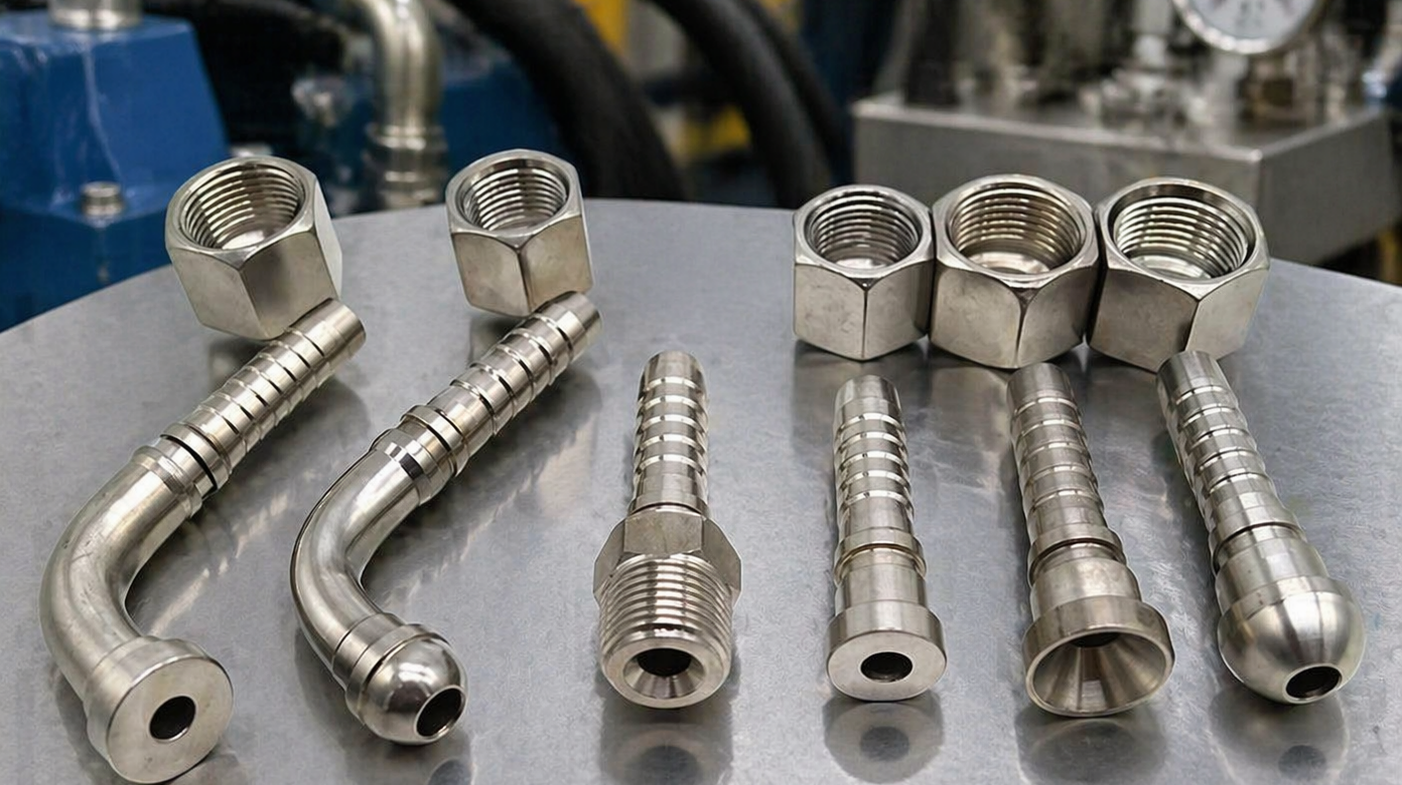
1. Ferrule / Compression Fittings
Ferrule fittings consist of a body, ferrule(s), and a nut. When the nut is tightened, the ferrule compresses radially, gripping the outer layer of the hose or tube. Advantages: no flaring or welding needed, quick installation, easy disassembly. Suitable for medium/low pressure oil and air circuits. Common standards: DIN 2353, ISO 8434-1. Note: the ferrule requires a precise outer diameter on the hose, and sealing performance degrades after repeated assembly.
2. Flange Fittings
Flange fittings are mainly used for large-diameter or high-pressure hydraulic systems (e.g., excavator travel circuits, mining equipment). They use bolts to clamp two flanges together, with an O-ring or metal gasket providing the seal. Flange fittings offer high load capacity, excellent vibration and shock resistance, and relatively easy maintenance. Common standards: SAE J518 (Code 61 & 62), ISO 6162. Disadvantages: larger footprint and higher cost.
3. Crimp Fittings (Permanent Crimp)
Crimp fittings are the most common type in hydraulic hose assemblies. The fitting’s stem inserts into the hose, and an external ferrule is radially compressed using a dedicated crimping machine, creating a permanent bond between the hose reinforcement and the fitting. Crimp fittings provide reliable sealing, high pressure resistance, and excellent pulse fatigue performance. They are widely used in high-pressure hose assemblies. Disadvantage: non-reusable and requires a crimping machine.
4. Reusable / Field Attachable Fittings
Reusable fittings can be assembled at the job site without a crimping machine. They come in two-piece or three-piece designs, clamping the hose between a stem and an outer sleeve via threads. Ideal for field repairs and emergency replacements. Advantages: simple tools, multiple uses. Disadvantages: generally lower pressure and pulse resistance compared to crimp fittings, and improper installation can cause leaks.
5. Threaded Fittings
Threaded fittings connect directly to hydraulic ports via various thread standards:
NPT / NPTF: American tapered pipe thread. Seals by thread interference; requires PTFE tape or sealant.
JIC (37° flare): UNF thread with a 37° flare seat. Metal-to-metal seal, high pressure capability, widely used in high-pressure oil systems.
BSPP / BSPT: British parallel/tapered pipe threads. BSPP uses a bonded washer or O-ring; BSPT is self-sealing via taper.
Metric: Metric threads, commonly with 24° cone (DIN 3865) or O-ring seal.
Threaded fittings are compact and standardized, but improper torque control can damage threads.
6. Quick Couplings (Quick Disconnects)
Quick couplings are used where frequent connection and disconnection are required (e.g., hydraulic tools, test points). Built-in check valves enable leak-free connection and disconnection. Types: single shut-off, double shut-off, or straight-through. Advantages: fast operation, improved efficiency. Disadvantages: higher cost, restricted flow area, significant pressure drop at high flow rates.
7. Other Special Types
Weld-on fittings: Welded to the tube/pipe; high strength, suitable for permanent installations.
Flared fittings: The tube end is flared and sealed by a nut; often used for low-pressure lines (e.g., copper tubing).
Selection Summary
When selecting hydraulic hose fittings, consider working pressure, media temperature, installation space, disconnection frequency, and standard compatibility. For high-pressure, high-flow applications, flange or crimp fittings are preferred. For field repairs, keep reusable fittings on hand. For frequent coupling, choose quick disconnects. Correct selection not only prevents leaks but also significantly extends hydraulic system life.
