
In shale gas and conventional oil and gas field completion operations, acid fracturing, sand fracturing, and hydraulic fracturing are core technologies for enhancing recovery rates. These processes require rapid and stable delivery of fracturing fluids downhole under extremely high pressure, and the performance of the fracturing hose directly determines operational efficiency and safety. Fracturing fluids can be divided into four major categories: water-based, oil-based, foam, and acid-based. Different media impose vastly different chemical resistance requirements on the hose inner tube. This article provides a complete fracturing hose selection guide based on the characteristics of these four fracturing fluid types.
I. Water-Based Fracturing Fluids – Hydrolysis Resistance is the Core
Water-based fracturing fluids are the most widely used fracturing fluid system, using water as the solvent with additives such as thickeners, crosslinkers, and gel breakers. They are characterized by low cost, safety, and environmental friendliness, but require long-term hydrolysis resistance from the hose.
Water-based fracturing fluids are relatively mild in terms of chemical corrosion on the hose inner tube, but long-term conveyance still requires consideration of the damaging effects of hydrolysis on rubber materials. The recommended choice is a UPE (Ultra-High Molecular Weight Polyethylene) and synthetic rubber composite inner layer. UPE has an extremely low friction coefficient and excellent water resistance, effectively reducing delivery resistance; synthetic rubber provides good elasticity and sealing performance. This composite structure not only withstands the hydrolysis effects of water-based media but also ensures hose flexibility under high-pressure pulsation.
II. Oil-Based Fracturing Fluids – Oil Swelling Resistance is the Prerequisite
Oil-based fracturing fluids use diesel, crude oil, or refined oil as the base fluid, suitable for water-sensitive reservoirs or low-pressure oil and gas reservoirs. The greatest threat from oil-based fluids is that ordinary rubber swells upon contact with oils, causing volume expansion of the inner layer, a sharp decline in mechanical properties, and ultimately seal failure or even hose burst.
The key to selecting hoses for oil-based fracturing fluids lies in the oil resistance of the inner layer material. UPE material itself has excellent oil resistance and, when combined with a specialized synthetic rubber liner, ensures no swelling occurs even with long-term contact with diesel, crude oil, and other petroleum products. Some premium products also use HNBR (Hydrogenated Nitrile Butadiene Rubber) as the inner layer material, which offers excellent oil and chemical resistance. For oil-based systems with higher aromatic hydrocarbon content, FKM (Fluorocarbon Rubber) inner layers can be selected for their higher oil resistance rating.
III. Foam Fracturing Fluids – Shear Resistance and Gas Permeation Resistance Are Equally Important
Foam fracturing fluids are gas-liquid two-phase mixtures formed by dispersing gas (typically nitrogen or carbon dioxide) in a liquid, offering advantages such as low fluid loss and rapid flowback. However, the gas-liquid two-phase flow presents dual challenges to the hose inner layer: on one hand, the impact force generated by the collapse of high-velocity gas bubbles causes shear wear on the inner layer; on the other hand, gas molecules are small and can easily permeate through ordinary rubber inner layers.
For foam fracturing fluids, a high-elasticity synthetic rubber and UPE composite structure is recommended. The high-elasticity rubber layer absorbs the impact energy from bubble collapse, resisting shear damage; the dense structure of the UPE layer effectively blocks gas permeation. The combination of both provides shear resistance and gas permeation resistance, ensuring stable and safe foam fracturing fluid delivery.
IV. Acid-Based Fracturing Fluids – Strong Acid Corrosion Resistance is the Bottom Line
Acid-based fracturing fluids (typically hydrochloric acid or hydrochloric acid-hydrofluoric acid mixtures) are used in acid fracturing operations, dissolving carbonate minerals in reservoir rocks to improve permeability. Acidic media pose the greatest challenge to the hose inner layer. Ordinary rubber undergoes chemical degradation upon contact with high-concentration acids—molecular chain scission, hardness changes, volume shrinkage—ultimately losing its sealing capability.
Acid-based fracturing fluids must use inner layer materials with strong acid corrosion resistance. UPE has excellent acid corrosion resistance and can work long-term in high-concentration acid without degradation. High-end inner lining materials such as German or Japanese UHMWPE (Ultra-High Molecular Weight Polyethylene) can withstand 28% hydrochloric acid, delivering acid-based fracturing fluids without pressure issues. Some products use a UPE and specialty synthetic rubber composite inner layer, combining acid resistance with elasticity. When purchasing, be sure to confirm that the hose inner layer is clearly marked as acid-resistant and complies with API 7K standards. According to GB/T 46167-2025 “Specification for flexible hoses and hose assemblies for fracturing” , acid-resistant rubber liners should be prioritized in acidic media environments.
V. General Selection Criteria: Pressure, Temperature, Couplings, and Certification
In addition to selecting inner layer materials based on fracturing fluid type, fracturing hose selection must also consider the following factors.
Working Pressure: Fracturing operating pressures typically range from 35MPa to 140MPa. Ultra-high pressure conditions (≥70MPa) require multi-layer spiral-wound high-strength super-flexible steel wire as the reinforcement layer. Common configurations feature 4 to 6 layers of spiral-wound high-strength super-flexible steel wire or steel cable. The API Spec.7K standard has clear requirements for rated working pressure, burst pressure, and bend radius—purchasers must verify whether the product is marked with API Spec.7K FSL0 (FSL0 is the fatigue performance level). Some premium products achieve burst pressures up to 4 times the working pressure, far exceeding the industry 3:1 standard.
Temperature Range: Fracturing operations may face extreme climates or fracturing fluid heating/cooling conditions. Common fracturing hoses have a temperature range of -29°C to +100°C, with premium products reaching -40°C to +150°C. Low-temperature environments require low-temperature-resistant synthetic rubber to prevent hardening and embrittlement.
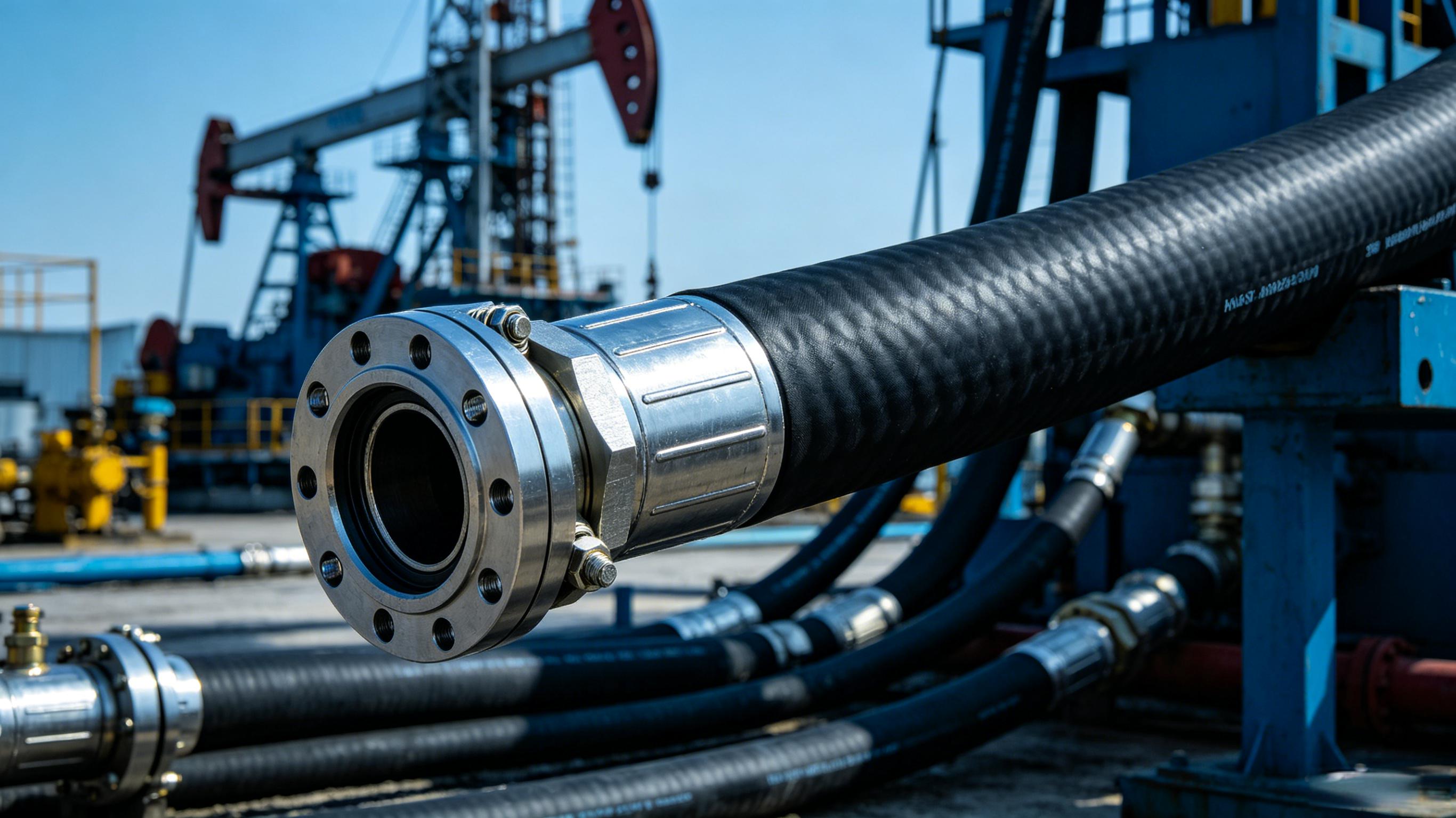
Coupling Types: Hose ends are typically equipped with integral unions or integral flanges. Integral unions are suitable for quick connections and frequent assembly/disassembly, while integral flanges are suitable for permanent high-pressure heavy-load conditions.
Certification Requirements: Fracturing hoses should pass API 7K certification, and some products also require ABS (American Bureau of Shipping) certification to meet the stringent requirements of offshore platforms and other harsh environments.
Conclusion
Water-based, oil-based, foam, and acid-based fracturing fluids each have their own chemical characteristics, imposing distinctly different tolerance requirements on hose inner layer materials. The UPE + synthetic rubber composite inner layer, with its excellent water resistance, oil resistance, acid resistance, and shear resistance, has become a universal solution covering all four types of fracturing fluids. Follow the selection process of “confirm fracturing fluid type → select inner layer material → confirm working pressure → select reinforcement layer → confirm temperature range → select outer layer material → confirm coupling type and certification” to precisely match the most suitable fracturing hose.
