
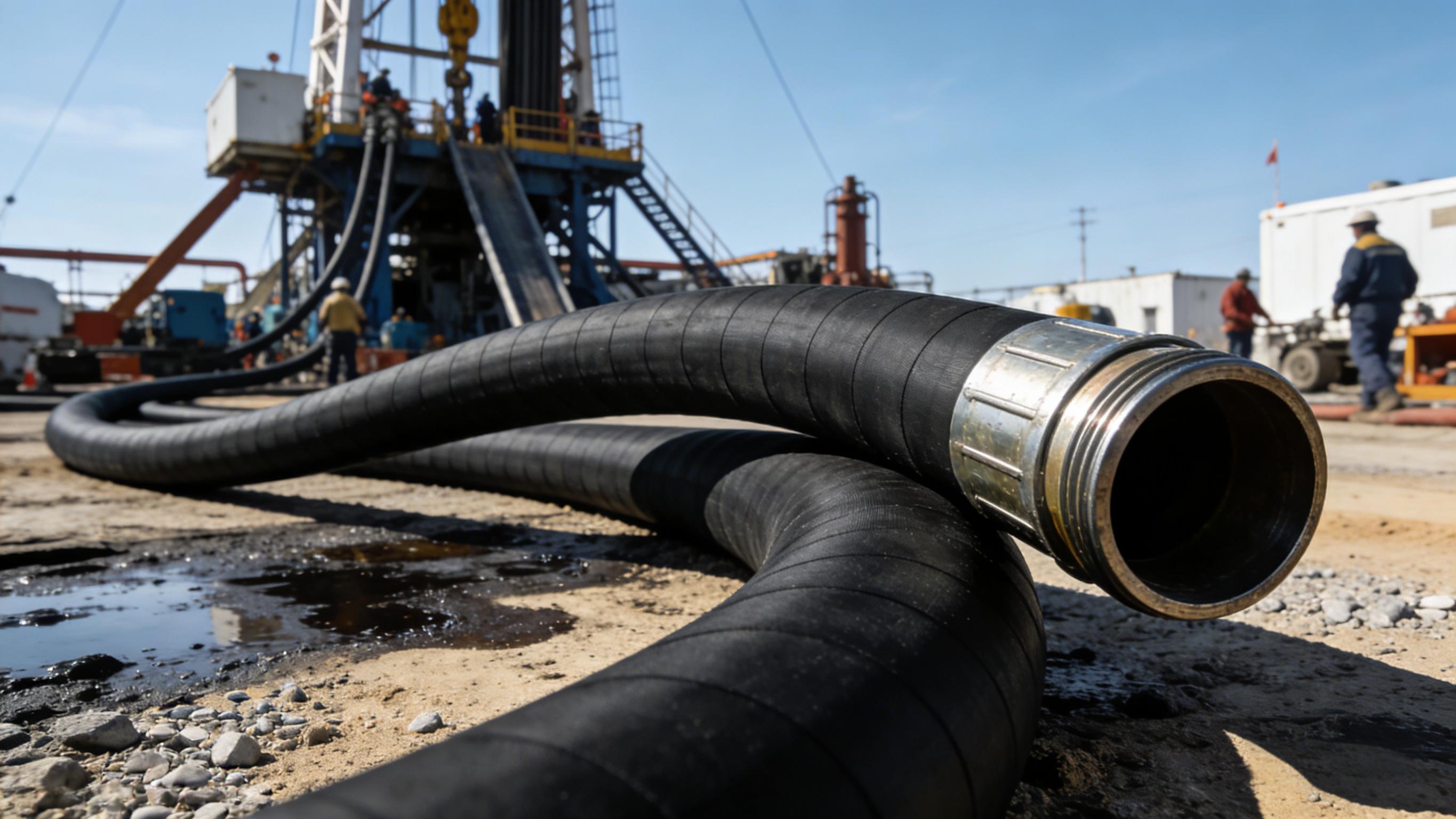
In oil and gas drilling operations, drilling hoses are critical flexible components connecting the standpipe to the swivel and the mud pump to the manifold, with the core mission of continuously delivering drilling fluid under extreme high pressure. The API Spec 7K — Drilling and Well Servicing Equipment — developed by the American Petroleum Institute (API), is the globally recognized authoritative standard for the oil drilling industry, providing comprehensive specifications for the design, materials, manufacturing, testing, and marking of rotary drilling and vibrator hoses, high-pressure mud hoses, and cementing hoses. This article provides a complete interpretation of API 7K drilling hoses from four dimensions: specification system, core tests, material structure, and selection guidelines.
I. Specification System: Pressure Ratings and Product Classification
The API 7K standard divides the working pressure of drilling hoses into multiple grades from Grade A to Grade G. Taking a Grade D (34.5MPa/5000psi) hose as an example, the proof pressure must reach 2 times the working pressure (69.0MPa), and the minimum burst pressure must reach 2.5 times or more of the working pressure (86.3MPa). For the higher pressure Grade G (103.4MPa) hose, the proof pressure reaches 155MPa, and the minimum burst pressure reaches 232.7MPa. The working pressure range of API 7K hoses covers 3,500psi to 20,000psi (approximately 24MPa to 138MPa).
In terms of product classification, the 7K standard divides hoses into Type A (general purpose) and Type B (sour service specific) . Type B hoses require materials to pass the NACE MR0175 hydrogen sulfide stress corrosion test, suitable for sour drilling environments containing H₂S. Additionally, the standard classifies products into three FSL levels: FSL 0, FSL 1, and FSL 2. The FSL 2 level has the highest requirements, with hoses required to withstand 10,000 high-frequency load cycles (2 seconds per cycle, pressure 70-350 bar), a 4-hour 700 bar static pressure test, and an 863 bar burst test.
II. Core Tests: Five Rigorous Assessments from Burst to Impulse
The API 7K standard specifies a series of strict testing requirements for drilling hoses to ensure safety and reliability under extreme operating conditions.
Burst Test is the core item for verifying the pressure limit of the hose. The standard explicitly requires that the minimum burst pressure of the hose must reach 2.5 times or more of the rated working pressure. This stringent multiplier requirement provides sufficient safety redundancy for drilling operations.
Pressure Cycle Fatigue Test simulates the continuous pressure fluctuations generated by the reciprocating motion of mud pumps. The standard requires that the hose can withstand more than 200,000 pressure pulse cycles at 133% of working pressure without structural failure. Some 7K products are also required to pass 1 million pressure cycle fatigue tests.
Hydrostatic Test is a mandatory test that every hose must pass before leaving the factory. During the test, fuller's earth must be applied to the couplings and adjacent cover areas to observe minute leaks—any signs of moisture will result in rejection. Three key indicators must be monitored during the test: hose twist angle (not exceeding 3° per meter), displacement movement (not exceeding one hose outer diameter), and elongation (not exceeding 2% of original length).
In addition, API 7K also covers bend testing, low-temperature flexibility testing, and electrical conductivity testing, among others, ensuring comprehensive performance throughout the hose's entire lifecycle.
III. Materials and Construction: Synergistic Design of Three-Layer Composite
API 7K drilling hoses adopt a multi-layer composite construction design, consisting of three parts: inner tube, reinforcement layer, and outer cover.
Inner Tube comes into direct contact with drilling fluid and must possess excellent oil resistance, mud erosion resistance, and weak acid/alkali resistance. Mainstream materials include Ultra-High Molecular Weight Polyethylene (UPE), Hydrogenated Nitrile Butadiene Rubber (HNBR), and NR&SBR synthetic rubber. UPE has wear resistance 6 to 7 times that of ordinary rubber, capable of long-term resistance to mud scouring containing abrasive particles. The inner tube hardness is typically 65 to 75 Shore A, with abrasion resistance (DIN 53516 standard) wear volume not exceeding 150mm³.
Reinforcement Layer is the core load-bearing structure enabling the hose to withstand ultra-high pressure, using 2 to 6 layers of high-strength super-flexible steel wire spiral winding. The tensile strength of the steel wire typically reaches 2500MPa or more, with phosphate coating treatment to enhance adhesion with rubber. The intermediate rubber layers between reinforcement layers use high-adhesion formulations to bond each layer into a solid whole, deforming synergistically under pulse loads to avoid interlayer peeling caused by stress concentration.
Outer Cover uses abrasion-resistant, weather-resistant synthetic rubber with UV and ozone aging resistance; some products also incorporate flame retardants to meet downhole fire safety requirements. The temperature range typically covers -40°C to +150°C.
IV. Selection Guidelines and Application Scenarios
Typical application scenarios for API 7K hoses include: flexible connections between the top of the drilling standpipe and the top drive, high-pressure mud transmission between the mud pump and standpipe, and acid fracturing and sand fracturing in completion operations. In workover operations, it connects the pump to the lower end of the standpipe, withstanding dynamic loads and preventing pipeline rupture caused by sudden pressure changes.
Key parameters to focus on during selection: Working pressure rating must exceed the equipment's actual operating pressure with consideration of pressure peaks; Inner diameter should be selected based on flow requirements, with common sizes ranging from 2 inches to 6 inches; Temperature range must cover both operating environment and media temperatures; Media compatibility requires confirmation of chemical compatibility between hose materials and drilling fluids, completion fluids, etc., with special attention to corrosive media containing H₂S, CO₂, etc.. It is recommended to select products with burst pressure ≥3 times working pressure to effectively cope with pressure fluctuations during operations. Before procurement, ensure the product has API certification and bears the API monogram.
The specifications and testing requirements of API 7K drilling hoses are ultimately a quality assurance system centered on 2.5× burst safety factor, 200,000-cycle pulse fatigue life, and rigorous hydrostatic verification. Only through comprehensive understanding and strict implementation of these requirements can the safety and efficiency of drilling operations be ensured.
