
In hydraulic systems, hose fittings serve as the critical interface connecting pumps, valves, actuators, and other core components—their quality directly determines the system‘s reliability, safety, and maintenance costs. The two most common types of hydraulic hose fittings on the market today—one-piece fittings and crimp (two-piece) fittings—differ significantly in structural design, assembly processes, and long-term durability. This article provides an in-depth comparison from the perspectives of structural definition, performance testing, core advantages, and application scenarios, serving as a reference for users in construction machinery, mining equipment, and industrial manufacturing.
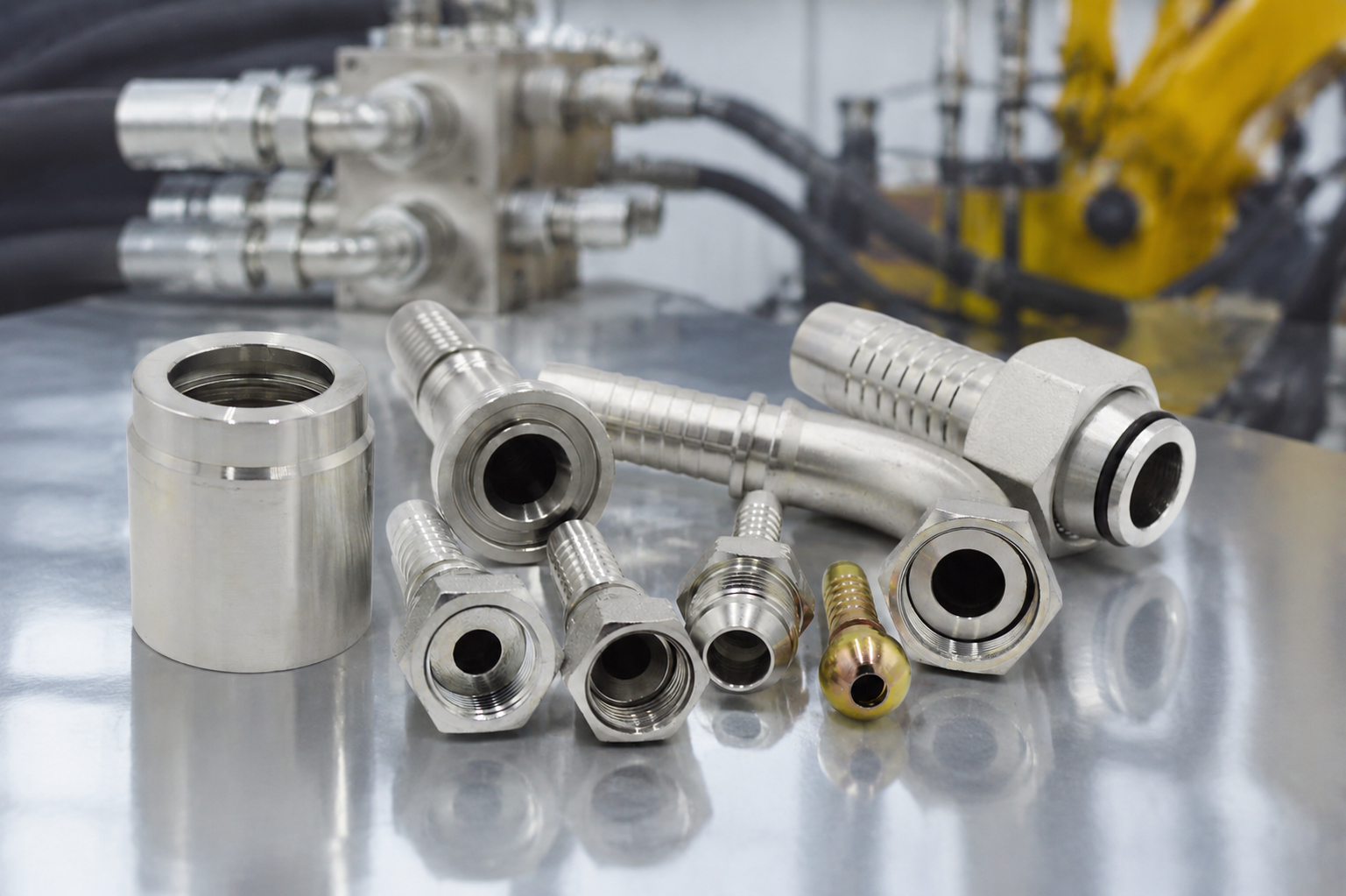
Crimp fittings, also known as two-piece or skive fittings, are a classic permanent connection solution. They consist of three separate components: a nipple (inner stem), a ferrule (outer sleeve), and a connector body. During assembly, the ferrule is slipped over the hose, the nipple is inserted into the hose interior, and a dedicated crimping machine applies high pressure to compress the ferrule‘s serrated grooves against the hose‘s inner rubber and wire reinforcement layers, creating a permanent connection.
Crimp fittings have been the industry standard for decades and remain dominant in heavy-duty, high-pressure, and custom hydraulic applications. Their modular design allows nipples and ferrules to be mixed and matched for different hose types, offering broad compatibility. Typical crimp fittings operate at pressures ranging from 350 to 700 bar (approximately 5,000 to 10,000 psi). In safety-critical hydraulic systems, crimped assemblies are generally considered the safer choice.
One-piece fittings, as the name suggests, feature an integral structural design—the nipple and connector body are manufactured as a single component, and the ferrule and fitting body form one complete part. The entire fitting is crafted from a single piece of steel, with no brazed or welded joints. During assembly, there is no need to disassemble the fitting into multiple parts or to skive (remove the outer rubber cover from) the hose—the hose is simply inserted into the fitting and crimped.
The defining feature of this design is its non-skive nature—no outer cover removal is required before assembly. One-piece fittings have gained popularity in mass production and standardized hose assembly lines primarily because they significantly simplify inventory management and speed up assembly.
Component count: Crimp fittings consist of two separate components—nipple and ferrule—requiring separate inventory management; one-piece fittings are single-piece designs with one SKU per size.
Assembly process: Crimp fittings typically require skiving (removing the outer rubber cover), inserting the nipple, and then crimping the ferrule—multiple steps; one-piece fittings require no skiving—insert and crimp in fewer steps.
Process risk: During the skiving process for crimp fittings, improper technique can easily damage the hose‘s inner rubber and wire reinforcement layers; one-piece fittings eliminate this source of human error through their non-skive design.
Inventory management: Crimp fittings require managing separate inventories for nipples and ferrules, with more part numbers; one-piece fittings require only one SKU per size, significantly reducing inventory complexity.
Leak paths: Crimp fittings have mating interfaces between the nipple and ferrule, plus welded or threaded connections—more potential leak points; one-piece fittings have a monolithic structure with no welded joints and fewer leak paths.
Reusability: Once crimped, crimp fittings cannot be reused; one-piece fittings are also permanent connections and cannot be reused.
Pulse testing is the core method for evaluating the durability of hydraulic hose assemblies under repeated pressure cycles. During testing, the hose assembly is bent to 90° or 180°, filled with high-temperature test fluid, and subjected to alternating pressure at a set frequency until leakage or rupture occurs.
In this rigorous test, one-piece fittings demonstrate exceptional performance. For example, hoses paired with one-piece non-skive fittings from a leading manufacturer have achieved over 1 million pulse cycles across the entire product line. This means that under standard operating conditions, one-piece fitting assemblies offer significantly longer service life and can operate stably in high-pressure, high-frequency hydraulic systems over the long term.
In contrast, traditional crimp fittings perform markedly worse. Due to clearance gaps between multiple components and the potential for reinforcement layer damage during skiving, many crimp fitting assemblies develop leakage at the fitting or hose pull-out failures at 500,000 to 800,000 pulse cycles. The gap between 1 million and 500,000 cycles is not just a number—it is a direct reflection of reliability, safety, and total service life.
Advantages of one-piece fittings include: non-skive design eliminates human error, preventing seal insufficiency or wire layer damage from improper skiving; monolithic structure eliminates weld defect risks; with high-performance seals, achieves near-zero leakage; quick installation, labor savings, one fitting fits multiple hose types, reducing inventory costs and management complexity; compact one-piece construction reduces heat and pressure loss.
Advantages of crimp fittings include: modular design offers exceptional flexibility—nipples and ferrules can be mixed and matched for various hose types; proven reliability through decades of industrial use; excellent performance in ultra-high-pressure and large-bore hose assemblies; suitable for custom and low-volume configurations; per-unit cost may be lower in certain scenarios.
Choose one-piece fittings when: your hydraulic system demands high reliability, long service life, and installation efficiency; applications involve harsh conditions and difficult maintenance access, such as construction machinery, mining equipment, and agricultural machinery; high-volume, standardized production scenarios; you aim to simplify inventory management and reduce SKU count.
Choose crimp fittings when: cost sensitivity and limited assembly conditions are primary concerns; you need to accommodate multiple hose types and pursue maximum flexibility; ultra-high-pressure or large-bore hose assemblies are required; small-batch, high-mix production models.
The choice between one-piece and crimp fittings is essentially a trade-off between “ultimate reliability” and “flexible adaptability.” One-piece fittings, with their monolithic structure and non-skive design, hold clear advantages in pulse life, leak risk, and assembly efficiency. Crimp fittings, backed by decades of proven reliability and exceptional flexibility, continue to dominate in heavy equipment and custom applications. Users should make their selection based on specific operating conditions, pressure ratings, production scale, and maintenance requirements.
