
Hydraulic fitting leakage is one of the most common and troublesome failures in hydraulic systems. Statistics show that pipe fittings and oil plugs account for as much as 30% to 40% of all hydraulic system oil leakage incidents. Leakage not only wastes oil and pollutes the environment but also directly impacts equipment safety and service life. This article systematically reviews the five core causes of hydraulic fitting leakage and provides an in-depth analysis of how one-piece design solves this industry-wide problem at its root.
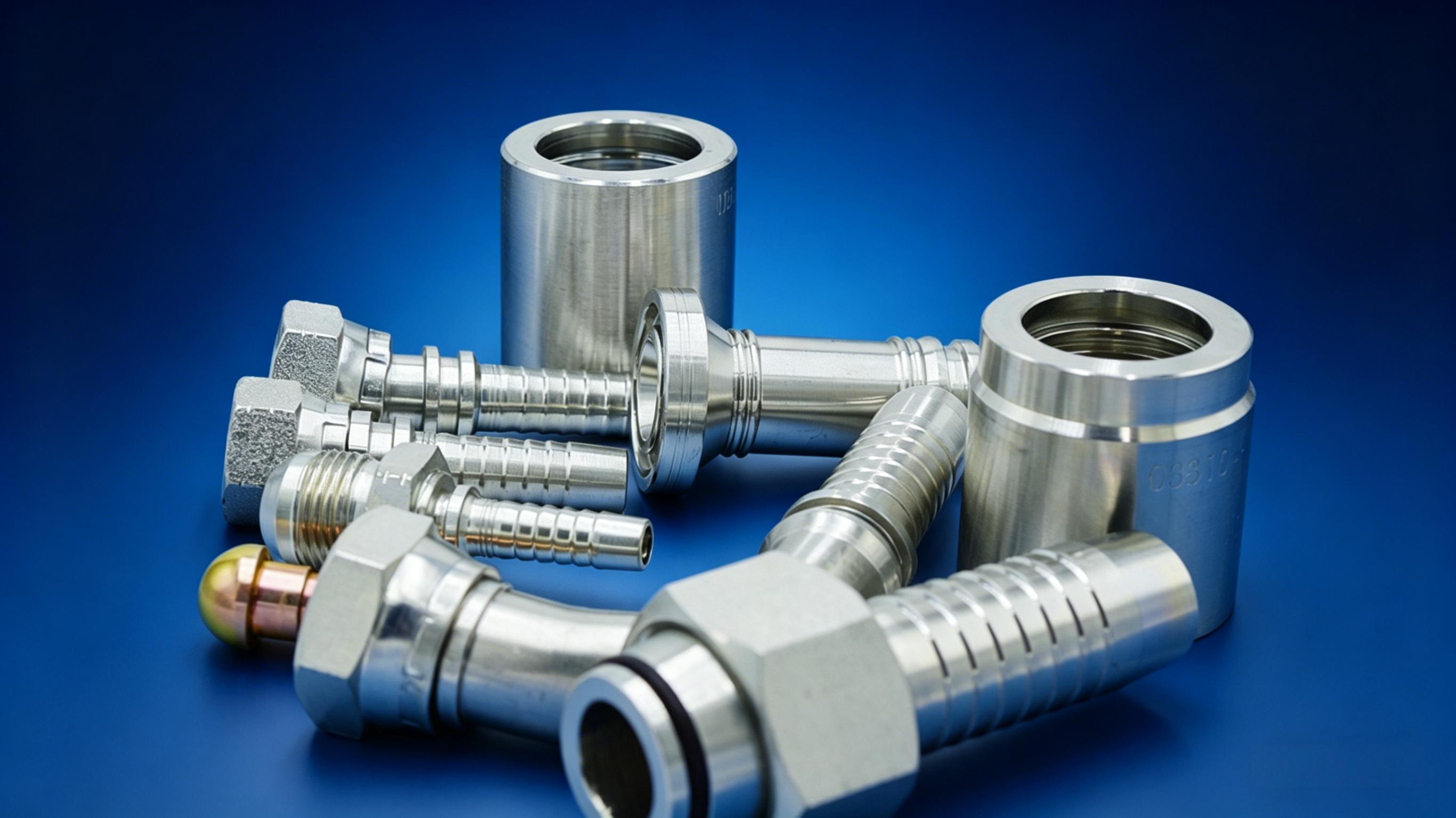
Cause 1: Seal Failure – The Most Common Leakage Source
O-rings are the most widely used sealing elements in hydraulic fittings, with multiple failure modes: aging and deformation leading to loss of elasticity, improper assembly causing uneven compression or cutting, insufficient compression preventing effective sealing, and excessively deep O-ring grooves preventing proper compaction. The compression amount of O-rings should generally be controlled between 0.35-0.65mm. Under high-pressure conditions, O-rings may also suffer from "extrusion damage" – when the seal hardness is too low or the end-face clearance is too large, the ring can be squeezed into the gap and damaged.
Cause 2: Manufacturing Quality Defects – Hidden Hazards from the Start
The machining quality of the fitting body directly determines sealing performance. Substandard sealing surface precision – burrs, scratches, pits, pinholes, or excessive roughness on tapered, flat, or threaded sealing surfaces – prevents complete contact between sealing faces, allowing media to penetrate through microscopic gaps. Unqualified thread machining is equally critical: incomplete thread profiles, pitch deviations, thread eccentricity, or excessively loose or tight threads can cause coaxiality deviation after tightening, resulting in uneven sealing face contact. Additionally, internal porosity or micro-cracks in cast or forged fittings may show no abnormality under normal pressure but can form penetrating leakage channels once pressurized.
Cause 3: Improper Installation – High Incidence of Human Error
Improper installation is the most significant human-related cause of hydraulic fitting leakage. Incorrect tightening torque is the primary culprit – insufficient torque leaves threads unlocked, allowing media to leak under pressure; excessive torque can cause fitting deformation, thread stripping, and sealing face misalignment. Assembly coaxiality deviation is equally common: misaligned piping or forced connection creates radial stress, causing one-sided compression and one-sided gaps on the sealing face. Failure to clean sealing surfaces before assembly, leaving dust and debris residue, can cause immediate leakage upon first pressurization.
Cause 4: Operating Condition and Environmental Mismatch – Beyond Rated Limits
Even with correct assembly, leakage can occur if actual operating conditions exceed rated parameters. When system pressure spikes exceed the fitting's rated pressure, the sealing structure and threaded connections undergo elastic deformation, increasing clearance. Low temperatures cause metal contraction, while high temperatures cause thermal expansion – both alter the original sealing fit precision. Media冲击 and vibration can loosen threaded connections, enlarging sealing gaps.
Cause 5: External Impact and Vibration – Cumulative Long-Term Damage
In heavy equipment such as mining and construction machinery, external forces or impact loads on piping are common causes of leakage. For ferrule-type fittings, impact forces can loosen the ferrule or deform the tube end face; for flared-type fittings, excessive flaring or repeated disassembly can cause deformation or cracking. Long-term vibration can also lead to bolt creep loosening, and if not retightened in time, leakage will progressively worsen.
Traditional crimp fittings consist of multiple independent components including nipples and ferrules, and the mating interfaces between components are themselves potential leak paths. One-piece fittings, however, feature an integral structural design that fundamentally changes this situation.
Solution 1: Eliminate Mating Interfaces – Cut Off Leak Paths at the Source
One-piece fittings integrate the nipple and connector body into a single component, with the ferrule and fitting body forming one complete part. The monolithic structure has no welded joints, eliminating leakage risks caused by welding defects. As industry analysis points out, the one-piece structure eliminates potential leak paths between the fitting and the hose body, offering inherent advantages in high-pressure applications. This design significantly reduces potential leak points.
Solution 2: Non-Skive Process – Eliminate Human Operational Error
Traditional crimp fittings typically require skiving (removing the outer rubber cover) before assembly, a process that demands high operator skill. Excessive skiving leads to insufficient sealing in the crimp area, while insufficient skiving damages the wire reinforcement layer. One-piece fittings feature a non-skive design that requires no hose preparation before installation – simply insert and crimp. This not only significantly reduces assembly time but also completely eliminates human error in the skiving process.
Solution 3: Precision Crimp Control – Ensure Sealing Consistency
One-piece flange assemblies complete the crimp connection between hose and fitting during the production stage, with CNC crimping equipment controlling crimp allowance to within ±0.01mm. This permanent connection completely eliminates leakage risks caused by improper crimping or insufficient tightening during field assembly. Combined with high-performance hydrogenated nitrile seals, it achieves sealing performance approaching zero leakage. Some products achieve helium leak detection rates below 0.01ml per year, reaching industry-leading levels.
Solution 4: Extended Pulse Life – Verifying Leak-Proof Reliability
Pulse testing is the "touchstone" for evaluating the leak-proof performance of hydraulic fittings. One-piece fittings perform exceptionally well in this rigorous test – achieving over 1 million pulse cycles across the entire product line. In contrast, traditional crimp fittings, due to clearance gaps between multiple components and the potential for reinforcement layer damage during skiving, often develop leakage at the fitting or hose pull-out failures at 500,000 to 800,000 pulse cycles. The gap between 1 million and 500,000 cycles is the most direct reflection of leak-proof performance.
The five major causes of hydraulic fitting leakage – seal failure, manufacturing quality defects, improper installation, operating condition mismatch, and external impact and vibration – all ultimately relate to the fitting's structural design and assembly process. One-piece fittings systematically solve the leakage pain points of traditional fittings from multiple dimensions: eliminating mating interfaces through monolithic structure, eliminating human error through non-skive design, and ensuring sealing consistency through precision crimping. For applications with harsh operating conditions and difficult maintenance access, such as mining and construction machinery, one-piece fittings are undoubtedly the more reliable choice.
