
In chemical production, the transfer of sulfuric acid, hydrochloric acid, nitric acid, aqua regia, and various organic solvents has always been the greatest challenge in pipeline selection. Ordinary rubber hoses often swell, crack, or leak within months when exposed to highly corrosive media, while stainless steel rigid pipes, though corrosion-resistant, lack the flexibility needed for flexible connections between chemical equipment. PTFE (polytetrafluoroethylene), with its near universal chemical inertness, has become the ideal solution to this challenge. The global PTFE-lined chemical transfer hose market is projected to reach USD 1.98 billion in 2026, growing at a CAGR of 6.2%, driven by sustained demand from the chemical industry for high-purity, corrosion-resistant fluid transfer solutions. EN12115, established by the European Committee for Standardization, provides unified technical specifications for PTFE hoses used with corrosive media.
PTFE's chemical inertness is nearly unmatched among engineering plastics. Its molecular chain consists of carbon-fluorine bonds with a bond energy of 485 kJ/mol, one of the strongest known chemical bonds. This structure gives it exceptional resistance to strong acids, alkalis, organic solvents, and oxidizers. PTFE safely resists fuming sulfuric acid, nitric acid, amines, antioxidants, and methanol, reacting only with molten alkali metals, elemental fluorine, and chlorine trifluoride. In practical chemical industry applications, EN12115 PTFE hoses have been widely used for sulfuric acid loading, hydrochloric acid unloading, reactor batching systems, and waste acid treatment lines, with multi-layer steel wire reinforcement maintaining flexibility under high-pressure pulsation conditions.
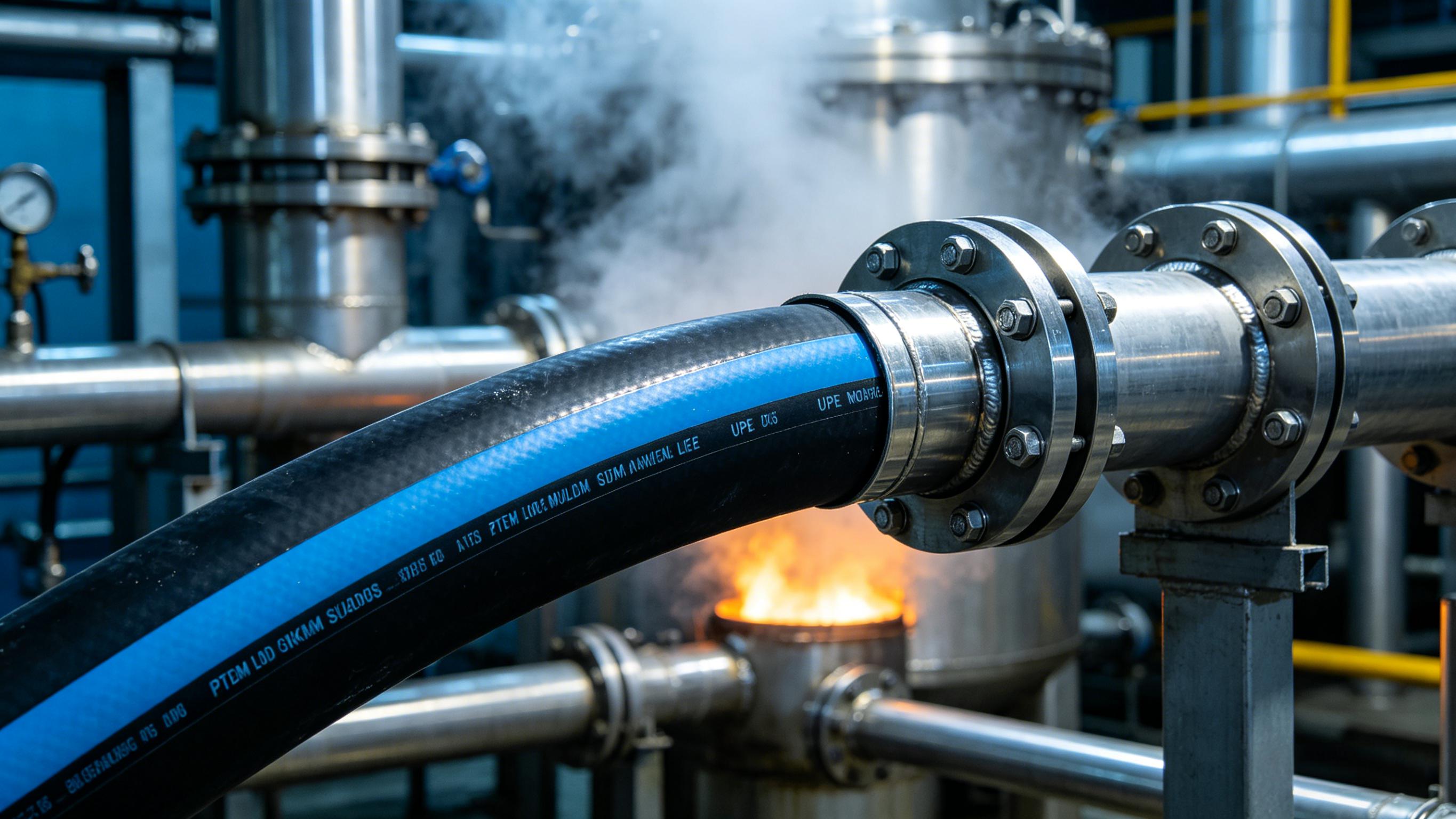
EN12115 PTFE hoses employ a three-layer composite structure. The inner tube is a pure PTFE seamless extruded tube that directly contacts corrosive media, with its fully saturated character ensuring no adsorption, no extractables, and no media contamination. The reinforcement layer has two configurations depending on pressure requirements: low-pressure conditions use high-tensile synthetic fiber winding with helical steel wire, covering 8 to 16 bar working pressure; high-pressure conditions use 2-layer braided or 4-layer spiral wound high-flexibility steel wire, reaching 42 MPa class working pressure. The outer cover uses EPDM or FKM synthetic rubber with ozone, UV, and abrasion resistance, optionally with a UPE abrasion-resistant layer for harsh external environments. Temperature range covers -55°C to +220°C, with burst pressure no less than 4 times working pressure.
Corrosion Resistance Matching: First, confirm the chemical nature of the media being transferred. PTFE is inert to most chemicals, but chlorine trifluoride, chlorine gas, fluorine gas, oxygen difluoride, phosgene, and molten alkali metals are not suitable for EN12115 hoses. During selection, provide the supplier with a media list and verify chemical compatibility item by item.
Pressure Rating Selection: Determine the hose pressure rating based on maximum system working pressure (including instantaneous peaks). Low-pressure conditions (8-16 bar) use fiber-wound reinforcement; high-pressure conditions (16-42 MPa) use steel wire spiral construction. System working pressure should be below 80% of the hose's rated pressure.
Conductivity Type Determination: The chemical industry involves extensive transfer of flammable and explosive chemicals, where static accumulation is a major safety hazard. The EN12115 standard classifies hoses into Ω type and T type conductivity grades. Ω type requires inner layer resistance below 10⁶Ω, and T type requires wall resistance below 10⁹Ω. Both types can be ATEX certified for Ex-Zone 0/1 hazardous areas.
Fitting and Installation Matching: Fittings should use 316L stainless steel flanges, unions, or quick-connects for sealing reliability under vibration. During installation, bend radius should be no less than 6 to 10 times the hose outer diameter, avoiding sharp bends that damage the reinforcement layer.
In sulfuric acid loading operations, EN12115 PTFE hoses must withstand long-term attack from 96% concentration sulfuric acid while providing antistatic properties for tanker loading safety. In reactor batching systems, hoses connect reactors to metering pumps, with PTFE inner layers ensuring catalysts and intermediates remain uncontaminated. In waste acid treatment lines, hoses must remain stable long-term under corrosive media and outdoor conditions. At Salinen Austria, a leading European salt producer, PTFE-lined hoses transfer 96% sulfuric acid in CIP systems, with double-walled piping and leak monitoring enabling safe operation of a 35-meter dosing line.
EN12115 PTFE hoses require attention to the following points: verify chemical compatibility between media and PTFE before installation; perform system depressurization checks before startup; avoid prolonged exposure to high temperatures or UV environments; regularly inspect the outer cover for cracking, bulging, or exposed wire; quarterly pressure-holding tests at 1.5 times working pressure are recommended. Hose service life is typically 3 to 5 years, with shorter replacement cycles under highly corrosive and high-temperature conditions. Choosing the right PTFE hose means safeguarding the baseline of chemical production safety.
