
The operating environment of mining crushing equipment is the ultimate test for hydraulic hoses: high-frequency vibrations from breakers transmit continuously through the lines, flying rocks can slash the outer cover at any moment, while dust and mine water accelerate aging and corrosion. Under such extreme conditions, ordinary industrial hoses often fail within hundreds of hours. Mining rubber hoses meet these challenges through an integrated protection system combining structural design, material formulation, and safety standards.
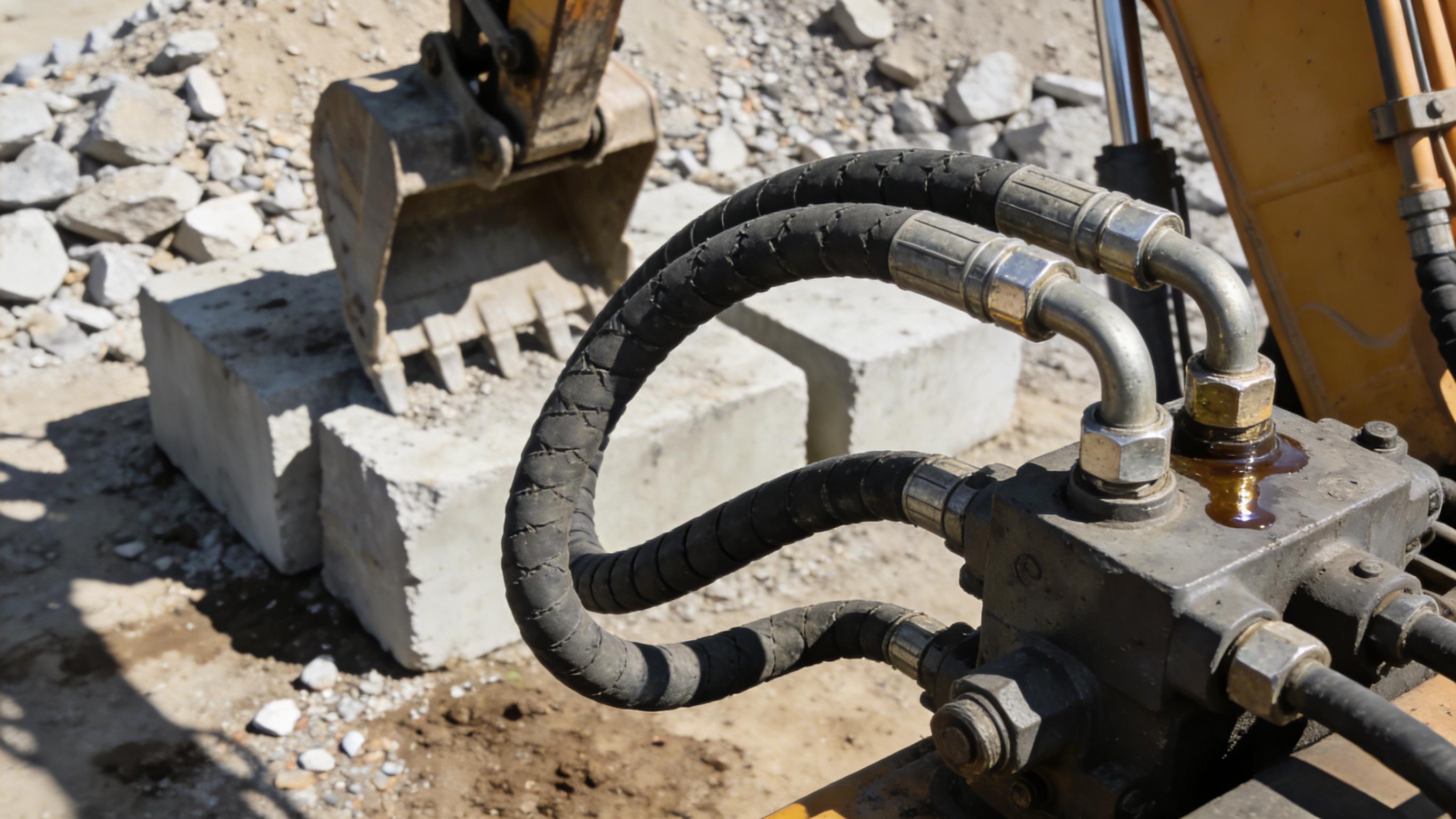
1. Vibration Resistance: Multi-Layer Wire Spiral Reinforcement and Impulse Life Design
Hydraulic impulses in mining equipment are extremely severe—breaker working pressure fluctuates between zero and peak hundreds of times per minute. This high-frequency pulsation is the primary cause of hose fatigue failure, accounting for approximately 65% of all failure cases.
The core defense against vibration shock lies in the reinforcement layer structure. Take the commonly used EN 856 4SH hose for mining breaker circuits—it features a four-layer high-tensile steel wire spiral reinforcement, with adjacent layers wound in opposite spiral angles to effectively cancel out stress concentrations. Compared to standard braided hoses, this spiral construction delivers several times longer impulse life. The MT/T98 mining standard requires hoses to withstand no less than 500,000 impulse cycles (at 1.33× working pressure) and a burst pressure of at least 4× working pressure. Some premium products have been tested to exceed 680,000 cycles while remaining intact.
2. Rock Impact Resistance: Thickened Cover and Tear-Resistant Formulation
The cover is the first line of defense against rock impacts and abrasion. Mining-grade hoses typically feature a thickened outer cover with wear-resistant fillers, achieving abrasion resistance at least double that of standard products. For extreme wear scenarios, an additional PU cover or metal spring guard can be applied as supplementary protection.
A more advanced solution is the ceramic-rubber composite hose—high-quality wear-resistant ceramic tiles are vulcanized into the rubber wall. The outer rubber layer cushions impact forces, while the ceramic liner withstands abrasion, delivering wear resistance up to 20 times that of conventional rubber hoses. This construction performs exceptionally well when resisting impacts from large, sharp rock particles.
3. Structural Details: Reinforced Protection at Elbow Sections
Elbow sections experience the most concentrated impact and wear, and are therefore the first points to fail. An optimized design approach incorporates 30–50% thicker inner rubber on the extrados (outer curve) of the elbow compared to straight sections. Simultaneously, the wire spiral pitch at the extrados is enlarged to 2–3 times that of the intrados. This increased pitch reduces the steel wire layer's stiffness, allowing the tube wall to expand slightly outward under slurry impact—absorbing the shock rather than allowing continuous stress concentration at a single point.
4. Mining Safety Certification: Mandatory Flame Retardancy and Static Conductivity
In underground coal mines, hoses must meet two additional mandatory safety requirements: flame retardancy (passing flame tests) and static conductivity (surface resistance ≤10⁹ Ω) to prevent static buildup that could ignite methane gas. In Chinese coal mines, hoses bearing the MA mark (Mining Safety Certification) are mandatory. MT/T98 specifies detailed testing protocols, including flame application duration with average after-flame or after-glow times not exceeding 30 seconds.
5. Field Maintenance Best Practices
Even with the correct hose selection, proper field installation and maintenance are equally critical: avoid sharp bends (maintain bend radius ≥1.5× the minimum recommended); install protective sleeves where hoses pass through metal structures to prevent friction wear; implement a preventive replacement schedule—typically every 2,000–3,000 working hours or every 12 months for critical circuit hoses, whichever comes first.
