
There is no simple “higher is better” answer when selecting ultra-high pressure cleaning hoses. The choice between 1000bar, 2000bar, and 3000bar (or higher) corresponds to completely different applications, equipment configurations, and cost structures. Over-specify and you waste money and add unnecessary bulk; under-specify and you lose efficiency or fail to complete the job. This article provides a scenario-based selection guide based on mainstream product data.
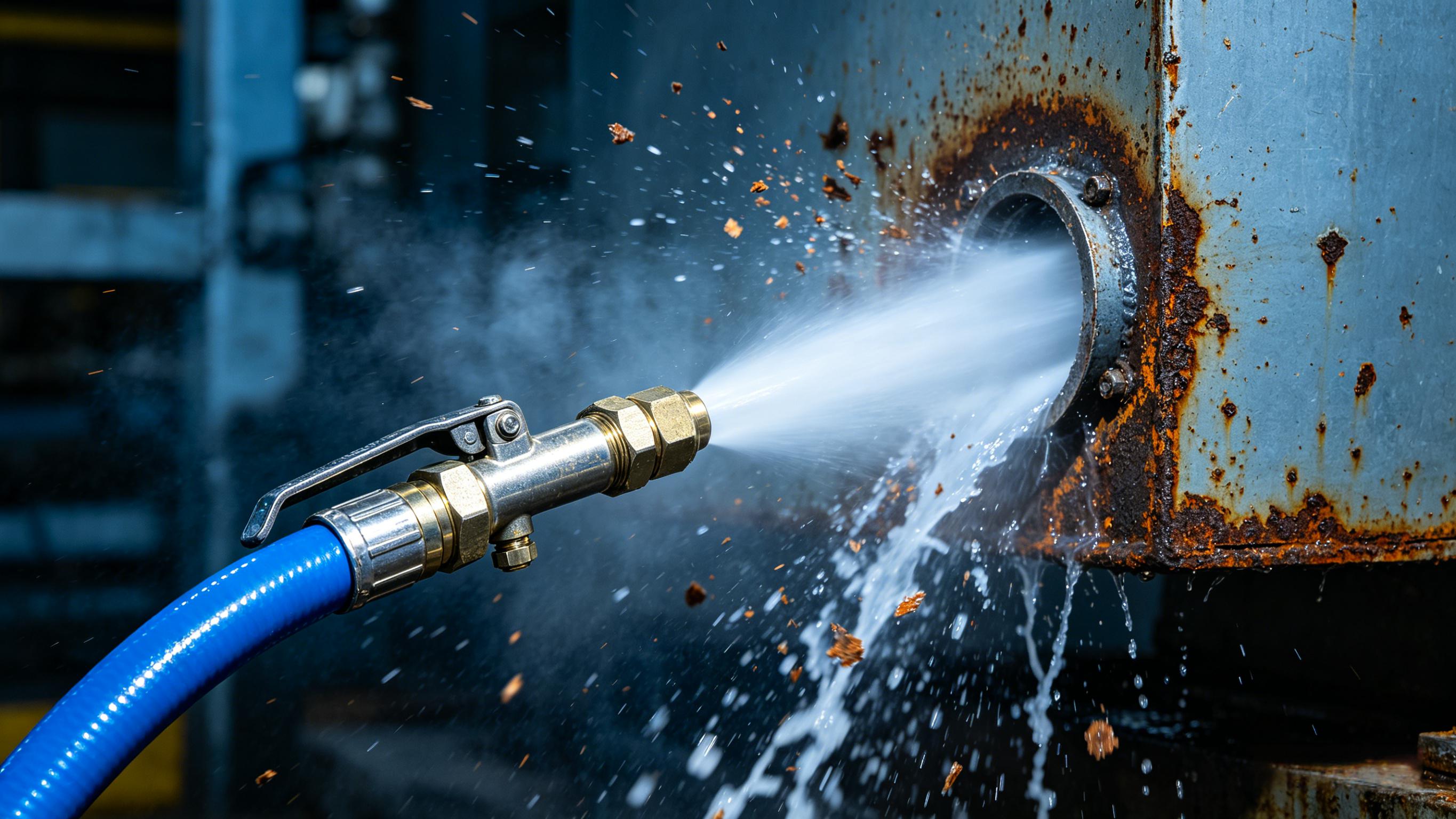
1. The “ID-Pressure Inverse Law” of Ultra-High Pressure Hoses
The first rule of ultra-high pressure hose selection is: the larger the inner diameter (ID), the lower the maximum working pressure. This is not a manufacturing defect but a law of physics—with the same number of wire spirals, larger diameters experience higher hoop stress, naturally reducing pressure capacity.
Take the LT799 series as an example: a -2 size with 3.5mm ID can handle 1040bar (≈15000psi) with 4-layer wire spiral reinforcement. With the same 4-layer construction, the -6 size with 9.9mm ID drops to 690bar (≈10000psi). Upgrade to 6-layer reinforcement, and 3.5mm ID can reach 2800bar (≈40600psi), but 12.8mm ID still only achieves 1800bar (≈26100psi).
Therefore, the first step in selecting pressure rating is: determine flow rate first, then ID, then see what pressure that ID can handle. Higher flow requirements → larger ID → lower maximum pressure. This is an inescapable engineering trade-off.
2. Three Pressure Grade Application Scenarios
1000bar Grade (≈14,500psi) – The Industrial Cleaning Workhorse
Corresponds to Parker 2440N series at 1400bar and LT series around 1100bar products. This is the “workhorse” of industrial cleaning—vehicle washing, building facade maintenance, pipe descaling, heat exchanger cleaning. Typical ID range: 4-10mm. Moderate flow, relatively small bend radius (75-200mm), easy to handle.
2000bar Grade (≈29,000psi) – Advanced Ultra-High Pressure Cleaning
Corresponds to Parker 2440D series up to 3000bar and LT series 2000bar products. Suitable for concrete scarifying, ship hull cleaning, hydrodemolition—applications requiring higher impact force. 2000bar grade hoses typically restrict ID to 4.8-6.3mm (3/16″ to 1/4″), with significantly larger bend radius (≥220mm) and reduced flexibility.
3000bar+ Grade (≈43,500-58,000psi) – Waterjet Cutting and Specialized Demolition
Corresponds to Parker 2840D series up to 4000bar (58,000psi) and LT799 8-layer spiral specifications up to 4000bar. Used for waterjet cutting, concrete cutting, nuclear facility demolition—specialty applications with extreme pressure demands. ID typically ≤5mm, large bend radius, requires specialized equipment for operation.
3. The “Safety Factor Trap” in Hose Selection
Many users focus only on working pressure, ignoring another critical metric: design safety factor. Ultra-high pressure hose burst pressure is typically 2.5× or 4× the working pressure, varying greatly by brand and series. Higher burst pressure means thicker walls, more steel wire, and higher cost for the same working pressure.
Recommendation: determine the peak impulse pressure (not steady-state working pressure), then add a 20-30% margin before selecting the hose rated pressure, rather than blindly selecting the maximum listed value. Over-specifying pressure grade brings larger bend radius, reduced handling flexibility, and skyrocketing costs.
4. Practical Four-Step Selection Process
Define the objective: General cleaning → 1000bar grade; concrete scarifying/ship hull cleaning → 2000bar grade; waterjet cutting/specialized demolition → 3000bar+ grade.
Calculate required flow: Based on nozzle size and work efficiency, determine the required hose ID.
Check pressure-ID cross-reference: With the chosen ID, verify that the hose’s working pressure meets system peak requirements.
Confirm safety certification: Choose hoses compliant with DIN EN 1829-2 standards for ultra-high pressure applications.
Summary
1000bar, 2000bar, 3000bar—none is inherently “best”; the question is which is “most suitable”. For routine industrial cleaning, 1000bar is sufficient. Concrete scarifying and ship cleaning require 2000bar. Waterjet cutting and extreme demolition demand 3000bar or more. The selection formula is: determine flow and ID first, then determine the pressure limit based on ID—not the other way around.
