
In fully mechanized longwall mining faces, every critical action of the hydraulic roof support—leg lifting/lowering, advancing/pushing, and shield extension—depends on high-pressure hose assemblies to precisely transmit emulsion pressure to each actuator cylinder. The four-layer spiral-wound hose (4SP type) and the two-layer braided hose (RB2 type) are the two most widely used and most debated products in this scenario. Many mine operators make procurement decisions based solely on "sufficient pressure rating" or "lower cost," overlooking the fundamental structural differences between these two hose types. This not only compromises operational reliability but can also introduce safety risks. This article provides a clear comparative framework for support hose selection across four dimensions: structural principle, pressure performance, bending adaptability, and actual application scenarios.
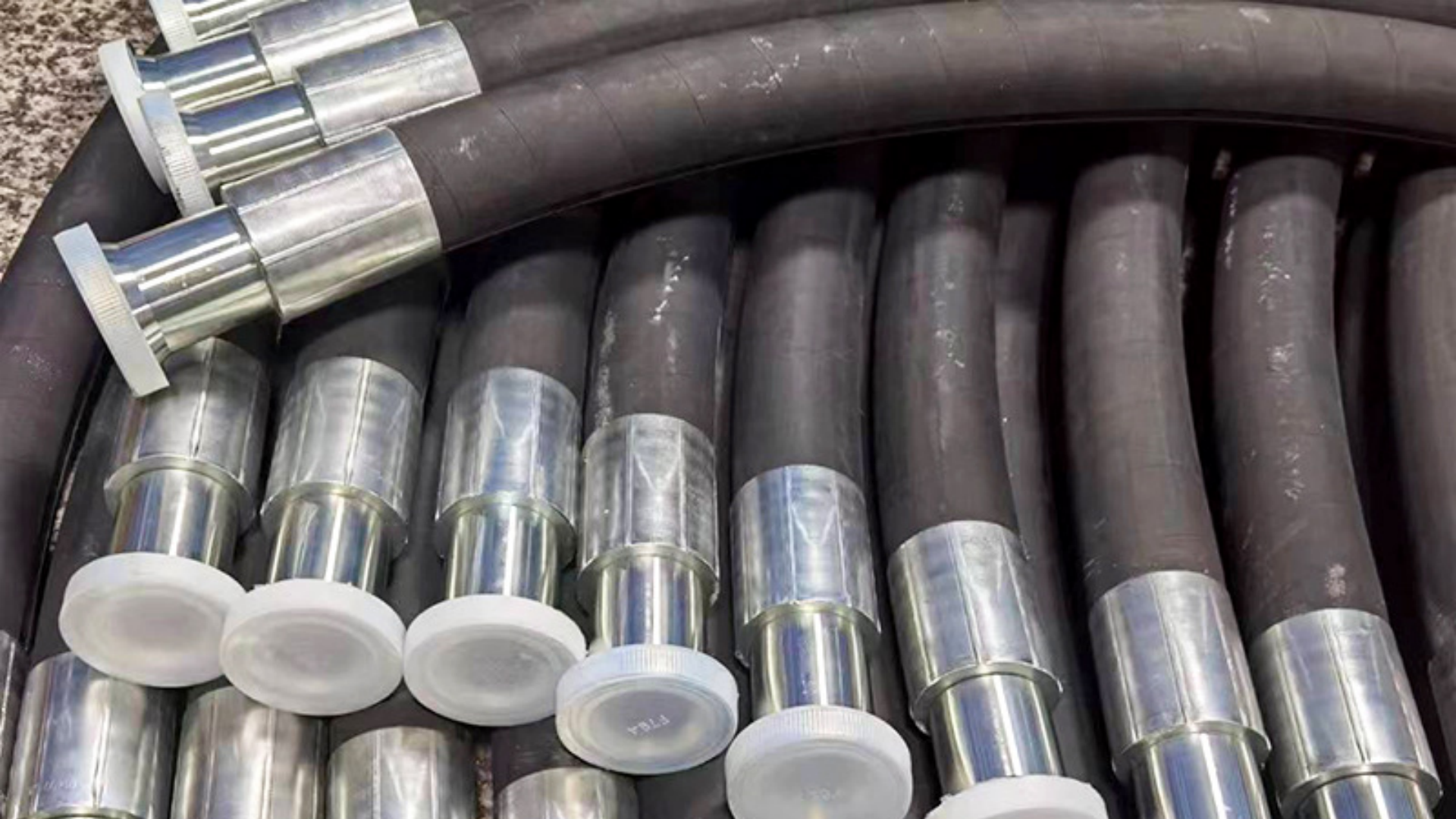
The two-layer braided hose (RB2 type) features two layers of steel wires arranged in a crisscrossing braided pattern, forming an interwoven mesh reinforcement layer. This construction allows relative slippage between wire layers during bending, giving the hose excellent flexibility and a relatively small bend radius. Consequently, RB2 hoses are widely used in support systems for advancing ram circuits, side shield control lines, and other locations requiring frequent bending in confined spaces.
The four-layer spiral-wound hose (4SP type) employs four layers of high-tensile steel wires wound in alternating spiral directions, with no interwoven contact points between layers and reduced inter-layer friction. This construction distributes stress more uniformly across layers, delivering significantly superior impulse fatigue resistance—spiral hoses typically achieve 300,000 to 500,000 impulse cycles, while braided hoses are rated at no less than 200,000 cycles. The trade-off is a larger bend radius and reduced flexibility compared to braided constructions.
Technical parameters reveal a clear gradient in pressure capacity between the two types. Taking the commonly used DN10 size in mining supports as an example: the two-layer braided hose (RB2-10) is rated at approximately 27.5MPa; the four-layer spiral medium-pressure hose (4SP-10) is rated at 44.5MPa. For advancing ram circuits operating in the 16–25MPa range, RB2 is adequate. However, for leg control and other critical circuits that must withstand 35–42MPa high pressure with severe impulse shocks, 4SP is the required choice.
Additionally, 4SP offers a higher design safety factor, with burst pressure typically 3–4 times the working pressure, while braided hoses have comparatively lower safety margins. In medium-pressure support applications, "medium-pressure" does not mean "low-demand" —during critical operations like leg lifting, system pressure peaks often far exceed nominal ratings, and insufficient pressure margin can lead to premature fatigue failure or even bursting.
Installation space adaptability is often the most overlooked hard constraint in on-site selection. For the same DN19 size, the two-layer braided hose has a minimum bend radius of approximately 300mm, while the four-layer spiral 4SP also has 300mm and 4SH has 280mm. For advancing ram and side shield lines—"dynamic hoses" that flex repeatedly with support movements—the small bend radius and repetitive bending durability of braided hoses offer clear advantages.
A critical warning: in confined spaces where a spiral hose with an excessive bend radius is incorrectly selected—even if pressure-rated correctly—forced installation induces stress concentration in the wire layers, leading to fatigue fracture within a very short period. This is a classic directional selection error.
Based on the operating characteristics of each support circuit, the selection logic can be summarized as follows:
Leg control and main leg supply circuits—these experience the highest pressures and most severe impulses in the support hydraulic system, with peak pressures often reaching 35–42MPa or higher. Four-layer spiral hoses (4SP) are preferred, as their impulse resistance and pressure capacity meet the long-term high-frequency demands of large mining-height supports. Recommended models include 4SP-10 (DN10, 44.5MPa) or 4SP-12.5 (DN12.5, 41.5MPa).
Advancing ram and side shield control circuits—operating in the 16–25MPa range with frequent bending during support advancing operations. In this scenario, bending flexibility requirements often outweigh pressure demands. Two-layer braided hoses (RB2) are the more economical and better-suited choice, with their smaller bend radius and good repetitive bending fatigue life meeting the demands of frequent cycling. Recommended models include RB2-12.5 (27.5MPa) or RB2-19 (21.5MPa).
Pilot control and spray dust-suppression low-pressure circuits—pressure requirements are typically below 10MPa, where low-pressure braided hoses or textile-reinforced hoses are sufficient, making spiral hoses an unnecessary cost.
Recent procurement data from mining operations shows both hose types are widely used with clear role differentiation. In one support hose assembly procurement, RB2 and RB3 braided hoses were specified for medium-to-low pressure circuits, while 4SP and 4SH spiral hoses were used for high-pressure critical circuits. Another mine's procurement list included 4SP hoses across sizes from DN10 to DN51, with DN38 alone reaching 28,660 meters—demonstrating the dominant role of spiral hoses in support systems.
Between four-layer spiral and two-layer braided hoses, there is no absolute superiority—only scenario-specific suitability. In coal mine hydraulic support applications, the selection logic should follow a basic principle: for high-pressure core zones like leg circuits, choose 4SP spiral; for dynamic bending zones like advancing ram circuits, choose RB2 braided; for low-pressure auxiliary zones, choose cost-optimized basic models. Zone-based, application-matched selection—allowing each construction to deliver its intended value—is the scientific approach to ensuring long-term reliable support system operation.
