
When an air compressor operates, motor torque and piston motion generate continuous vibration. If the discharge piping uses rigid connections (e.g., direct steel pipe welding), vibrations propagate along the piping undamped. This not only creates noise but also induces metal fatigue at stress concentration points—welds, elbows, and fittings—ultimately leading to cracks or even rupture. Vibration-damping hoses are specifically designed flexible connections to address this problem.
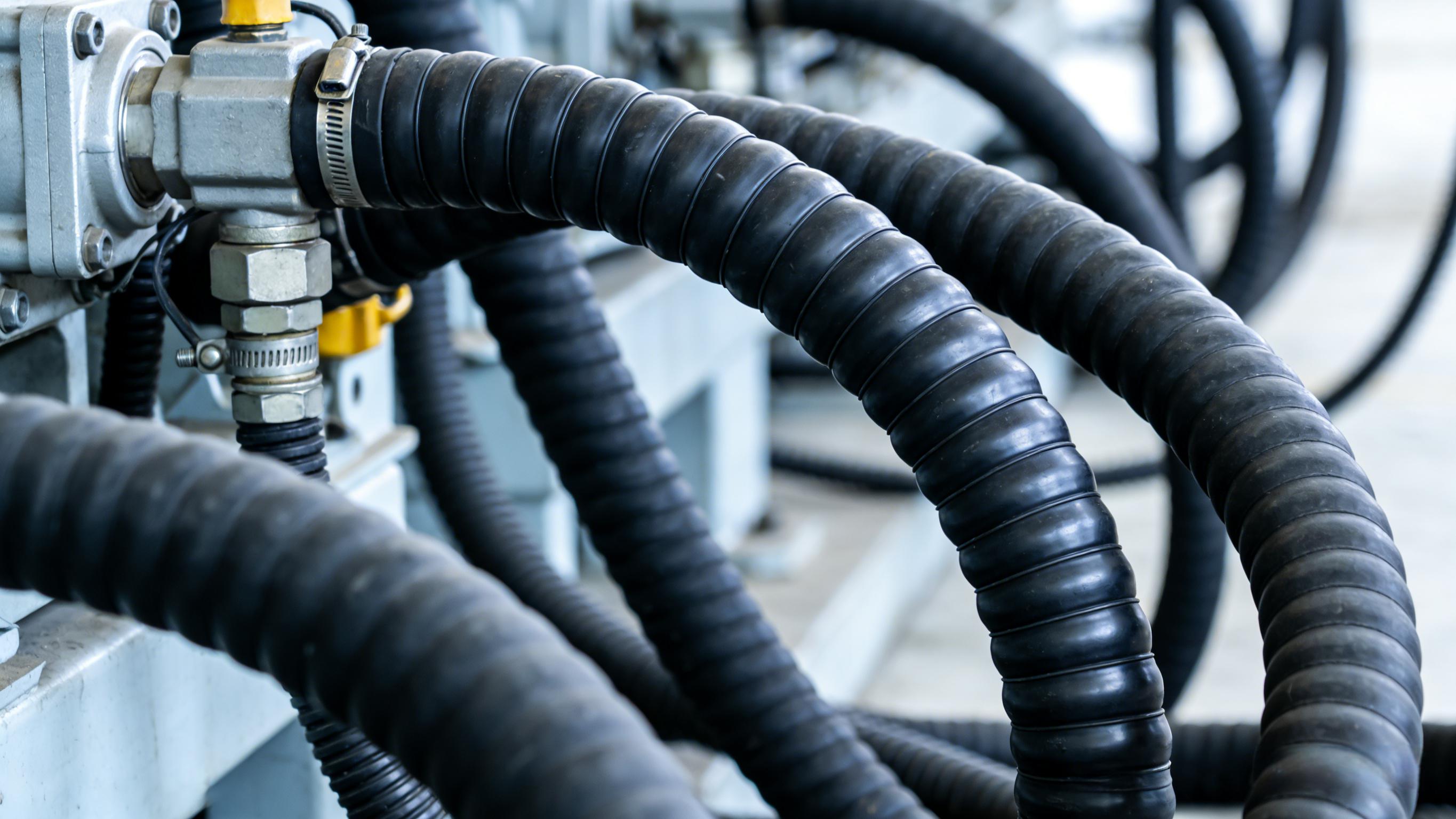
1. How Vibration-Damping Hoses Work
The core structure of a vibration-damping hose combines a bellows with a metal braided sleeve. The bellows provides axial and radial flexibility, absorbing the vibration displacement generated during compressor startup, operation, and shutdown. The outer stainless steel braided sleeve withstands system internal pressure, preventing the bellows from over-expanding under high pressure. This “flexible inner tube + load-bearing outer sleeve” design allows the hose to absorb vibration while withstanding compressor discharge pressure.
The damping mechanism works by converting the rigid connection between compressor and piping into a flexible one. Vibration energy is dissipated through elastic deformation of the bellows, preventing it from propagating as solid-borne noise along the piping system.
2. How Serious is Vibration Transmission Damage?
A case from a food plant in Zhuzhou, Hunan Province, illustrates the risk of omitting vibration-damping hoses: a 30-hp semi-hermetic piston compressor with a copper pipe directly welded to the discharge line developed a crack at the weld after about one year of operation, caused by metal fatigue from compressor vibration. After replacing the connection with a vibration-damping hose, the problem never recurred.
This case reveals a key principle: without vibration isolation, compressor vibrations continuously act on rigid piping. Stress concentrates at welds, elbows, and joints; after tens of thousands of microscopic deformation cycles, fatigue cracks initiate internally and propagate, eventually leading to rupture. Vibration-damping hoses absorb vibration energy, significantly reducing piping stress and fundamentally breaking the fatigue failure chain.
3. Key Installation Guidelines
1. Install as close to the compressor as possible: The vibration-damping hose should be installed near the compressor discharge port—the closer, the better the vibration isolation. The hose should be kept in a straight line during installation, avoiding static tension or compression before and after installation.
2. Pay attention to mounting orientation: For compressors supported by spring vibration isolators, the motor’s starting torque causes side-to-side sway. The vibration-damping hose should be installed parallel to the crankshaft to accommodate this movement. Horizontal installation perpendicular to the crankshaft is not permitted.
3. Allow sufficient hose length: Never use excessively short hoses just to save space inside the machine. Insufficient length not only defeats the purpose of flexible connection but also risks connector rupture from tension during vibration.
4. Coordinate with vibration isolators: The compressor’s spring isolators absorb body vibration, while the vibration-damping hose isolates the piping path. Both are essential—isolators address the vibration source, while the hose prevents vibration from propagating through the piping system.
4. Application Scenarios and Comparison
In air compressor systems, the discharge line should use stainless steel bellows vibration-damping hoses. Rubber flexible hoses offer better vibration isolation but are limited by temperature (typically ≤80°C) and pressure ratings, making them suitable for water supply or low-pressure ventilation. Compressor discharge has high temperature and pressure; stainless steel bellows are irreplaceable for high-temperature, high-pressure, and corrosion resistance.
Summary
The role of air compressor vibration-damping hoses goes beyond “noise reduction”—it is about absorbing vibration energy, eliminating piping stress concentration, and preventing metal fatigue fractures. Correct installation—near the compressor, parallel to the crankshaft, with sufficient length—is the prerequisite for effectiveness. Choose the right hose, but install it wrong, and performance suffers significantly.
