
Ship descaling is one of the most demanding applications for high-pressure hoses. Ultra-high pressure waterjets must strip rust and old paint while withstanding seawater corrosion, impact erosion, and repeated dragging across decks and bulkheads. Choosing the wrong hose leads to frequent replacements, project delays, or even burst-related injuries. This article breaks down the key selection criteria for ultra-high pressure hoses in ship descaling, referencing mainstream product specifications and industry standards.
1. The Dual Threat: Seawater Corrosion and Abrasive Erosion
Ship descaling operations face two overlapping challenges. First, seawater corrosion—the hose’s outer surface is constantly exposed to salt-laden mist, seawater splashes, and residual salt crystals. Standard carbon steel fittings or standard covers quickly rust and degrade under these conditions, leading to cover cracking or seized fittings. Second, abrasive erosion—ultra-high pressure waterjets (typically 1400bar to 2800bar or higher) generate high-velocity streams that strip rust and paint. Beyond the jet’s inherent erosive effect, the constant dragging and rubbing of hoses across decks and floors continuously wears the outer layer.
Ship descaling hoses must therefore satisfy two non-negotiable requirements: seawater resistance and high abrasion resistance.
2. Material Solution: Polyurethane Cover Provides Core Protection
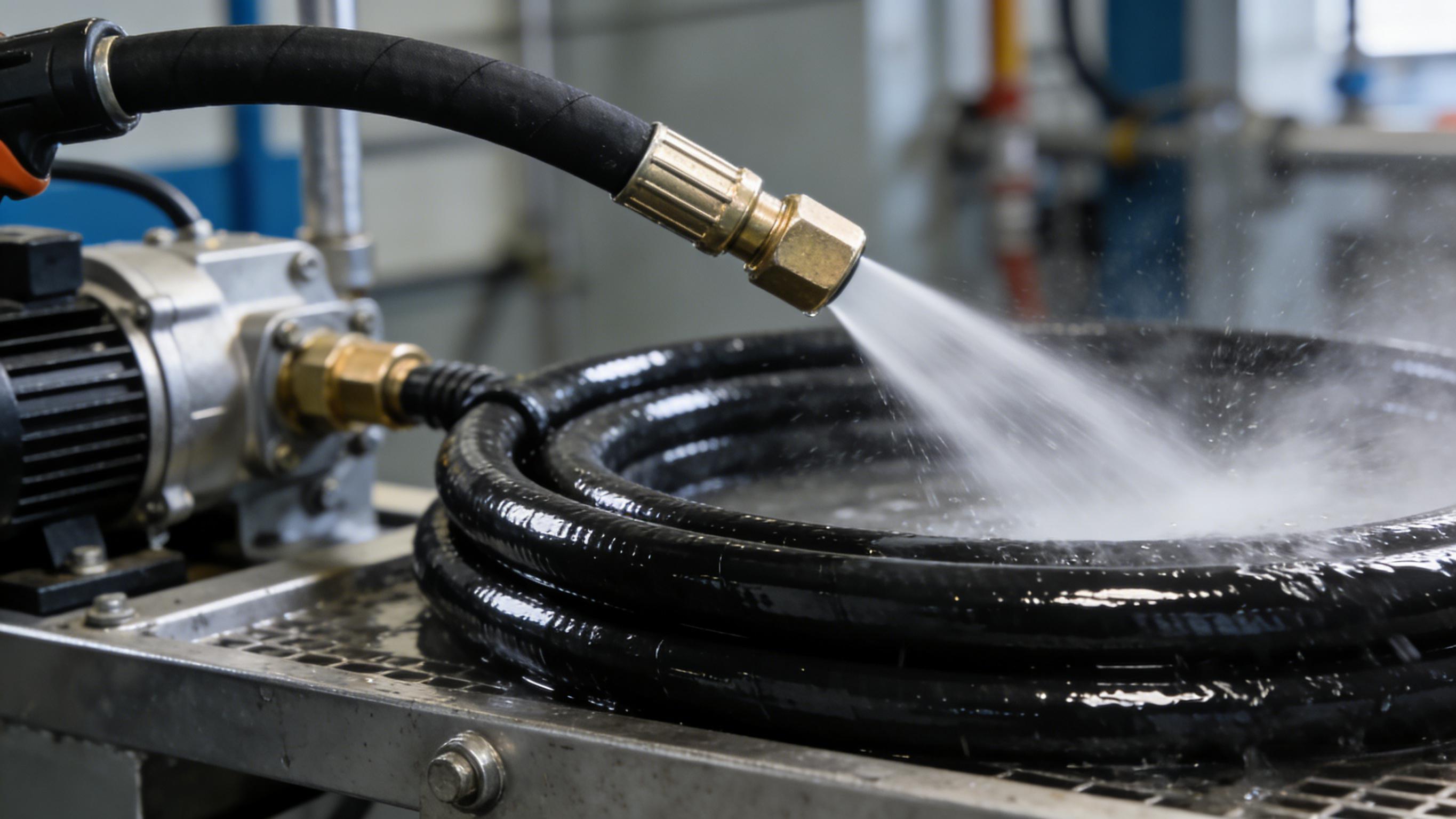
To address these dual requirements, leading ultra-high pressure hose manufacturers have clear material solutions: outer covers made of polyurethane (PUR) or specialty polyester copolymers, explicitly rated for “seawater resistance” and “abrasion resistance”. The advantages of this material choice are:
PUR covers offer excellent cut, scratch, and drag abrasion resistance, effectively withstanding repeated friction and impacts during operation.
Seawater-resistant formulations resist salt spray and seawater splash, preventing the cover from hardening, cracking, or peeling due to salt corrosion.
Advanced models go further with a dual-layer cover design—an inner specialty polyester copolymer layer and an outer wear-resistant black polyurethane layer. The two layers have different colors; when the outer layer wears through and exposes the inner color, operators can immediately identify wear levels and replace the hose before a burst occurs.
3. Reinforcement Layers: Multi-Layer Steel Wire Supports Ultra-High Pressure and Flexibility
Ship descaling typically requires working pressures of 1400bar to 2800bar or higher, placing extreme demands on the hose reinforcement. Common reinforcement configurations include:
4+2 layers (four tightly wound layers + two spaced layers of steel wire), rated up to 1400bar for standard ultra-high pressure cleaning.
6 layers of high-tensile steel wire, rated up to 2500bar for more demanding descaling applications.
8 layers of steel wire, rated up to 3800bar for extreme waterjet cutting and specialized demolition.
Liner material is equally critical—polyamide (PA) and polyoxymethylene (POM) are the two mainstream choices. POM offers extremely low permeability under ultra-high pressure, ideal for pure water operations, while PA provides better flexibility and fatigue resistance.
4. Safety Standards and Selection Checklist
Ship ultra-high pressure water descaling operations are governed by clear safety regulations. Per T/CSNAME 046-2022, the minimum burst pressure of high-pressure hoses must be 2.5× the working pressure, hoses must be pressure-tested at 1.5× working pressure, and the bending radius must be no less than 0.9m. The national standard GB/T 43142-2023 further specifies the selection method for high-pressure hose nominal diameter and pressure loss calculation, providing a quantitative basis for piping configuration.
Quick Selection Guide:
Pressure matching: Working pressure typically ranges from 1400-2800bar. The hose rated pressure must exceed the system peak pressure with a 20-30% margin.
Cover wear resistance: Priority to polyurethane (PUR) covers, rated for wear resistance, seawater resistance, and UV resistance.
Fitting material: Stainless steel fittings (e.g., 316L) are mandatory to prevent seawater corrosion.
Wear indication: Dual-layer cover designs allow field operators to assess wear levels visually.
Summary
The selection logic for ship descaling ultra-high pressure hoses comes down to one principle: the cover withstands drag and abrasion, the reinforcement handles ultra-high pressure pulses, and the fittings resist seawater corrosion. Focus on the “PUR cover + multi-layer steel wire reinforcement + stainless steel fittings” combination, and always verify burst safety factors against industry standards to ensure safe and efficient operations.
