
Today's data center liquid cooling technology is rapidly evolving along two mainstream paths: cold-plate liquid cooling, where coolant flows through cold plates in contact with chips, transferring heat via conduction while remaining physically isolated from electronic components; and immersion liquid cooling, where entire server motherboards are submerged in dielectric coolant, achieving heat exchange through direct fluid contact with all heat-generating components. These two technical routes impose fundamentally different performance requirements on liquid cooling hose assemblies—their priorities differ dramatically across material chemistry, cleanliness grades, mechanical flexibility, and long-term reliability. Selecting the wrong hose can compromise cooling efficiency at best, or cause coolant contamination, seal failure, or even equipment short circuits at worst. This article systematically compares the key dimensions of hose selection based on the core differences between these two liquid cooling scenarios.
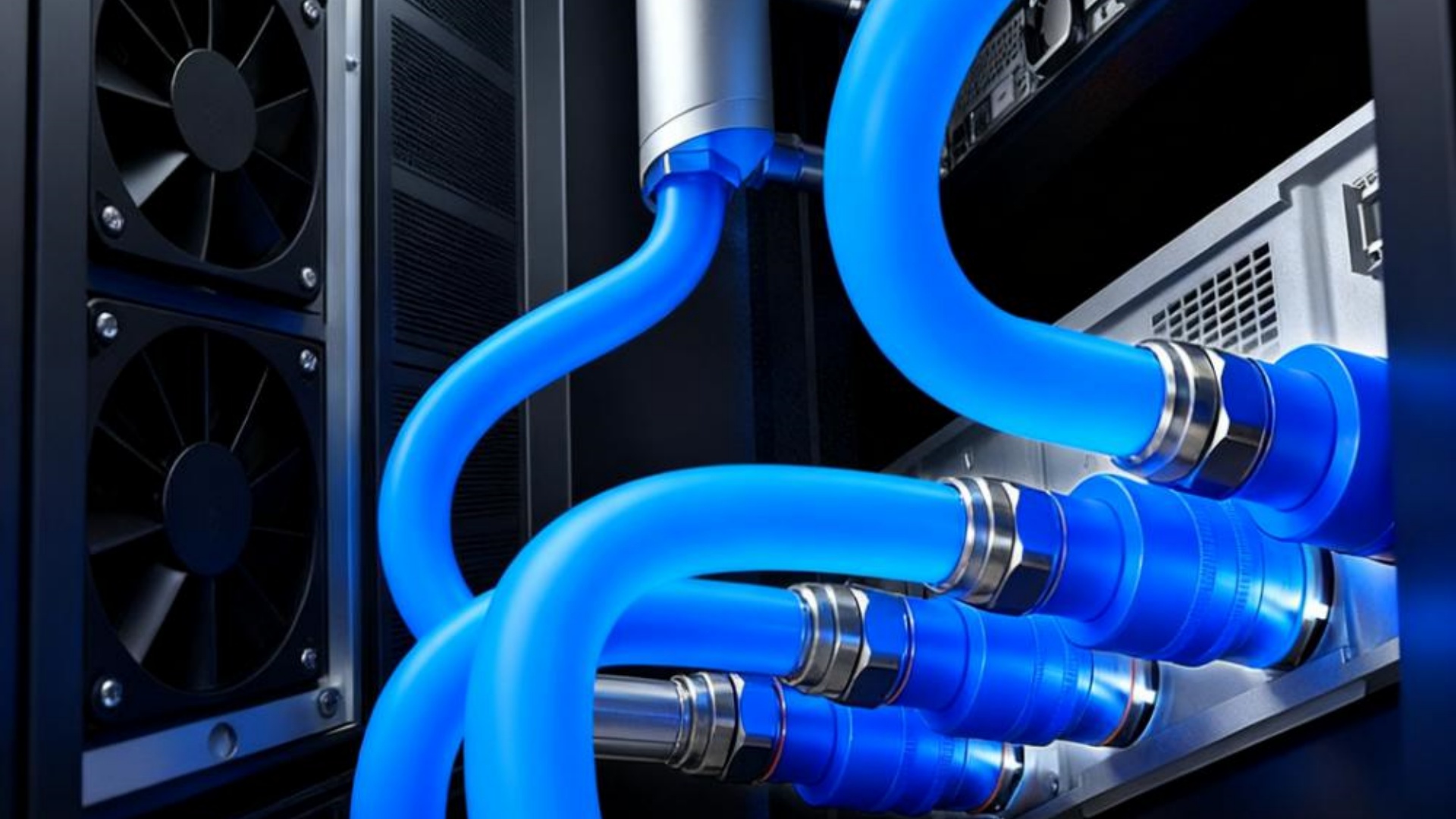
Cold-plate liquid cooling is the mainstream solution for AI computing clusters and general-purpose data centers, typically using water-glycol or water-propylene glycol coolants, with deionized water used in some cases. The flow channels inside cold plates are extremely small (often millimeter-scale micro-channels)—any trace ionic leaching, particle shedding, or extractable matter can block these channels or deposit on cold plate inner walls, causing rapid degradation of heat dissipation capacity. Therefore, cold-plate liquid cooling demands exceptionally high cleanliness and low extractables from hoses.
In these applications, PTFE/FEP fluoroplastic hoses, with their ultra-low extractable levels and excellent chemical inertness, are the preferred choice for chip-near connections. The smooth inner surface of PTFE does not adsorb contaminants, helping maintain coolant cleanliness within system-specified limits. EPDM rubber hoses offer a more cost-effective alternative—EPDM exhibits good compatibility with water-glycol, and peroxide-cured formulations can control extractables to acceptable levels, making them widely used for rack manifold-to-cold-plate connections.
Additionally, cold-plate liquid cooling imposes clear particulate control requirements on hose assemblies, typically demanding ISO 4406 cleanliness levels no lower than 16/14/11. Cleanroom environments during manufacturing and assembly, end-capping protection, and pre-commissioning flushing procedures are all essential to ensuring long-term system reliability.
Immersion liquid cooling submerges entire motherboards in coolant, which comes into direct contact with CPUs, GPUs, memory modules, capacitors, and all other electronic components. This requires the coolant to possess both dielectric properties (non-conductive) and material compatibility (non-corrosive, non-solvent to all component materials). Currently, mainstream immersion coolants fall into two categories: hydrocarbon synthetic oils (mineral oil, PAO) and fluorinated fluids (3M Fluorinert, Novec series).
Immersion liquid cooling imposes hose selection requirements that fundamentally differ from cold-plate systems. First is chemical compatibility—the hose inner tube and fitting sealing materials must be fully compatible with the chosen coolant. For hydrocarbon oils, both EPDM and FKM inner tubes perform well; however, for fluorinated fluid systems, only PTFE/FEP perfluorinated hoses are acceptable, as fluorinated fluids have strong penetration and solvency—ordinary rubbers swell, degrade, and cause seal failure and system contamination upon contact.
Second is long-term immersion—hoses in immersion systems experience internal flow while their outer surfaces are also continuously immersed in coolant. This imposes additional requirements on the outer cover's resistance to fluid permeation and dimensional stability. While PTFE is inherently impermeable, EPDM outer covers may exhibit weight gain and dimensional changes after prolonged hydrocarbon oil immersion, requiring specific validation.
Third is electrical safety—hoses in immersion systems with electrostatic charge accumulation or conductivity risks may cause discharge incidents. Hose assemblies must possess anti-static properties, with surface resistance controlled within safe limits. If metallic components like stainless steel corrugated hoses are used, proper grounding and insulation isolation must be ensured.
The mechanical flexibility requirements also differ between the two scenarios. Cold-plate liquid cooling requires hoses to achieve small-radius bends within rack cabinets while accommodating frequent server node insertion/removal operations, with hoses subjected to repeated bending and dragging. Smooth-bore corrugated-outer PTFE and ultra-flexible EPDM braided hoses are specifically designed for such frequent-handling scenarios, offering significantly lower bending forces than ordinary rubber hoses while maintaining flow cross-section integrity.
In immersion liquid cooling, servers are fully submerged in liquid baths, with piping primarily arranged in the external circulation system, resulting in lower hose bending frequencies. However, high-density cabling within immersion tanks requires hoses with good self-weight sag control and long-term immersion dimensional stability to prevent gravitational sag from pressing against motherboard components or causing excessive bending.
Cold-plate (water-glycol/deionized water) : EPDM hoses with UQD quick disconnects are preferred—good cleanliness at manageable cost; PTFE-lined hoses for chip-near ultra-high-cleanliness segments; focus on ionic leaching, particle control, and fitting seal reliability.
Cold-plate (fluorinated fluid) : Low system pressure but high permeability—mandates PTFE/FEP perfluorinated hoses with anti-twist metal fittings; FFKM seals required; permeation-resistant outer sleeves recommended.
Immersion (hydrocarbon oil) : EPDM or FKM inner tubes acceptable; outer covers must be validated for long-term immersion; FKM seals preferred for fittings; pay attention to static-dissipative performance.
Immersion (fluorinated fluid) : PTFE/FEP perfluorinated hoses are the only option; FFKM seals; 316L stainless steel fittings recommended for corrosion resistance; strict temperature control to prevent fluorinated fluid vaporization pressure fluctuations.
Cold-plate liquid cooling systems use shorter hoses with standardized connectors (UQD series), making replacement convenient with relatively low per-hose cost. In immersion fluorinated fluid systems, hose materials are costly (PTFE costs 5–10 times more than EPDM), with special seal materials further increasing replacement costs. However, from a total system perspective, immersion cooling requires fewer hoses than cold-plate systems, potentially reducing overall hose consumption.
The differences in hose selection between cold-plate and immersion liquid cooling are essentially the cascading consequences of fundamentally different "contact modes." The core mission of cold-plate hoses is "clean delivery," while immersion hoses must achieve "compatible coexistence." Before selecting hoses, three questions must be answered: which technology route is adopted, what coolant is used, and what cleanliness grade is required. Once these three are determined, half of the material selection answer becomes clear. As liquid cooling rapidly gains adoption, incorporating hose selection into front-end system design is a critical step toward avoiding retroactive replacements and ensuring long-term data center reliability.
