
The piping design of a hydraulic system directly impacts equipment stability and operational safety. In the two major circuits—the high-pressure line and the return line—rubber oil hoses and steel wire spiral hoses each play distinct yet complementary roles. A well-designed combination of these two hose types not only optimizes system costs but also significantly enhances overall hydraulic system reliability and service life. This article provides a technical analysis of this complementary design approach.
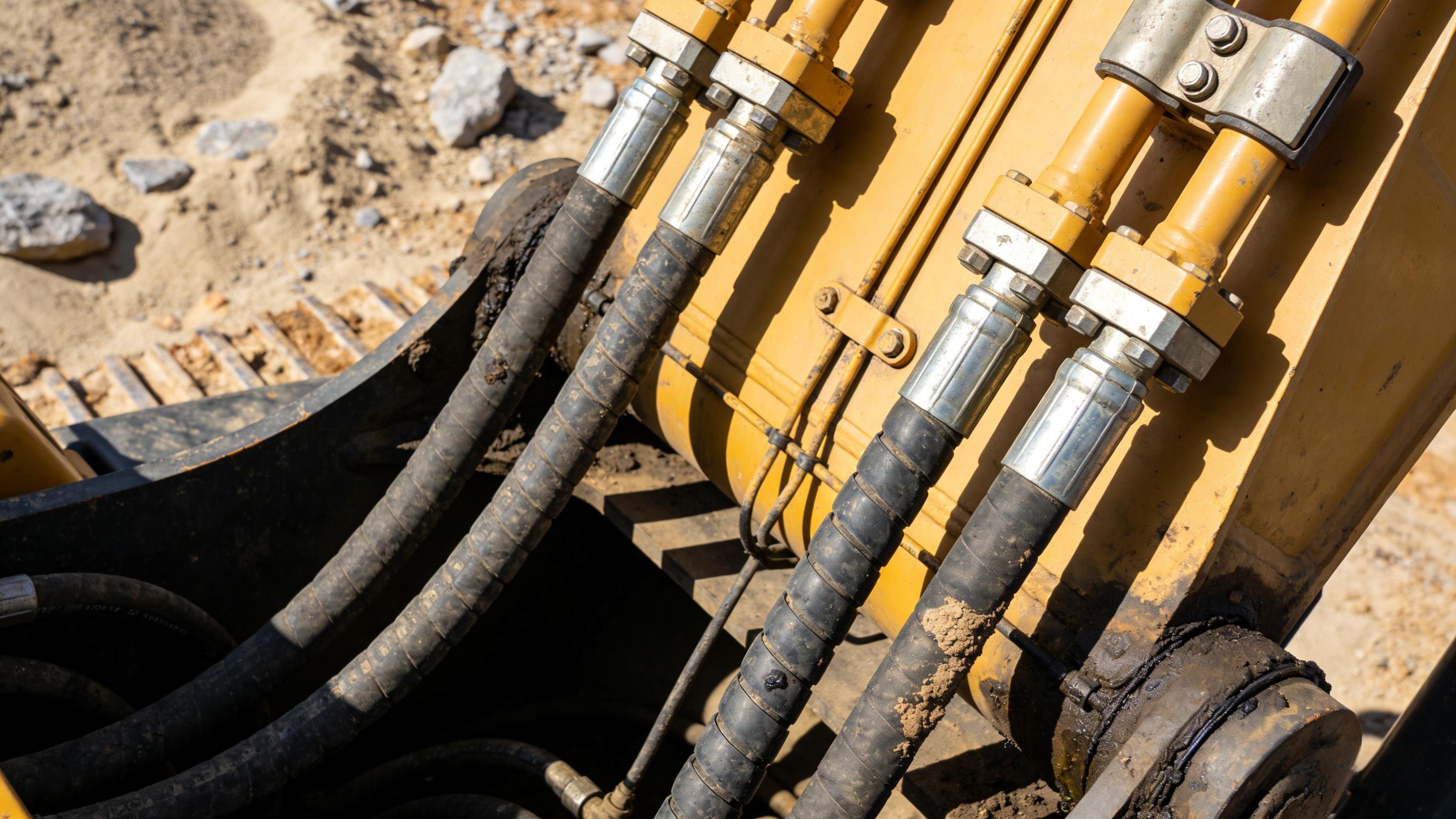
Rubber oil hoses typically consist of a synthetic rubber body reinforced with fiber braiding or lightweight steel wire braiding, primarily suited for medium-to-low pressure return lines, drain lines, and suction lines. Their typical working pressure ranges from 1.0MPa to 6.0MPa, offering excellent flexibility and vibration absorption to effectively dampen pressure pulsations and mechanical vibrations in hydraulic systems. In hydraulic systems, rubber oil hoses handle the return of oil from actuators back to the reservoir, directly affecting backpressure and heat dissipation efficiency.
Steel wire spiral hoses, in contrast, are heavy-duty hydraulic hoses featuring high-strength steel wire spiral reinforcement as the skeleton layer. Comprising an inner rubber layer, intermediate layer, multiple steel wire spiral layers, and an outer cover, they are designed for high-pressure and ultra-high-pressure conditions, with maximum working pressures reaching 35MPa to over 50MPa. These hoses are typically applied in high-pressure main circuits such as pump outlets to valve blocks and valve blocks to actuators, serving core energy transmission functions.
In terms of performance parameters, rubber oil hoses prioritize flexibility, bending life, and low-cost maintenance, while steel wire spiral hoses emphasize pressure capacity, pulse resistance, and extreme environmental adaptability. The performance curves of the two types exhibit a clear high-low complementarity, providing a natural material foundation for graded system design.
In hydraulic system high-pressure lines, oil pressure typically ranges from 20MPa to 40MPa, with some ultra-high-pressure equipment exceeding 50MPa. Pulse pressure impacts are frequent, and working environments often involve high temperatures, vibrations, and mechanical wear. Under these conditions, steel wire spiral hoses, with their multi-layer high-strength steel wire reinforcement, effectively resist hoop and axial stresses generated by internal pressure, preventing burst or excessive expansion.
Another major advantage of steel wire spiral hoses in high-pressure lines is their pulse resistance. By optimizing spiral angles and layer distribution—with inner layers focusing on pressure-bearing and outer layers on flexibility—pulse service life can far exceed national standard requirements. This makes them especially suitable for high-intensity equipment such as excavators, loaders, concrete pump trucks, and mine hydraulic supports.
In high-pressure line connections, steel wire spiral hoses are typically paired with heavy-duty steel fittings, crimped by specialized equipment to ensure reliable sealing and strong pull-out resistance, capable of withstanding instantaneous pressure peaks without leakage. Thus, steel wire spiral hoses are irreplaceable as the primary choice for high-pressure circuit selection.
The return line is the circuit with the lowest pressure but relatively high flow rate in a hydraulic system, returning oil from actuators (e.g., hydraulic cylinders, motors) to the reservoir. Pressure in this section typically does not exceed 3MPa, with relatively high temperatures but mild pulse impacts. Using steel wire spiral hoses here would result in significant cost waste and installation inconvenience—their larger bending radii make routing in compact spaces difficult.
Rubber oil hoses excel in this scenario. Their bending radius can be as small as 3 to 5 times the hose outer diameter, providing flexible routing around equipment frames and obstacles. The damping characteristics of rubber effectively attenuate return flow pulsations and reduce system noise, while good heat dissipation aids oil cooling and maintains viscosity stability. Additionally, rubber oil hoses offer significant cost advantages, typically costing 1/3 to 1/2 of steel wire spiral hoses of equivalent specifications, substantially reducing overall machine piping costs.
For drain lines (such as variable pump control oil drains and valve pilot drains), pressures are even lower (below 1MPa). However, continuous oil immersion without swelling or degradation is required—here too, high-quality oil-resistant rubber hoses are the optimal choice.
In practical engineering design, rubber oil hoses and steel wire spiral hoses should follow these complementary principles:
Pressure-Graded Selection: Main circuit sections with working pressure ≥15MPa mandate steel wire spiral hoses; sections below 6MPa (return, drain, suction) should use rubber oil hoses.
Space-Based Routing: Equipment articulation points and compact routing areas prioritize rubber oil hoses; straight sections or large-radius bends may use steel wire spiral hoses.
Temperature-Medium Matching: Both types require attention to oil temperature range—steel wire spiral hoses withstand up to +121°C, rubber oil hoses typically up to +100°C. Higher-temperature areas should increase the proportion of steel wire spiral hoses.
Fitting Standardization: Use fittings with consistent interface standards (e.g., SAE flanges, ISO 6149, metric threads) to enable interchangeability between the two hose types and reduce spare parts variety.
Safety Margin Reservation: Steel wire spiral hoses should be selected with working pressure not less than 1.5 times the system's maximum pressure; rubber oil hoses should have burst pressure not less than 4 times the peak return pressure.
Excavator Hydraulic System: Pump outlet to multi-way valve uses SAE 100R13 four-layer steel wire spiral hoses; valve block to boom and arm cylinders uses six-layer ultra-high-pressure steel wire spiral hoses; return filter to reservoir uses heat-resistant rubber oil hoses.
Mine Hydraulic Support System: Pump station main supply lines use six-layer steel wire spiral hoses (pressure ≥45MPa); inter-support connecting lines use four-layer steel wire spiral hoses; column return and pilot control circuits use rubber oil hoses.
Construction Crane: Winch motor inlet uses steel wire spiral hoses; motor drain and cooling return lines use rubber oil hoses.
In summary, the rational complementary design of rubber oil hoses and steel wire spiral hoses is the key to balancing performance, cost, and reliability in hydraulic systems. Pressure-graded selection, space-based routing, and temperature-matched material choice are the core methods for ensuring efficient and stable system operation.
