
In concrete pumping operations, the concrete pump rubber hose (also known as concrete delivery hose or pump hose) is the critical flexible component connecting the pump truck outlet to the placement point. It directly withstands high-pressure pulsations from concrete pumping while offering excellent wear resistance and flexibility. However, during actual selection, many users tend to focus excessively on the hose price while neglecting the matching relationship among working pressure, inner diameter, and delivery distance—leading to reduced pumping efficiency, premature hose failure, and even safety accidents. This article systematically explains the selection matching principles for concrete pump rubber hoses from an engineering application perspective.
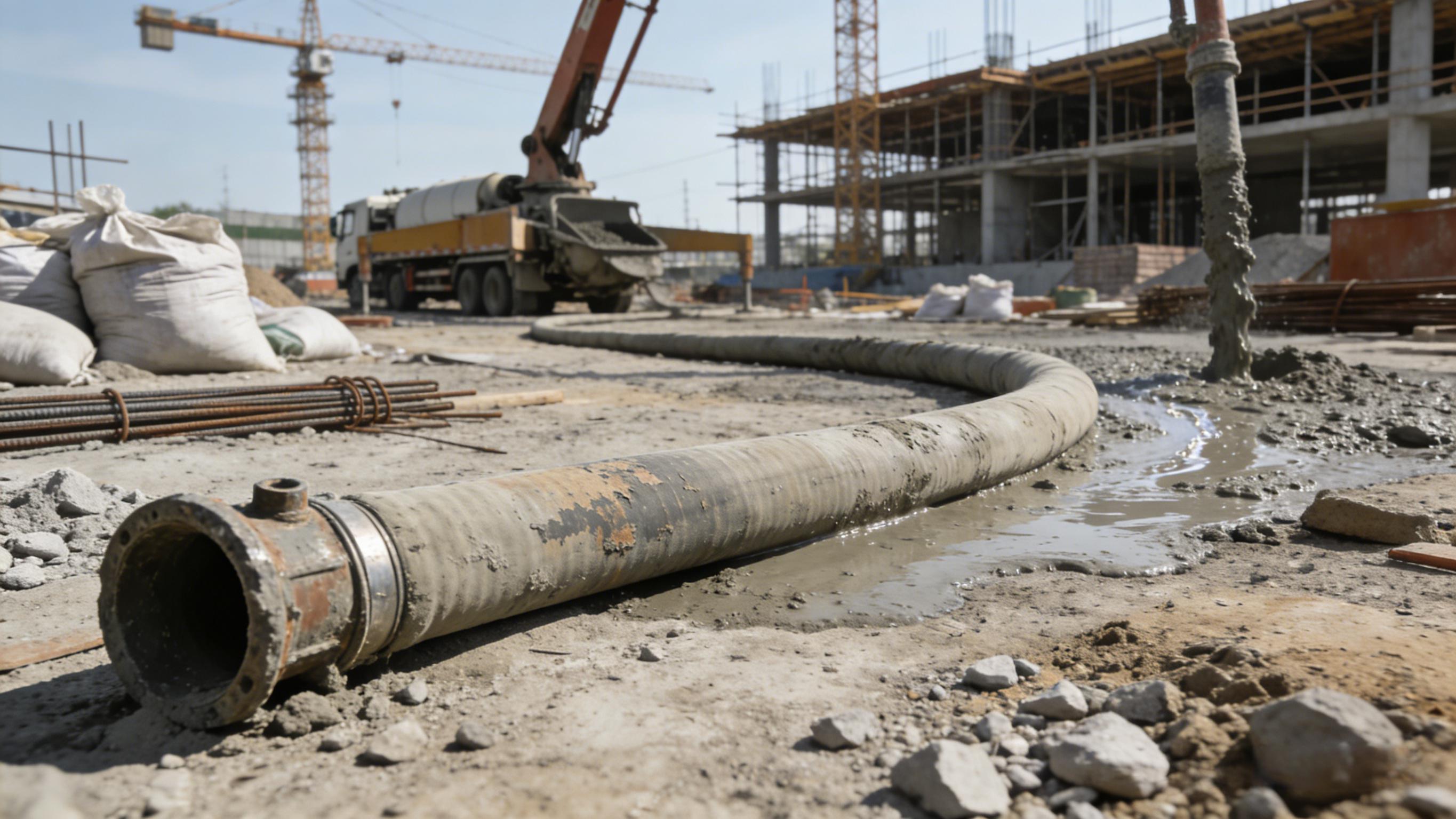
Concrete pump rubber hoses typically consist of an inner rubber layer (wear-resistant synthetic rubber), a steel wire braided or steel wire spiral reinforcement layer, and an outer protective rubber cover. Unlike standard hydraulic hoses, concrete pump hoses handle highly abrasive concrete slurry containing sand and aggregate, requiring the inner layer to possess exceptional wear and impact resistance. The reinforcement layer usually employs two or four layers of high-strength steel wire braiding or spiraling to withstand radial pressure and axial tensile forces during pumping.
In terms of performance indicators, qualified products must meet the following key parameters: working pressure typically ranges from 4MPa to 12MPa (up to 15MPa for special high-pressure applications); inner diameters cover sizes from 50mm to 150mm; bending radius must accommodate site routing requirements; and wear resistance should comply with GB/T 12721 or ISO 4649 standards. Additionally, products should offer good anti-static properties and ozone aging resistance for long-term outdoor operations.
Working pressure is the primary parameter in concrete pump hose selection. The system working pressure is determined by concrete grade, pumping height, horizontal delivery distance, and piping layout. Generally, for high-rise building pumping (height exceeding 100m) or long-distance horizontal pumping (over 500m), the pump outlet pressure can reach 8MPa to 12MPa. In such cases, hoses with rated working pressure no less than 1.5 times the system's maximum pressure should be selected—i.e., four-layer steel wire spiral hoses rated at 12MPa to 18MPa.
For ordinary low-rise construction or ground slab pouring with short pumping distances, working pressure typically ranges from 4MPa to 6MPa, where two-layer steel wire braided hoses suffice. It must be emphasized that low-pressure hoses should never be used in high-pressure scenarios, as this can easily lead to hose burst accidents. Conversely, over-specifying pressure ratings (e.g., using a 12MPa hose for a 4MPa application) results in unnecessary cost waste. The goal is precise matching of pressure rating to system requirements.
Inner diameter directly affects concrete delivery flow rate and velocity. An undersized inner diameter increases flow velocity, accelerating abrasive wear on the inner layer while raising pipeline pressure drop; an oversized diameter can cause concrete segregation (separation of mortar from aggregate), compromising pouring quality.
Common concrete pump hose inner diameter specifications include DN65, DN80, DN100, DN125, and DN150. Selection should be determined based on the concrete pump's output (m³/h) and delivery distance. A general rule of thumb: for pumping outputs of 30–60 m³/h, DN80 or DN100 is recommended; for 60–100 m³/h, DN125 is appropriate; for outputs exceeding 100 m³/h or ultra-long-distance pumping, DN150 or larger should be used.
Additionally, inner diameter must match the pump outlet size and end hose fitting specifications. Different manufacturers may use different fitting standards, so confirming the interface type (e.g., Type A, Type B, Type C, or flange connection) is essential to avoid installation or sealing issues.
Delivery distance is another critical variable in hose selection. As distance increases, frictional resistance along the pipe wall rises significantly, with pressure drop increasing nonlinearly. Therefore, when horizontal delivery distance exceeds 300m, multi-layer steel wire spiral hoses are recommended to handle higher pulse pressures, with increased wall thickness to extend service life.
For ultra-long-distance pumping (over 500m), in addition to higher pressure ratings, attention must be paid to hose support and anchoring. Under high pressure, hoses experience slight radial expansion and axial contraction; improper anchoring causes stress concentration at fittings, leading to pull-out or fatigue cracking. Flange connections are recommended over traditional clamp connections in such scenarios for improved reliability.
In vertical pumping applications (e.g., super high-rise buildings), hoses must withstand not only internal pumping pressure but also static pressure from the concrete column's self-weight. The working pressure should be calculated as "pumping pressure + static head," then multiplied by a 1.5 safety factor for selection.
In actual engineering, working pressure, inner diameter, and delivery distance are not independent variables but are mutually coupled. Below are selection recommendations for typical scenarios:
Scenario 1 – Low-rise buildings/ground pouring (height <30m, horizontal <100m): Working pressure 4–6MPa, inner diameter DN80–DN100, two-layer steel wire braided hose, clamp connections.
Scenario 2 – Mid-to-high-rise buildings (height 30–100m, horizontal 100–300m): Working pressure 6–10MPa, inner diameter DN100–DN125, four-layer steel wire spiral hose, clamp or flange connections.
Scenario 3 – Super high-rise buildings/long tunnels (height >100m or horizontal >300m): Working pressure 10–15MPa, inner diameter DN125–DN150, four-layer or six-layer ultra-high-pressure steel wire spiral hose, flange connections.
Beyond the three main parameters, attention should be given to: wear resistance grade (high-wear-resistance inner layers significantly extend service life), bending radius suitability for site turns, hose weight for manual handling, and anti-static/flame-retardant properties (especially important in tunnel or underground construction). Finally, it is recommended to source products from reputable manufacturers with third-party type test reports to avoid safety risks from substandard hoses.
In summary, concrete pump hose selection is a systematic process requiring comprehensive evaluation of working pressure, inner diameter, and delivery distance, along with interface type and wear performance. Only through scientific selection can pumping systems operate safely, efficiently, and economically.
