
High-pressure waterjet technology, with its unique advantages of cold cutting, zero pollution, and high efficiency, has been widely adopted across aerospace, shipbuilding, petrochemicals, construction, and municipal maintenance sectors. However, different application scenarios impose fundamentally different requirements on high-pressure piping systems—ultra-high-pressure water cutting demands extreme pressures with minimal flow pulsation; sandblasting and rust removal require wear-resistant inner tubes and large-particle passage capacity; while industrial cleaning must balance high pressure, elevated temperatures, and frequent bending cycles. A “one-size-fits-all” hose solution is clearly inadequate for these diverse needs. This article systematically addresses differentiated customization strategies for one-stop high-pressure waterjet piping solutions across three major application scenarios.
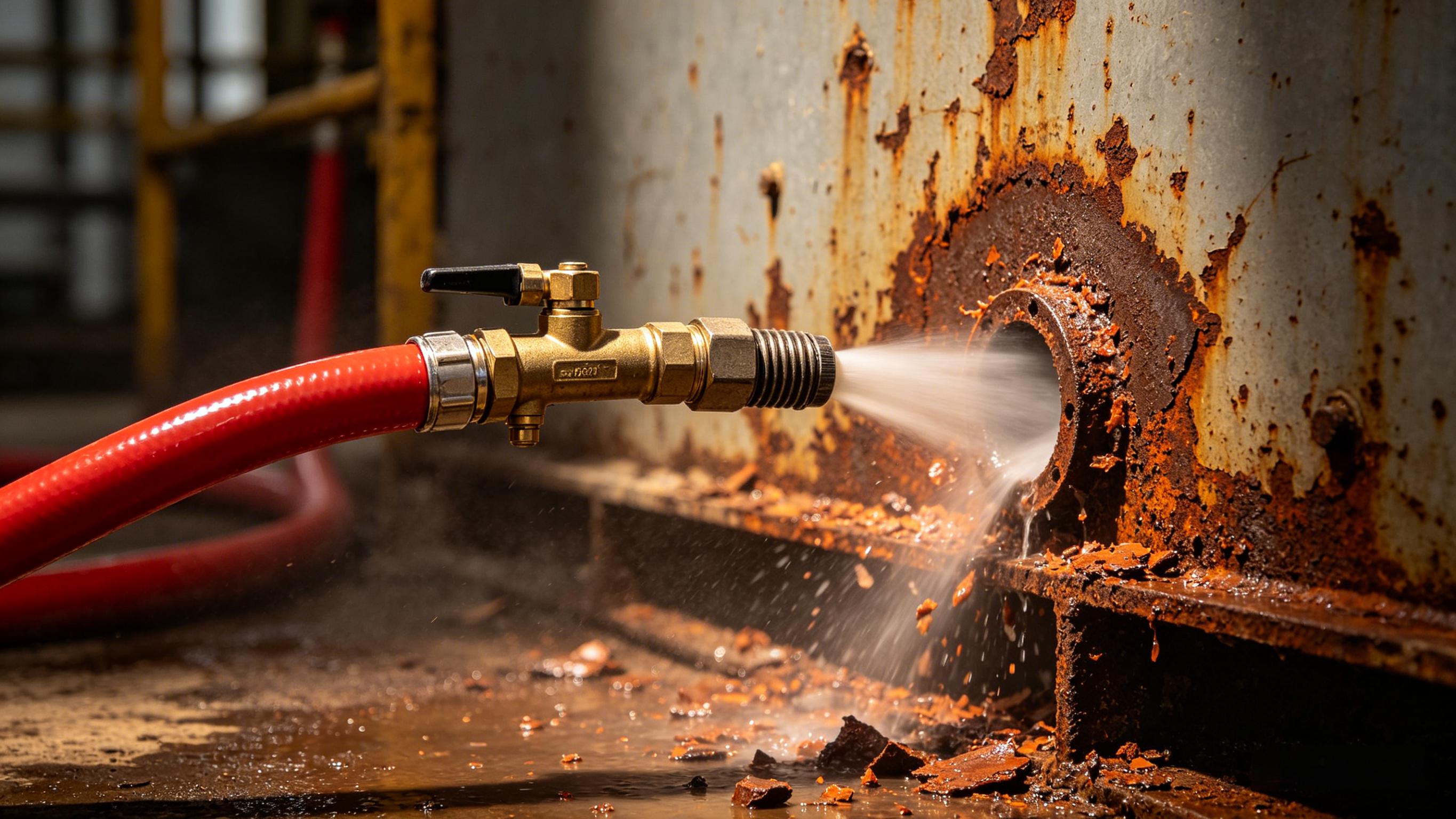
Ultra-high-pressure water cutting (typically 2500–4000 bar) imposes the most stringent requirements on piping systems. In this scenario, the hose’s pressure rating is the primary consideration—working pressure must stably reach above 3000 bar, and volumetric expansion must be minimal to prevent pressure loss and flow pulsation from pipe expansion during cutting, which would directly affect cut surface finish and accuracy.
Recommended Solution: Use ultra-high-pressure thermoplastic hoses (e.g., nylon inner layer + multi-layer steel wire spiral construction) rated up to 4000 bar, with burst pressure 2.5–4 times working pressure and extremely low volumetric expansion. Fittings should be high-precision stainless steel heavy-duty types, crimped by specialized equipment to ensure no loosening or leakage under repeated pulse impacts. For extreme precision cutting (e.g., aerospace composite processing), it is advisable to add accumulator matching with the piping system to further smooth pressure fluctuations.
Additionally, the “non-bonded inner layer and reinforcement” characteristic of thermoplastic hoses actually becomes an advantage in cutting applications—the three-layer structure slides independently, reducing internal stresses during bending and performing exceptionally well in the trajectory movements of frequently moving cutting heads.
Sandblasting applications (typically 250–800 bar) pose wear threats from two fronts: abrasive particle scouring on the inner wall, and particle impact and rebound at bends or fittings, creating concentrated erosion in localized areas. Thus, the design focus of high-pressure hoses for sandblasting shifts from “pressure-bearing” to a balance of “wear resistance” and “impact resistance.”
Recommended Solution: Use ultra-wear-resistant rubber inner layers + multi-layer steel wire spiral construction. The inner rubber should offer high tensile strength and excellent tear resistance, with Shore A hardness controlled between 75 and 85 to balance wear resistance and flexibility. Hose inner diameter should be selected based on particle size and conveying flow—typical sandblasting particles range from 0.2 to 2.0mm, with a recommended minimum inner diameter of 10mm to prevent clogging. Fitting areas should incorporate thickened bushings or embedded wear rings to prevent localized wear from particle-induced turbulence.
Special attention should be given to the “negative pressure section” design in sandblasting systems. In suction-feed systems, hoses must withstand a certain negative pressure without collapsing—this requires sufficient hoop stiffness in the reinforcement layer. Therefore, sandblasting applications require not only positive-pressure capacity verification but also dedicated negative-pressure performance testing.
Industrial cleaning (typically 500–2000 bar) covers the broadest range of high-pressure waterjet applications, including heat exchanger cleaning, pipe unblocking, concrete demolition, and ship paint removal. This scenario imposes the most comprehensive demands on hoses—requiring resistance to high-temperature water (typically 60–90°C, up to 150°C in special cases), excellent anti-pulse fatigue performance, and structural integrity under frequent dragging and bending cycles.
Recommended Solution: Both ultra-high-pressure rubber hoses and high-performance composite thermoplastic hoses are viable options. Rubber hoses offer clear advantages in flexibility and small bending radii, suitable for frequent cleaning gun movements; composite thermoplastic hoses are lighter with longer pulse life (over 1 million cycles). The key lies in outer cover protection—industrial cleaning sites often involve chemicals, oil residues, and sharp metal debris, so the outer cover should provide triple protection: oil resistance, ozone resistance, and scratch resistance.
For fitting selection in industrial cleaning, quick-release couplings are recommended for rapid tool changes on site. Additionally, given the frequent use of extension hoses, anti-twist swivel joints should be incorporated into the system to relieve torsional stress accumulation and extend service life.
The core value of a one-stop high-pressure waterjet piping solution is not simply packaging hoses, fittings, and protective sleeves together, but rather providing end-to-end lifecycle services—from selection design and product customization to installation and maintenance—grounded in deep understanding of the three major application scenarios.
Specifically, a complete one-stop solution should include the following modules:
Condition Diagnosis and Selection Calculation: Based on customer’s working pressure, flow rate, medium temperature, operational frequency, and space constraints, calculate required hose inner diameter, spiral layer count, and fitting type.
Differentiated Custom Manufacturing: Provide low-volumetric-expansion thermoplastic hoses for cutting, thickened wear-resistant inner-layer hoses for sandblasting, and high-temperature flexible hoses for cleaning, with application labels on the hose body to prevent misuse.
Pre-assembled Fitting Assemblies: Pre-crimp fittings according to customer equipment interface standards (e.g., NPT, BSP, metric threads) for ready-to-install delivery.
On-site Installation Guidance and Training: Provide practical guidance on bending radius control, support bracket layout, and routine inspection points.
Periodic Inspection and Replacement Alerts: Establish hose health records based on pulse test data and historical replacement cycles, proactively plan replacement schedules, and avoid unplanned downtime.
High-pressure waterjet technology is increasingly widely applied across cutting, sandblasting, and industrial cleaning scenarios, yet each scenario has fundamentally different performance requirements for piping systems. Blindly selecting general-purpose hoses often leads to insufficient cutting accuracy, shortened sandblasting life, or reduced cleaning efficiency. Through “one-stop differentiated customization”—grounded in condition diagnosis, oriented by scenario adaptation, and safeguarded by full lifecycle management—users can significantly improve overall equipment efficiency while reducing piping failure rates and total operational costs. For further details on specific selection solutions, please contact our technical team with your actual operating parameters.
