
In metal surface treatment projects such as ship rust removal, bridge maintenance, and pipeline cleaning, high-pressure water jetting has become a mainstream process due to its environmental friendliness and high efficiency. However, water jetting rust removal operates at extremely high pressures—typically ranging from 1,400 bar to 2,800 bar or even higher—and ordinary hoses simply cannot handle such conditions. Choosing the wrong hose not only leads to frequent hose bursts and work interruptions but can also cause serious safety accidents. This guide provides a complete selection strategy from three dimensions: pressure rating, material matching, and coupling selection.
I. Pressure Rating: The Primary Safety Threshold
Water jetting rust removal equipment typically operates at pressures above 1,000 bar, with some ultra-high pressure systems reaching 3,000 bar or even 4,000 bar. When selecting a hose, the rated working pressure must exceed the equipment's maximum output pressure with sufficient safety margin. Industry-recommended safety standards require the hose's rated pressure to be 20% to 30% higher than the system's peak pressure, with burst pressure reaching at least 2.5 times the working pressure. Some high-standard requirements even call for a 4× safety factor.
For typical parameters: conventional ultra-high pressure rust removal applications can use hoses with a rated working pressure of 1,400 bar and burst pressure above 3,500 bar; 2,800 bar class operations require hoses with higher rated pressures and reinforcement layers of 6 or even 8 layers of steel wire spiral. Never use sandblast hoses for ultra-high pressure water jetting—they will burst instantly.
II. Material Matching: Synergistic Protection of Inner Tube, Reinforcement, and Cover
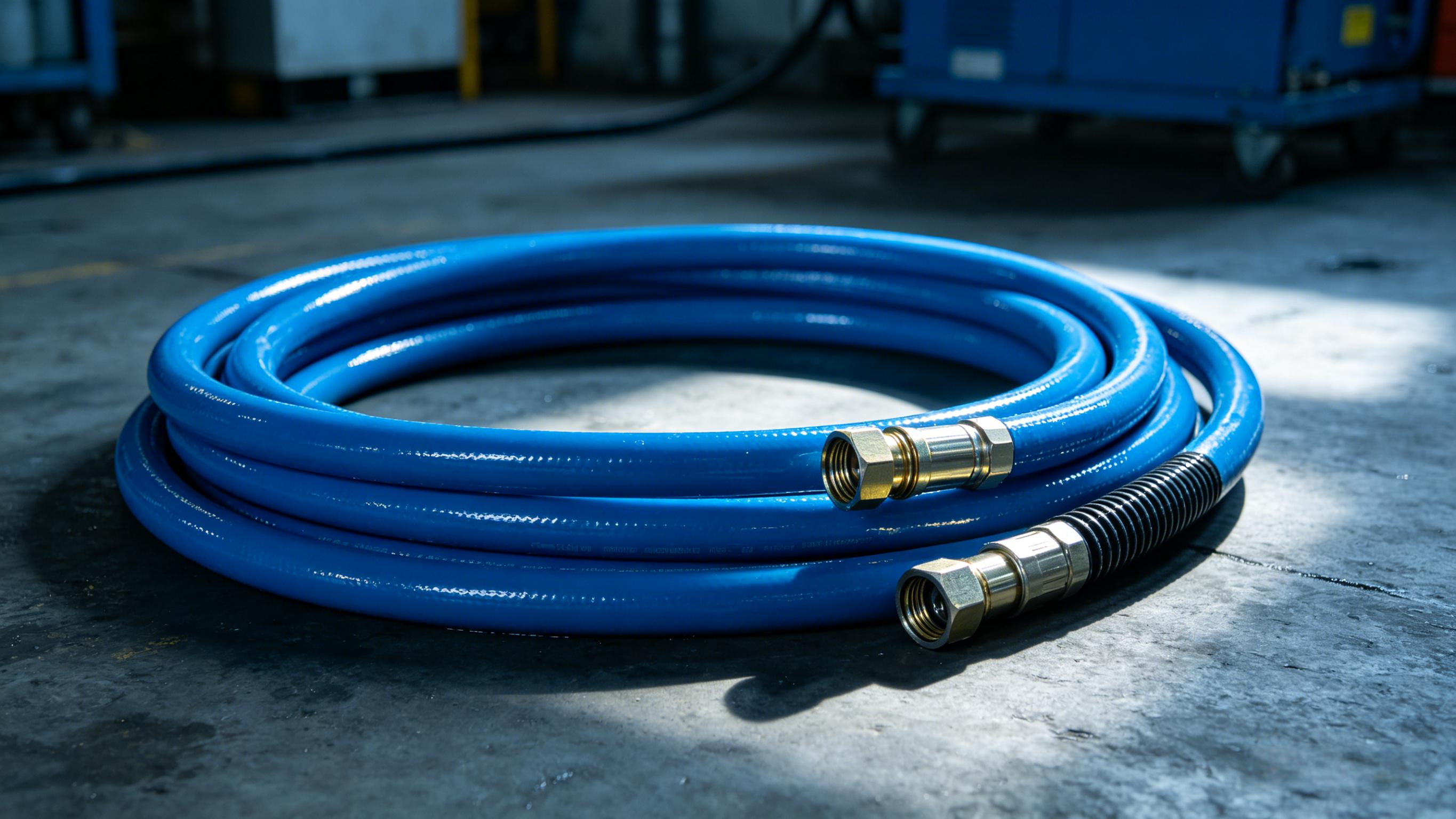
A water jetting rust removal hose consists of three parts: inner tube, reinforcement layer, and outer cover. The material selection for each layer is critical.
Inner tube material comes into direct contact with high-velocity water flow and must have extremely low permeability and excellent chemical stability. The mainstream choices are Polyoxymethylene (POM) and high-density polyethylene, both of which have extremely low permeability under ultra-high pressure and do not react with pure water or additives. Some premium products also use Polyamide (PA), which offers better flexibility and fatigue resistance.
Reinforcement layer is the core structure that enables the hose to withstand ultra-high pressure. Water jetting rust removal hoses typically employ multi-layer high-tensile steel wire spiral construction—common configurations include 4, 6, or even 8 layers. Multi-layer steel wire spiral not only ensures dimensional stability under ultra-high pressure but also effectively resists the repeated impulse fatigue caused by water jet pulsation.
Outer cover material directly faces dragging, friction, and corrosion at the job site. In marine environments such as ship rust removal, the hose cover is constantly exposed to salt-laden mist and seawater splash—ordinary materials will degrade rapidly. Polyurethane (PUR) cover is currently recognized as the best choice—it offers excellent scratch resistance, cut resistance, and drag wear resistance, while also being resistant to seawater and UV. Some premium models feature a dual-layer cover design: an inner layer of special polyester copolymer and an outer layer of abrasion-resistant black polyurethane. When the outer layer wears through to reveal the inner layer color, operators can visually identify the wear level and replace the hose in time.
III. Coupling Selection: A Critical Safety Factor
Couplings are among the weakest links in a hose system. In water jetting rust removal operations, couplings must withstand repeated pressure shocks and seawater corrosion. Key selection points: the coupling pressure rating must exceed the main hose's maximum working pressure; material must be stainless steel (such as 316L) to prevent seawater corrosion; forged ultra-high pressure couplings with threaded lock or crimped connections are recommended. The coupling inner diameter should transition smoothly with the hose inner diameter to avoid flow turbulence that accelerates local wear.
IV. Other Key Selection Parameters
Inner diameter selection: Water jetting rust removal hoses generally have small inner diameters—common sizes are 1/4 inch, 3/8 inch, or 10 mm. A smaller inner diameter helps reduce water hammer effect and recoil force. For large-area flat surface operations, 3/8 inch or 1/2 inch inner diameters can be selected to ensure sufficient flow rate.
Bend radius: Ship structures are complex, and hoses need the smallest possible bend radius for flexible operation in confined spaces. Industry standards require a bend radius of no less than 0.9 meters.
Temperature range: Confirm that the hose's operating temperature range covers the job site environment. Typical ultra-high pressure thermoplastic hoses operate from -10°C to 70°C.
V. Safety Standards and Daily Maintenance
Water jetting rust removal hose selection should reference relevant industry standards. China's national standard GB/T 43142-2023 provides clear specifications for nominal diameter selection and pressure loss calculation; the international standard DIN EN 1829/2 sets globally applicable technical requirements for impulse testing and safety factors.
For daily use, inspect the hose cover for cuts, bulges, and coupling tightness before each operation. After use, rinse the hose exterior with fresh water to remove salt and impurities; store coiled without excessive bending. Never exceed the hose's working pressure or working temperature—this is the fundamental底线 for operational safety.
Conclusion
Selecting the right water jetting rust removal hose ultimately comes down to a comprehensive consideration of five dimensions: pressure rating, inner tube material, reinforcement layer construction, outer cover protection, and coupling quality. Only when all five dimensions are properly matched can you ensure efficient, safe, and durable rust removal operations.
