
In industrial scenarios such as pneumatic systems, automated equipment, shipbuilding, and mining, compressed air is often referred to as the "fourth utility". As the critical component delivering this power, the proper selection of air hoses directly impacts system efficiency and operational safety. With countless specifications available on the market, how do you make the right choice quickly? This article distills the 3 Golden Rules of air hose selection—diameter, wall thickness, and bend radius—into a practical matching formula to help you get it right the first time.
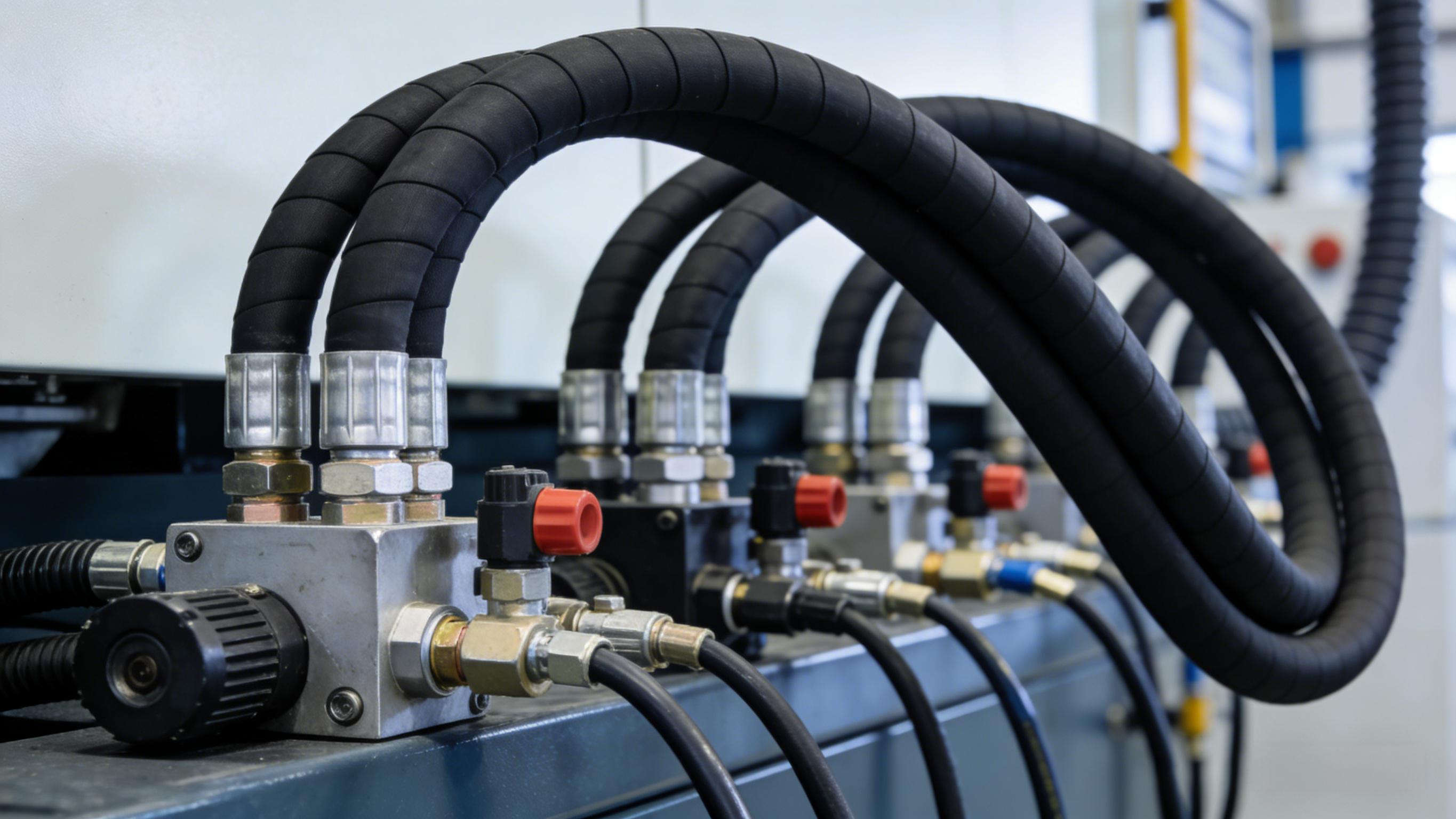
Golden Rule 1: Get the Diameter Right for Optimal Flow
Diameter is the primary parameter in air hose selection, with inner diameter (ID) serving as the core metric. The inner diameter directly determines airflow: the larger the ID, the greater the volume of air delivered per unit time, and the lower the pressure drop. The core formula for diameter selection is: Inner Diameter = Outer Diameter − 2 × Wall Thickness.
In practical terms, small-diameter hoses (e.g., 1/4 inch or 6 mm) are suitable for precision pneumatic instruments and low-consumption light-duty tools, offering excellent maneuverability. Medium-diameter hoses (3/8 inch or 10 mm) are ideal for general pneumatic systems and automation equipment, balancing flow capacity and flexibility. Large-diameter hoses (1/2 inch or 13 mm and above) are recommended for high-consumption tools such as jackhammers, impact wrenches, and grinders, effectively minimizing pressure loss. The hose diameter must be matched to the air consumption (CFM) of your tools—undersizing causes excessive pressure drop and weak tool performance, while oversizing adds cost and reduces maneuverability. Hose length also matters: excessive length increases pressure drop, while insufficient length limits installation flexibility.
Golden Rule 2: Choose the Right Wall Thickness for Reliable Pressure Resistance
Wall thickness is the key parameter determining a hose's pressure rating and durability. Greater wall thickness translates to higher burst pressure and better resistance to abrasion and puncture, but excessive thickness reduces flexibility and increases bending difficulty. The core formula for wall thickness selection is: Outer Diameter = Inner Diameter + 2 × Wall Thickness.
Based on application scenarios, recommended wall thickness ranges are as follows. For low-pressure light-duty applications (working pressure below 1 MPa), wall thickness typically ranges from 1.0 to 2.0 mm, with common specifications like 6×4 and 8×6. For medium-pressure general use (1–2 MPa), wall thickness should be between 2.0 and 4.0 mm, with common specs like 10×6.5 and 12×8. For high-pressure industrial use (above 2 MPa), wall thickness needs to reach 4.0 to 6.0 mm, with common specs like 19×13 and 25×19. The hose's rated working pressure must exceed the equipment's actual operating pressure with a safety margin of at least 1.5 times—for example, if your equipment runs at 10 bar, select a hose rated for at least 15 bar. Compressed air hoses compliant with GB1186 offer multiple pressure grades based on inner diameter and reinforcement layers. Operating temperature is also critical: high-temperature environments require heat-resistant materials like EPDM or silicone, while low-temperature conditions demand cold-resistant compounds.
Golden Rule 3: Select the Proper Bend Radius for Smooth Installation
Bend radius is the most overlooked yet critical parameter in air hose selection. The minimum bend radius is the smallest radius at which a hose can be bent without kinking, creasing, or permanent deformation. A bend radius that is too small causes inner wall collapse, restricted airflow, and in severe cases, reinforcement layer fracture and hose burst. The core formula for bend radius matching is: Minimum Bend Radius ≥ Hose Outer Diameter × Coefficient. For static installation, the published minimum bend radius is acceptable; for occasional bending, use 1.5 times the minimum; for frequent bending or reciprocating motion, use 2 to 3 times the minimum.
Typical examples: a hose with 6.5 mm ID, 10 mm OD, and 1.75 mm wall thickness has a minimum bend radius of about 40 mm; an 8.5 mm ID, 12.5 mm OD, 2.0 mm wall thickness hose has a minimum bend radius of about 55 mm; a 10 mm (3/8") ID, 18 mm OD, 4.0 mm wall thickness hose has a minimum bend radius of about 117 mm; and a 12.5 mm (1/2") ID, 22 mm OD, 4.8 mm wall thickness hose has a minimum bend radius of about 143 mm. In confined spaces or on equipment with frequent movement, prioritize hoses with smaller bend radii—polyurethane (PU) hoses generally offer superior flexibility compared to rubber hoses, and textile-reinforced construction provides excellent flexibility while maintaining pressure capacity. Never use a hose below its minimum bend radius to avoid localized stress concentration.
Integrating the Three Golden Rules
Combining the three rules, the complete selection logic is: correct diameter matching flow requirements, sufficient wall thickness meeting pressure requirements, and appropriate bend radius adapting to installation space—all three together yield the optimal solution. In practice, first confirm your equipment's operating pressure and air consumption to determine wall thickness grade and inner diameter; then, based on installation space bending requirements and movement frequency, select a model meeting the bend radius criteria; finally, verify material compatibility considering operating temperature and environmental conditions (indoor/outdoor, UV resistance, anti-static, etc.). Air hose selection is not about compromising on a single parameter—it's about systematically matching diameter, wall thickness, and bend radius. Master these three golden rules to select the best solution balancing performance, cost, and service life.
