
In concrete pump trucks, trailer pumps, and truck-mounted pumps, the delivery hose is the core channel for conveying concrete from the pump body to the placement point. Due to concrete's high density, high abrasiveness, and tendency to settle, proper delivery hose selection directly affects pumping efficiency, equipment life, and construction safety. The two most common delivery hose types on the market are ordinary rubber delivery hoses and high-pressure steel cord (steel wire cord) reinforced hoses. They differ fundamentally in working pressure rating, wear resistance, and applicable scenarios. This article provides a complete selection guide from three dimensions: working pressure, structural characteristics, and application scenarios.
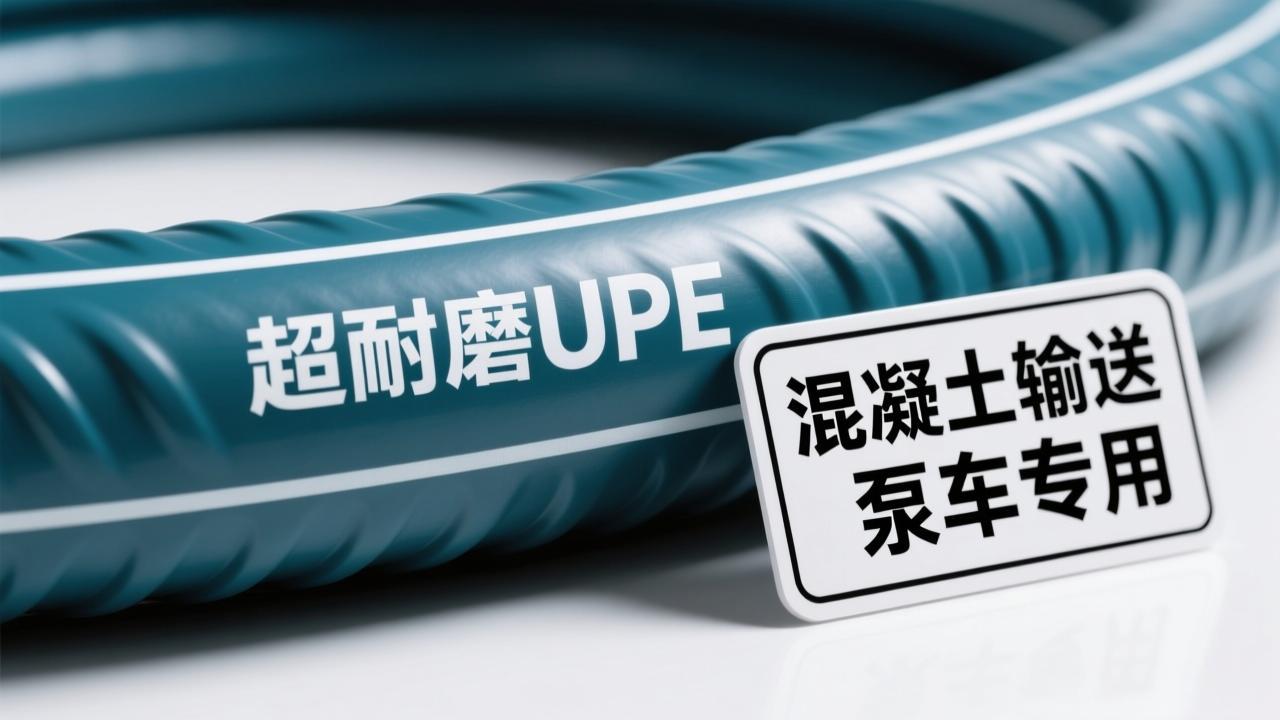
I. Ordinary Rubber Delivery Hoses: Simple Structure, Suitable for Low-Pressure Applications
Ordinary rubber delivery hoses adopt a traditional three-layer construction: inner tube, textile fabric reinforcement layer, and outer cover. Some products use single or multi-layer textile braid or spiral as reinforcement. Working pressure typically ranges from 3MPa to 6MPa (approximately 30-60 bar) . Burst pressure is approximately 3 times the working pressure.
Primary Application Scenarios: Ordinary rubber delivery hoses are suitable for small concrete pump trucks, trailer pump end hoses, placing boom end connections, on-site placement hoses, wash-down water lines, and low-pressure delivery applications.
Limitations: Relatively low working pressure—unable to withstand the impulse pressures of high-pressure pumping systems; limited abrasion resistance—not suitable for long-distance transport of high-aggregate concrete; under high-pressure conditions, may experience excessive expansion or even bursting.
II. High-Pressure Steel Cord Delivery Hoses: Specifically Designed for High-Pressure Pumping
High-pressure steel cord delivery hoses (also known as steel wire cord reinforced delivery hoses) use high-strength steel wire cord as the reinforcement layer, consisting of an inner tube, steel cord layer, and outer cover. The steel cord is made of high-strength copper-plated steel wire, with winding angles precisely calculated to withstand extremely high internal pressure. Working pressure typically ranges from 8MPa to 15MPa (approximately 80-150 bar) , with some heavy-duty specifications reaching 18MPa and above. Burst pressure is generally not less than 3 times the working pressure.
Core Structural Difference: The steel cord reinforced structure produces almost no circumferential deformation under high pressure, with extremely low volumetric expansion—ensuring stable concrete delivery under high pressure. Ordinary textile-reinforced hoses show noticeable expansion under equivalent pressure, affecting pumping efficiency.
III. Root Causes of Working Pressure Differences
The working pressure difference between ordinary hoses and high-pressure steel cord hoses stems fundamentally from differences in reinforcement layer materials and construction.
Ordinary hoses use organic fibers (such as polyester, nylon, aramid) for braiding or spiral winding. Fibers have relatively low elastic modulus and undergo tensile deformation under high pressure, causing hose body expansion. When pressure exceeds the fiber's load-bearing limit, the reinforcement layer progressively fails.
High-pressure steel cord hoses use high-strength copper-plated steel wire cord for the reinforcement layer. Steel's elastic modulus is tens of times that of fibers, resulting in virtually no deformation under high pressure. Multiple steel cord layers share loads cooperatively, distributing internal pressure evenly across the pipe wall. Because steel wire is nearly inextensible, steel cord hoses have far lower volumetric expansion than textile hoses, ensuring dimensional stability and delivery efficiency under high pressure.
IV. Four Key Selection Points
Pumping Pressure Confirmation: Concrete pump outlet pressures are typically classified into low, medium, and high levels. For low-pressure pumping (≤6MPa), ordinary rubber delivery hoses are acceptable; for medium-high pressure pumping (6-15MPa), high-pressure steel cord hoses are required; for ultra-high pressure pumping (>15MPa), multi-layer steel cord specialty hoses should be selected.
Aggregate Characteristics: When conveying large particle size, sharp-edged crushed stone aggregates, prioritize steel cord hoses with excellent inner tube abrasion resistance; when conveying fine sand or mortar, ordinary hoses are adequate.
Delivery Distance and Vertical Height: For horizontal distances exceeding 200 meters or vertical heights exceeding 50 meters, high-pressure steel cord hoses are recommended to minimize pressure loss risks. For high-rise pumping, the discharge end hose should be of the abrasion-resistant steel cord type.
Frequency of Use and Maintenance Costs: Steel cord hoses have higher initial purchase costs but typically offer 2-3 times the service life of ordinary hoses. In high-frequency operations, the overall cost of steel cord hoses is actually lower.
V. Conclusion
Selection of concrete pump truck delivery hoses essentially involves a comprehensive trade-off among working pressure, delivery distance, aggregate characteristics, and frequency of use.
Ordinary rubber delivery hoses offer high cost-effectiveness, light weight, and operational flexibility, suitable for low-pressure (≤6MPa), short-distance (<100 meters), fine-aggregate concrete delivery, and auxiliary line applications. High-pressure steel cord delivery hoses offer high pressure capacity, excellent abrasion resistance, and good dimensional stability, suitable for medium-high pressure (6-15MPa), long-distance (>200 meters), high-drop (>50 meters), coarse-aggregate concrete delivery, and high-frequency operation applications.
Remember during selection: Pressure is the first threshold, abrasion resistance ensures service life, and construction determines applicable boundaries. Only through precise matching based on actual operating conditions can safe, efficient, and cost-effective pumping operations be guaranteed.
