
In hydraulic system design and selection, the SAE 100R series is one of the most widely adopted technical specifications. Developed by the Society of Automotive Engineers (SAE), this standard categorises hydraulic hoses into multiple types based on construction and performance. Among them, R1, R2, R13 and R15 are the four most representative types, covering the complete pressure spectrum from low to extreme high pressure. This article provides a systematic review of the structural design and pressure ratings of these four types, offering clear selection guidance for engineers and technicians.
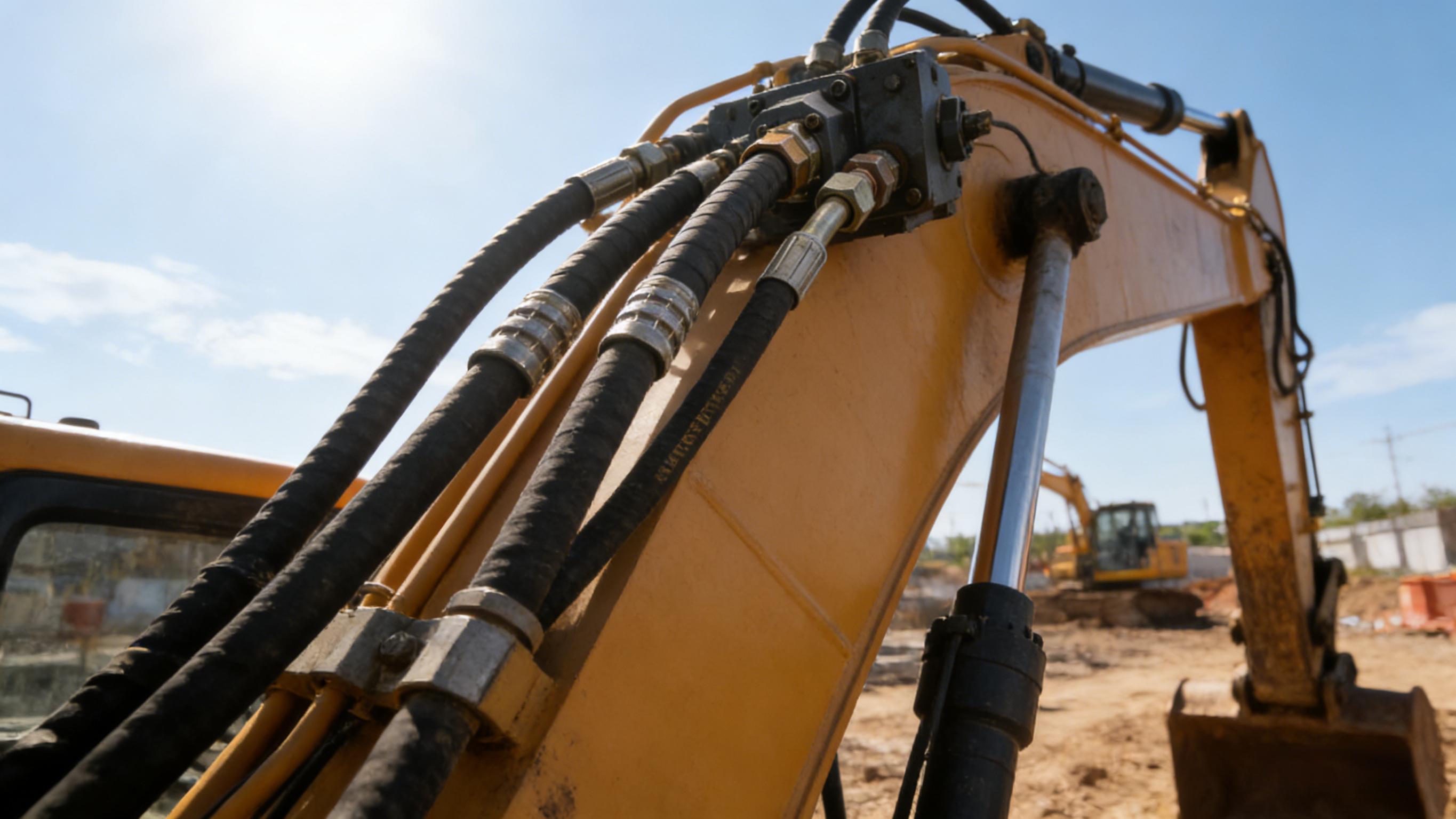
The classification logic of the SAE 100R series is straightforward – the reinforcement structure determines the type, and the type determines the pressure rating. Two main reinforcement technologies are used: wire braid and wire spiral. Braided constructions form the reinforcement layer through interwoven wires, offering good flexibility; spiral constructions use multiple layers of helically wound wires, providing superior strength and pulse resistance. R1 and R2 belong to the braided category, while R13 and R15 are spiral types. These four types form a clear gradient in structural complexity, pressure capability, and application suitability.
100R1 is the most basic model in the SAE 100R series, featuring a single layer of high‑tensile steel wire braid as the reinforcement. The inner tube is oil‑resistant synthetic rubber, and the cover is abrasion‑ and weather‑resistant synthetic rubber. This type is suitable for petroleum‑based hydraulic fluids and other media, with an operating temperature range of -40°C to +121°C.
Pressure rating – The working pressure of R1 decreases as the hose inner diameter increases. For example, in the Parker 560TJ series, the maximum working pressure ranges from 121 to 250 bar (12.1 to 25.0 MPa). Specific values include: 3/16″ ID approx. 25 MPa (3626 psi), 1/4″ ID approx. 22.5 MPa (3263 psi), 3/8″ ID approx. 18 MPa (2611 psi), and 1/2″ ID approx. 16 MPa (2321 psi). Burst pressure is typically 4 times the working pressure.
Applications – R1 is suitable for low‑pressure return lines, drain lines, and general industrial hydraulic systems. Its simple construction and low cost make it the most versatile hydraulic hose type.
100R2 employs two layers of high‑tensile steel wire braid as reinforcement. R2 is the most common type in industrial hydraulic systems, representing an upgraded version of R1 in terms of performance.
Pressure rating – R2 offers significantly higher working pressures than R1. The working pressure range for SAE 100R2 is 16 to 42 MPa. Specific values: 3/16″ ID approx. 41.5 MPa (6019 psi), 1/4″ ID approx. 40 MPa (5802 psi), 3/8″ ID approx. 33 MPa (4786 psi), and 1/2″ ID approx. 27.5 MPa (3989 psi). R2 also follows the 4:1 design safety factor.
Applications – R2 is widely used in medium‑to‑high pressure hydraulic systems such as construction machinery, agricultural equipment, and industrial hydraulic circuits. Its double braid construction strikes a good balance between strength and flexibility, making it one of the most broadly applicable types.
100R13 features a multi‑layer high‑tensile steel wire spiral reinforcement – four layers for sizes 3/4″ to 1‑1/4″, and six layers for 1‑1/2″ and 2″. Unlike braided constructions, spiral layers are wound helically, offering superior pulse resistance and fatigue performance. R13 is designed for severe high‑temperature and high‑pressure conditions using petroleum‑based fluids, with an operating temperature range of -40°C to +121°C.
Pressure rating – R13 follows a constant pressure design – the working pressure remains the same across all hose sizes. The maximum working pressure of R13 is 35 MPa (approx. 5076 psi) , and the minimum burst pressure is 140 MPa. Minimum bend radius increases with size, e.g., 240 mm for 3/4″ and 420 mm for 1‑1/4″.
Applications – R13 is used in heavy machinery such as mine roof supports, oilfield equipment, construction, lifting, metallurgical forging, mining machinery, and marine systems. Its multi‑spiral construction makes it capable of ultra‑high pressure and high‑pulse heavy‑duty conditions.
100R15 has the highest pressure rating in the SAE 100R series, representing the pinnacle of current hydraulic hose technology. Its reinforcement consists of multiple alternating layers of ultra‑high‑tensile steel wire spiral, specifically four or six layers of high‑tensile spiral. R15 is intended for severe high‑pulse, extreme high‑pressure applications, with the same operating temperature range of -40°C to +121°C.
Pressure rating – R15 also uses a constant pressure design – all sizes have the same working pressure. The maximum working pressure is 42 MPa (approx. 6092 psi) , and the minimum burst pressure is 168 MPa. For all sizes from 3/8″ to 1‑1/2″, the working pressure is 42 MPa (6090 psi) .
Applications – R15 is suited for the most demanding pressure scenarios, such as large mining equipment, ultra‑high pressure hydraulic systems, and extreme heavy‑duty applications. Its superior strength and pulse performance make it the “ceiling” of pressure capacity in the industry.
Structural differences – R1 has a single wire braid (simplest); R2 has a double wire braid (higher strength); R13 has multi‑layer spiral (four to six layers); R15 has four to six layers of ultra‑high‑tensile spiral. Braided types (R1, R2) offer better flexibility for frequent bending; spiral types (R13, R15) offer superior pulse resistance for high‑pressure heavy loads.
Pressure ratings – R1: approx. 12‑25 MPa (low‑pressure circuits); R2: approx. 16‑42 MPa (medium‑high pressure); R13: constant 35 MPa (ultra‑high heavy duty); R15: constant 42 MPa (industry maximum). Together they form a complete product matrix from low to extreme high pressure.
Standard equivalents – R1/R2 correspond to DIN EN 853 1SN/2SN and GB/T 3683; R13 corresponds to DIN EN 856 4SH and GB/T 10544; R15 has no direct DIN equivalent at present.
When selecting, follow these principles: Determine the type based on the system‘s maximum working pressure – below 25 MPa use R1; 25‑40 MPa use R2; around 35 MPa with high pulse requirement use R13; above 40 MPa use R15. Choose reinforcement type according to operating conditions – braided types for frequent bending; spiral types for high‑pressure heavy‑duty with frequent pulses. Check standard equivalents – verify both type and inner diameter, as pressure ratings vary with size even within the same type.
SAE 100R1, R2, R13 and R15, with reinforcement structure as the core variable, build a complete pressure spectrum ranging from single braid to multi‑spiral, and from 12 MPa to 42 MPa. Understanding the structural differences and pressure ratings of these four types is the foundation for rational hydraulic hose selection and a prerequisite for safe and efficient equipment operation. In practice, accurate selection decisions should be based on system working pressure, operating conditions, and standard compliance requirements.
