
The hydraulic system of an excavator functions like the human circulatory system—the hydraulic pump is the “heart,” hydraulic oil is the “blood,” and hose assemblies are the “blood vessels” connecting every organ. Different circuits have vastly different pressure levels, flow requirements, and operating conditions. Incorrect selection can lead to efficiency loss, overheating, hose burst, downtime, or even safety accidents. This article provides a systematic analysis of the three core circuits in an excavator hydraulic system—the pilot circuit, the boom circuit, and the breaker circuit—covering their operating characteristics and hose assembly selection solutions.
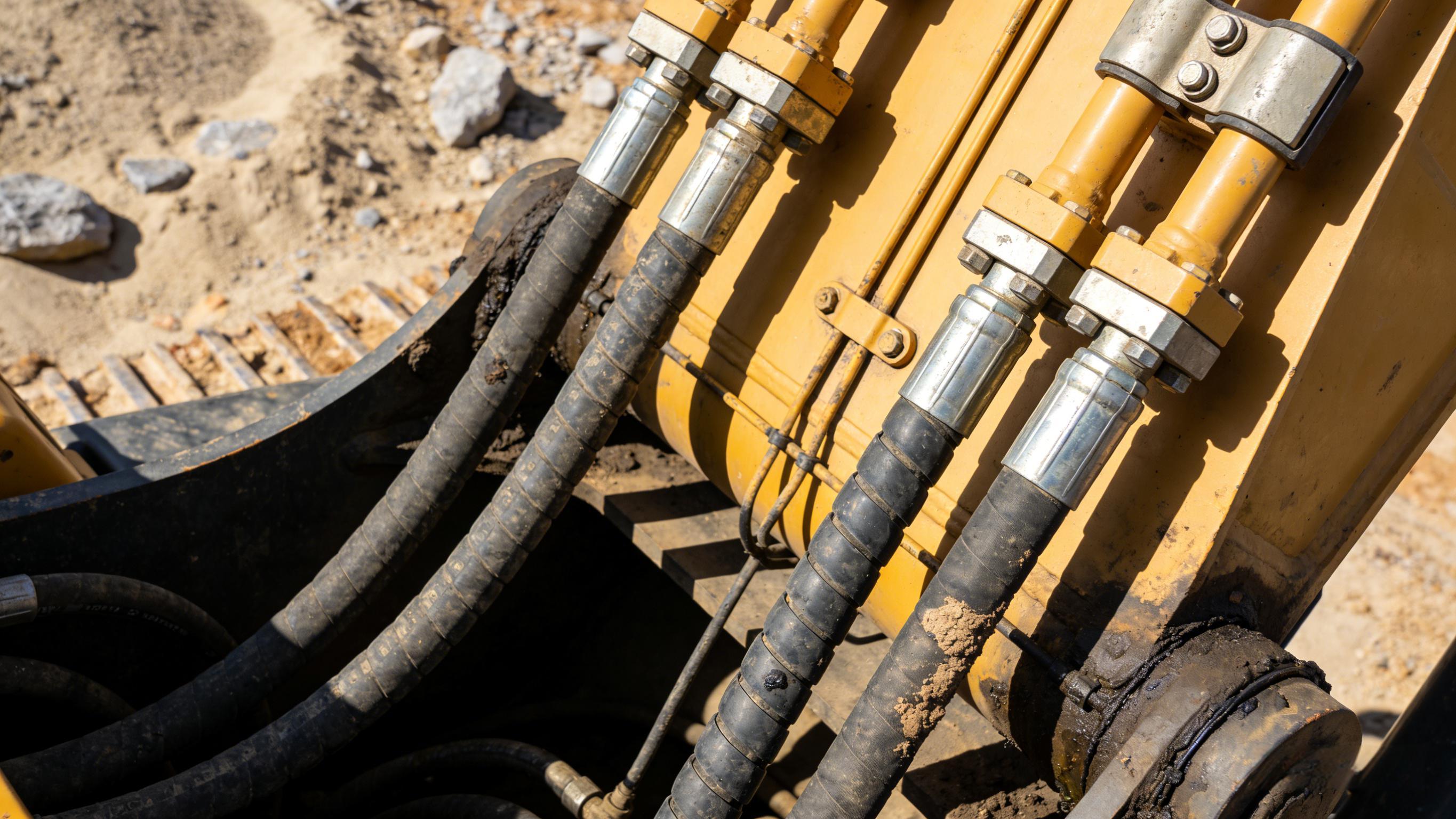
The pilot circuit is the “nervous system” of the excavator hydraulic system—every subtle movement of the control handle is transmitted through the pilot oil circuit to the main valve, enabling precise control of the boom, arm, bucket, and swing.
Operating Characteristics: Pilot control system pressure is relatively low, typically 3-5MPa, with some models having a pilot valve rated pressure of approximately 2.5MPa. The piping layout is extremely dense, with limited space around the valve block, placing high demands on hose flexibility and bend radius. Flow rates are small, but response speed requirements are stringent—improper hose selection can lead to insufficient pressure at the pilot port and delayed valve spool switching.
Selection Solution: The pilot circuit is best served by SAE 100R1 (single wire braid) or small-bore EN856 4SP hoses. The single-braid construction offers excellent flexibility and small bend radius, perfectly suited for tight wiring spaces around the valve block. In terms of size, 1/4 inch (6.2-7.0mm ID) is the mainstream choice, with a working pressure of 45MPa (far exceeding actual pilot circuit requirements) and a minimum bend radius of only 150mm. For weight-sensitive applications, SAE 100R7 thermoplastic resin hose is also an option. Note that although the pilot circuit operates at low pressure, the dense piping and frequent disassembly require hoses with excellent pulse resistance to avoid control failure due to premature aging.
The boom system is the core of the excavator's power and working height. Every lift, lower, and swing generates severe pressure shocks and continuous mechanical vibration in the hoses.
Operating Characteristics: The main circuit pressure of an excavator hydraulic system is typically 28-35MPa, with peak pressures on some ultra-large models reaching 35-42MPa. The boom circuit not only withstands the system's highest working pressure but also faces extreme pressure fluctuations—pressure surges during heavy digging, and potential pressure vacuum or shocks during unloading or lowering. Additionally, boom movements are often accompanied by slewing, subjecting the hoses to continuous bending, torsion, and length changes on top of internal pressure.
Selection Solution: The boom main circuit should use double wire braid hoses (SAE 100R2 / EN853 2SN) with a working pressure rating of no less than 35MPa. For excavators above 20 tons, with system working pressure around 35MPa, 2SN hoses can fully withstand the pulse shocks from frequent start-stop cycles. The DN19 (3/4 inch) size offers a working pressure of 21.5MPa and a burst pressure of 85MPa.
A higher-standard solution is to adopt ISO 18752-BC grade hoses (two-layer high-strength ultra-flexible wire braid), which require a pulse life of no less than 500,000 cycles at 133% working pressure—far superior to SAE 100R series (200,000 cycles) and EN853 series (150,000 cycles). The working pressure is a uniform 35MPa, with burst pressure at 4 times the working pressure (140MPa). For ultra-large excavators (40 tons and above), the boom and arm ultra-high-pressure circuits should use SAE 100R15 six-layer wire spiral hoses with a working pressure of 42MPa to handle extreme conditions. Inner diameter selection should be based on flow rate calculations—typically 3/4 inch to 1 inch sizes cover mainstream models.
The breaker represents the harshest operating condition for an excavator—thousands of impacts per minute, with pressure peaks reaching more than twice the normal working pressure.
Operating Characteristics: Breaker operations generate severe high-frequency pressure shocks and continuous vibration, placing extreme demands on hose pulse resistance and burst strength. Taking a 40-ton excavator matched with a 200-type breaker as an example, the system flow needs to be stable at 200-250L/min with a working pressure of 160-180 bar (16-18MPa) . However, the instantaneous impact peaks during breaking far exceed the average working pressure, requiring a significantly higher pressure rating in actual selection.
Selection Solution: The breaker circuit must use multi-layer wire spiral hoses—single or double braid hoses are insufficient. Mainstream solutions include:
EN856 4SP (four-layer wire spiral): Mainstream breaker sizes DN10-DN19 with working pressure of 35-44.5MPa, far exceeding the actual 20-30MPa working condition with ample safety margin. The 3/8 inch size offers 44.5MPa working pressure and a minimum bend radius of 178mm, fully covering the instantaneous impact peaks of breaking operations. The full series achieves pulse life of over 800,000 cycles.
EN856 4SH (four-layer wire spiral ultra-high pressure version): Positioned above 4SP, with working pressure of 40-60MPa. The 5/8 inch (16mm) size offers 45MPa working pressure, while the 2 inch size offers 25MPa. Specifically designed for high-impact, high-flow, long-cycle operations.
SAE 100R13 / R15: For extreme conditions such as mining equipment breakers, R13/R15 grade multi-layer spiral hoses are recommended. R13 offers 35MPa working pressure, and R15 offers 42MPa—the highest pressure capacity in the industry.
Breaker return lines should not be overlooked. Improper return line design can directly affect hydraulic system cleanliness and oil temperature. Return lines operate at lower pressure and can use larger-diameter spiral hoses to reduce return resistance and improve heat dissipation efficiency.
Pressure Selection Principle: The hose rated working pressure should be no less than 1.5 times the system's maximum working pressure, with greater margins for frequent pulse peaks. The system safety factor should be no less than 4:1.
Inner Diameter Selection Principle: Undersized inner diameter increases flow velocity, causes system overheating, and creates excessive pressure drop. Use the formula d≥4.6√(Q/v) for quick estimation (Q in L/min, v in m/s), with excavators typically using 3.5m/s flow velocity.
Maintenance Recommendations: Perform a walk-around inspection after each shift—replace immediately if bulging, oil seepage, or localized heating is found. Connections at the boom and arm joints require frequent bending—choose ultra-flexible series with bend radius ≤5 times the hose diameter, and install wear-resistant sleeves or spring guards to prevent external abrasion. Crimped one-piece fittings are recommended over reusable types for higher pressure resistance and lower leakage. In salt spray or humid environments, choose 316 stainless steel fittings.
The pilot circuit, boom circuit, and breaker circuit of an excavator span pressure levels from 3MPa to 45MPa—three orders of magnitude—with operating conditions ranging from precision control to extreme impact. Pilot circuits need flexibility, boom circuits need strength, and breaker circuits need spiral construction—only by precisely matching hose assemblies to the unique conditions of each circuit can this steel giant's “blood vessels” remain unobstructed and operate at peak efficiency.
