
In ultra-high pressure hydraulic systems, a high-performance thermoplastic hose is never selected by a single parameter alone. Instead, pressure rating, inner diameter, steel wire spiral layer count, and coupling type must be integrated as a complete system. Any mismatch among these factors can lead to premature hose failure, system leakage, or even severe safety incidents. This article systematically outlines the matching logic for these four core elements, helping specifiers make scientifically sound decisions.
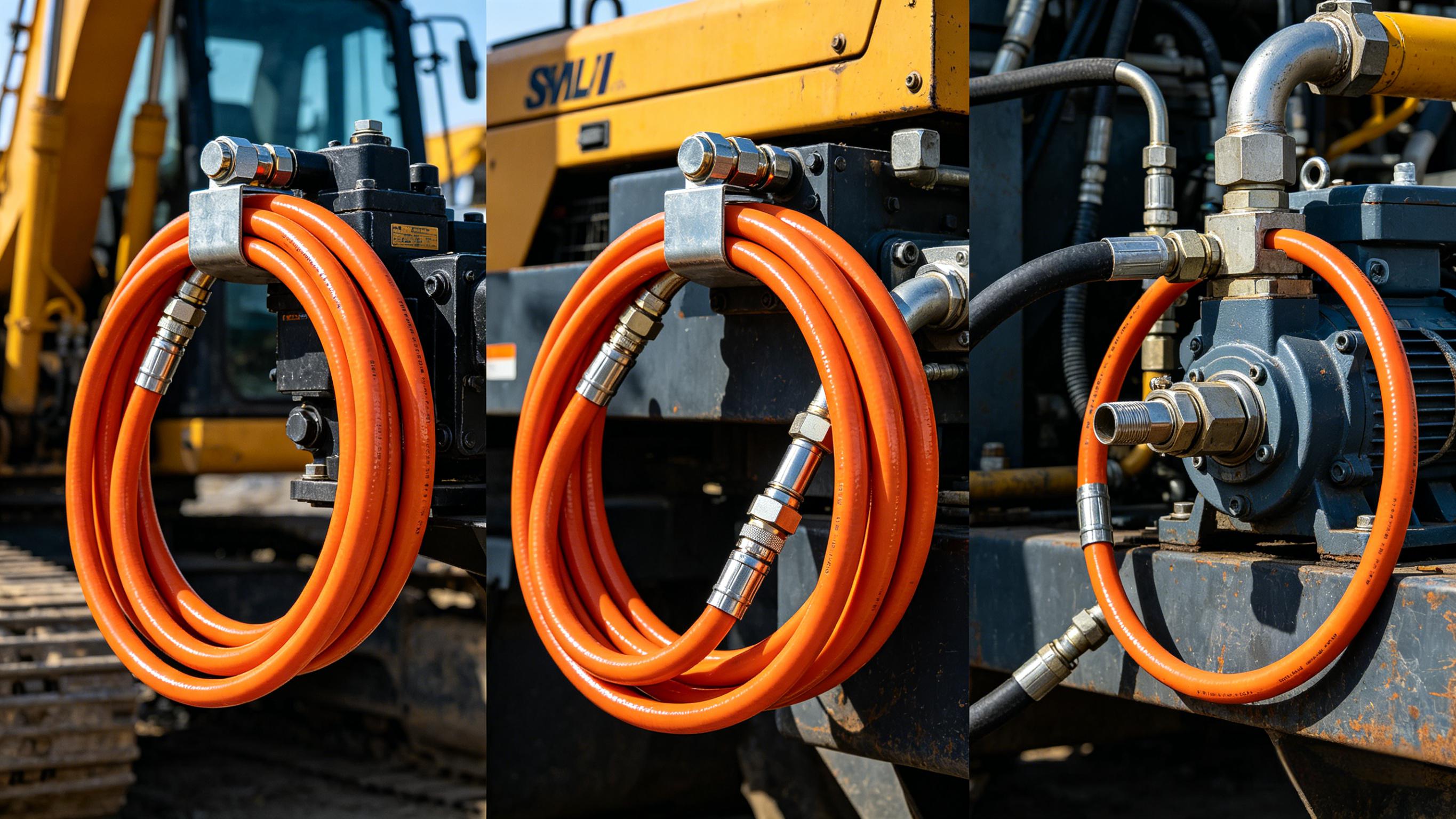
The pressure rating of a hose is typically expressed as Working Pressure and Burst Pressure. The former is the safe upper limit for continuous operation, while the latter is the ultimate destructive pressure the hose can withstand. The safety factor (burst pressure/working pressure) is usually 4:1 or 2.5:1, depending on the standard. During selection, the rated working pressure should be at least 1.25 to 1.5 times the system's maximum working pressure to accommodate start-up surges, pressure spikes, and pulse fatigue. Additionally, distinguish between dynamic pressure and static pressure—frequent impulse applications require spiral constructions with superior pulse performance and increased safety margins.
Inner diameter selection directly affects flow rate and pressure loss. For a given flow, an undersized ID causes excessive velocity, leading to severe pressure drops and frictional heat, accelerating inner tube aging. An oversized ID increases cost, reduces system response, and occupies more space. The correct approach: calculate the economical flow velocity (typically ≤6 m/s) based on required flow, then select the nearest standard ID using manufacturer-provided flow-pressure drop curves (empirical formulas can also be used). Notably, for the same layer count, a larger ID typically results in a slightly lower rated working pressure, so always verify that the pressure rating at that specific ID meets your requirement.
The number of steel wire spiral layers (2, 4, 6, 8) is the core structural factor determining pressure capability. More layers mean higher pressure resistance but also larger bend radius, reduced flexibility, increased weight, and higher cost. The selection principle is: given that pressure requirements are met, prioritize the fewest layers that offer the best flexibility to facilitate routing and minimize stress at couplings. For example, if working pressure is below 100MPa, two or four layers suffice; if above 200MPa, six or eight layers are needed. Also, layer selection must coordinate with ID—large ID combined with high layer count often results in an excessively large bend radius; if installation space is limited, reduce ID or choose a higher-pressure material.
Common coupling types include threaded fittings (NPT, BSP, JIC, metric), flanged fittings, quick-connect couplings, and specialized high-pressure connectors. Matching principles:
Pressure match: The coupling's rated working pressure must not be lower than the hose's rating; otherwise, the coupling will fail first.
Interface match: Thread or flange size must match the equipment port, and the sealing type (e.g., O-ring, metal cone seal) must be compatible with the media and temperature.
Connection method match: Hose ends require crimped or reusable fittings. Crimping parameters (indentation, compression) must match the hose outer diameter and layer count—over-crimping damages reinforcement, under-crimping causes pull-out.
Follow this logical sequence: ① Confirm system peak working pressure and pulse characteristics → ② Calculate required ID based on flow → ③ From the specification table for that ID, select the minimum layer count that satisfies the pressure → ④ Verify that the resulting bend radius fits the installation space → ⑤ Choose a coupling type that matches the equipment port and has adequate pressure rating → ⑥ Validate all. If any conflict arises, iterate by adjusting parameters until optimal balance is achieved.
Selecting an ultra-high pressure thermoplastic hose is never a simple parameter lookup; it is a systems engineering task. Only by treating pressure rating, ID, layer count, and couplings as an organic whole, dynamically weighing safety, performance, space, and cost, can you select the most reliable and economical solution. Always consult professional manufacturers with actual operating data for customized recommendations.
