
In compressed air transmission systems, the reinforcement layer is the core structure that determines hose performance. The two mainstream reinforcement methods on the market today—wire braid and fiber spiral—may look similar in appearance, but differ significantly in structural principles, pressure capacity, flexibility, and application scenarios. Incorrect selection can lead to premature hose failure at best, or serious safety incidents at worst. This article provides a systematic comparison of these two reinforcement methods from multiple dimensions, offering clear guidance for selection.
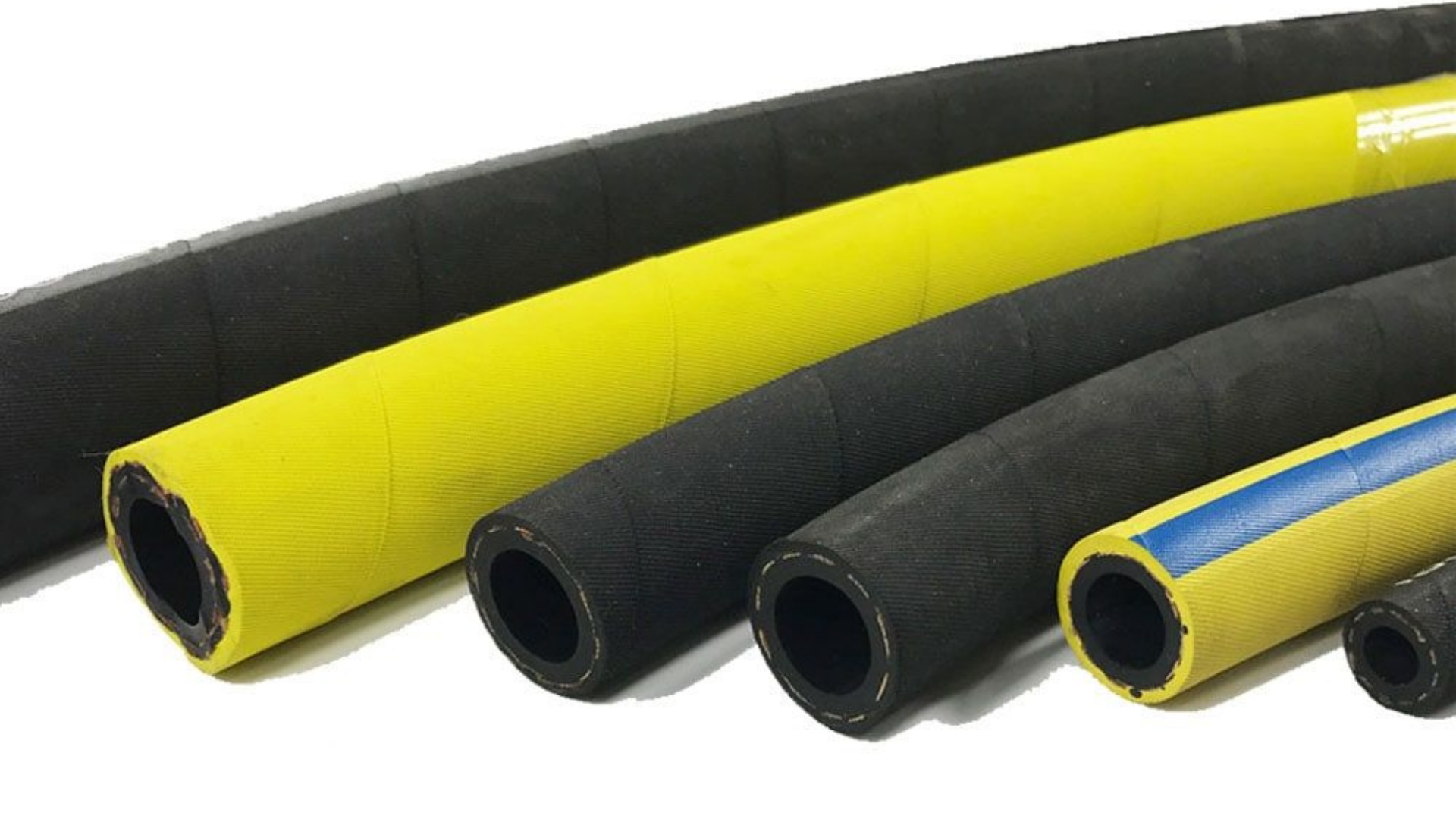
Wire braid reinforcement uses braiding machines to wrap high-strength steel wires in a crisscross mesh pattern around the inner tube surface. The braiding angle is typically 54°44′, with wires interwoven in a cross pattern and fixed with adhesive between layers. Visually, it resembles a medieval "chainmail"—numerous steel wires interwoven together, capable of resisting pressure while maintaining relative flexibility. Common configurations include single-layer (such as SAE 100R1) and double-layer (SAE 100R2). In the air hose sector, products like the LT801 series, featuring a single layer of ultra-flexible high-strength steel wire braid, are widely used.
Fiber spiral reinforcement, in contrast, uses high-tensile synthetic fibers (such as polyester or aramid) wound helically and tightly around the inner tube. Unlike braiding, the fibers are arranged in parallel with tight interlayer contact, typically supplemented with high-flexibility spiral steel wire for additional reinforcement. The winding angle is precisely controlled, resulting in a more regular structure. Representative products such as LT803 and LT805 fiber spiral compressed air hoses all employ a combined reinforcement structure of "high-tensile synthetic fiber spiral + high-flexibility spiral steel wire".
Wire braid air hoses have pressure capacity primarily determined by the number of braid layers and wire specifications. Single-layer braid air hoses typically operate at working pressures between 1.0 and 3.0MPa; double-layer braid can achieve higher levels. Taking a typical wire braid air hose as an example, the 1/2-inch size offers a working pressure of up to 160bar (approximately 2,300psi), with a burst pressure four times the working pressure. Some special-specification wire braid air hoses can reach working pressures of 5MPa to 10MPa. Overall, the braided structure has a relatively lower pressure ceiling due to stress concentration at wire crossover points.
Fiber spiral air hoses have pressure capacity that varies depending on reinforcement material and the number of spiral layers. Conventional fiber spiral compressed air hoses typically operate at working pressures between 10bar (150psi) and 40bar (600psi). Although the absolute values are not high, the advantage of the fiber spiral structure lies in uniform pressure distribution—the spirally arranged fibers have no cross-friction points, and burst pressure is generally no less than three times the working pressure.
It should be noted that if "fiber spiral" is confused with "steel wire spiral" (multi-layer steel wire helical winding), the pressure capacity is vastly different—steel wire spiral structures can withstand ultra-high pressures of 31.5 to 63MPa. However, this article focuses on fiber spiral air hoses, which are positioned for medium-to-low pressure, high-flexibility applications.
Wire braid air hoses have a clear advantage in flexibility. The interwoven steel wires can slide relative to each other during bending, enabling a smaller minimum bend radius. This characteristic makes them ideal for routing in compact spaces, facilitating design and installation. Braided air hoses are typically lightweight and flexible, suitable for applications requiring frequent movement and bending.
Fiber spiral air hoses offer even superior flexibility. Synthetic fibers are inherently highly compliant, and the spiral structure allows the hose to bend with minimal deformation and excellent recovery. Fiber spiral air hoses are lighter in weight, easy to handle, and cost-effective. Some products can bend freely within specified radii, improving construction safety. Compared to wire braid hoses, fiber spiral hoses generally offer smaller bend radii and lighter tube weight at the same pressure rating.
Wire braid air hoses are suitable for applications requiring moderate pressure capacity with high flexibility requirements, including: general industrial compressed air transmission, pneumatic tool air supply, auxiliary circuits in construction machinery, and medium-to-low pressure pneumatic systems in construction and mining industries. Their advantages lie in the good balance between strength and flexibility, along with relatively economical cost.
Fiber spiral air hoses are better suited for low-pressure, high-flexibility, lightweight scenarios, including: compressed air transmission in construction and mining industries, pneumatic tool air supply, civil engineering and shipbuilding, and compressed air systems requiring high-temperature resistance (some products can withstand up to 150°C). Their advantages are excellent flexibility, light weight, and economy.
Core selection principles: When system pressure exceeds 10MPa and strong impulse resistance is required, wire braid air hoses should be prioritized; when system pressure is low (typically below 2MPa) and flexibility and light weight are paramount, fiber spiral air hoses are the better choice. Installation space should also be considered—for tight spaces requiring small bend radii, both options are viable, but fiber spiral hoses generally have an edge.
Wire braid air hoses and fiber spiral air hoses each have their own strengths—there is no absolute "better" or "worse," only "more suitable" or "less suitable." Wire braid offers an excellent balance of strength and flexibility at medium pressures; fiber spiral wins with ultimate flexibility and light weight in low-pressure scenarios. The core of selection lies in matching the working conditions—precisely identifying system pressure, installation space, and operating environment to choose the optimal solution.
