
In oil and gas drilling operations, well control safety has always been the foremost concern for every drilling rig. The Blowout Preventer (BOP), as the last line of defense against blowouts, has its control system reliability directly determining the success or failure of the entire drilling operation. The API 16D BOP well control hose—the "lifeline" that delivers hydraulic oil under high pressure to remotely control the opening and closing of the BOP—has long evolved from an optional accessory to a standard safety equipment in BOP systems across all types of drilling platforms. From onshore rigs to deepwater semi-submersibles, from jack-up platforms to drillships, API 16D fire-resistant hoses are ubiquitous.
I. API 16D: From Industry Standard to Global Consensus
API Spec. 16D, officially titled "Specification for Control Systems for Drilling Well Control Equipment and Control Systems for Diverter Equipment," was published by the American Petroleum Institute (API), with the Third Edition released in 2018 and Addendum 1 in 2023. This specification establishes design standards for systems used to control BOPs and associated valves.
Core requirements of the API 16D standard include: Working Pressure of 5000psi (approx. 35MPa), Proof Pressure of 7500psi (approx. 52MPa), and Minimum Burst Pressure of 15000psi (approx. 103MPa). The most critical metric is fire resistance—the hose must withstand a flame temperature of 1300°F (approx. 704°C) for 5 minutes at working pressure without leakage. Some premium products can even operate continuously for over 30 minutes in 750°C flames.
It is precisely the universal applicability of this stringent standard that makes the API 16D BOP well control hose a globally recognized safety baseline—whether the drilling rig is located in the heart of a desert or in the depths of the ocean, this standard is an unbreachable red line.
II. Onshore Drilling Rigs: The Starting Point of Standard Status
Onshore drilling is the most traditional and widespread form of drilling operations. On land rigs, BOP well control hoses connect the hydraulic power unit to the BOP stack, providing hydraulic power to seal the wellhead in case of kicks or emergencies.
Core requirements for BOP hoses in onshore drilling include: resistance to fatigue damage from continuous rig vibration; maintaining moderate flexibility in tight spaces under the rig floor and around wellhead manifolds; and stable performance under sun, rain, and extreme temperature differentials. The standard configuration consists of an "NBR inner tube + 4-layer high-strength super-flexible steel wire spiral reinforcement + high-temperature and fire-resistant synthetic rubber outer cover". Some premium products can be optionally equipped with stainless steel armor protection.
On onshore drilling platforms, API 16D BOP hoses have been universally deployed as standard components. They are not merely an item on an equipment list but an irreplaceable fixed configuration in the well control system.
III. Offshore Drilling Platforms: From Standard to "Survival Necessity"
When drilling operations move from land to sea, the standard status of BOP fire-resistant hoses is not diminished but further reinforced—at sea, it upgrades from an "important accessory" to a "survival necessity."
Jack-up drilling rigs are the primary equipment for shallow-water oil and gas development. The platform legs are inserted into the seabed, the platform body is elevated above the water, and the BOP system is installed on the platform deck. BOP hoses on jack-up platforms must cope with high humidity and salt spray corrosion in the marine environment, while also withstanding platform sway caused by tides and waves. Stainless steel armor protection is nearly standard on jack-up platforms.
Semi-submersible drilling platforms and drillships face even more stringent challenges. These floating platforms operate in water depths exceeding 500 meters, with the BOP system located at the subsea wellhead and the control system on the platform above. The BOP hoses connecting them must withstand hydrostatic pressure from thousands of meters of water while resisting long-term seawater immersion and penetration. Deepwater low temperatures require hoses to maintain flexibility across a broader range, while long-distance hydraulic transmission demands full-flow design and low volumetric expansion characteristics.
API 16D explicitly specifies BOP closing response times—no more than 45 seconds for each ram BOP and no more than 60 seconds for each annular BOP. In deepwater environments, this requirement poses a severe test of hose pressure transmission efficiency and response speed.
IV. Universal Construction: Standards Consistent from Land to Sea
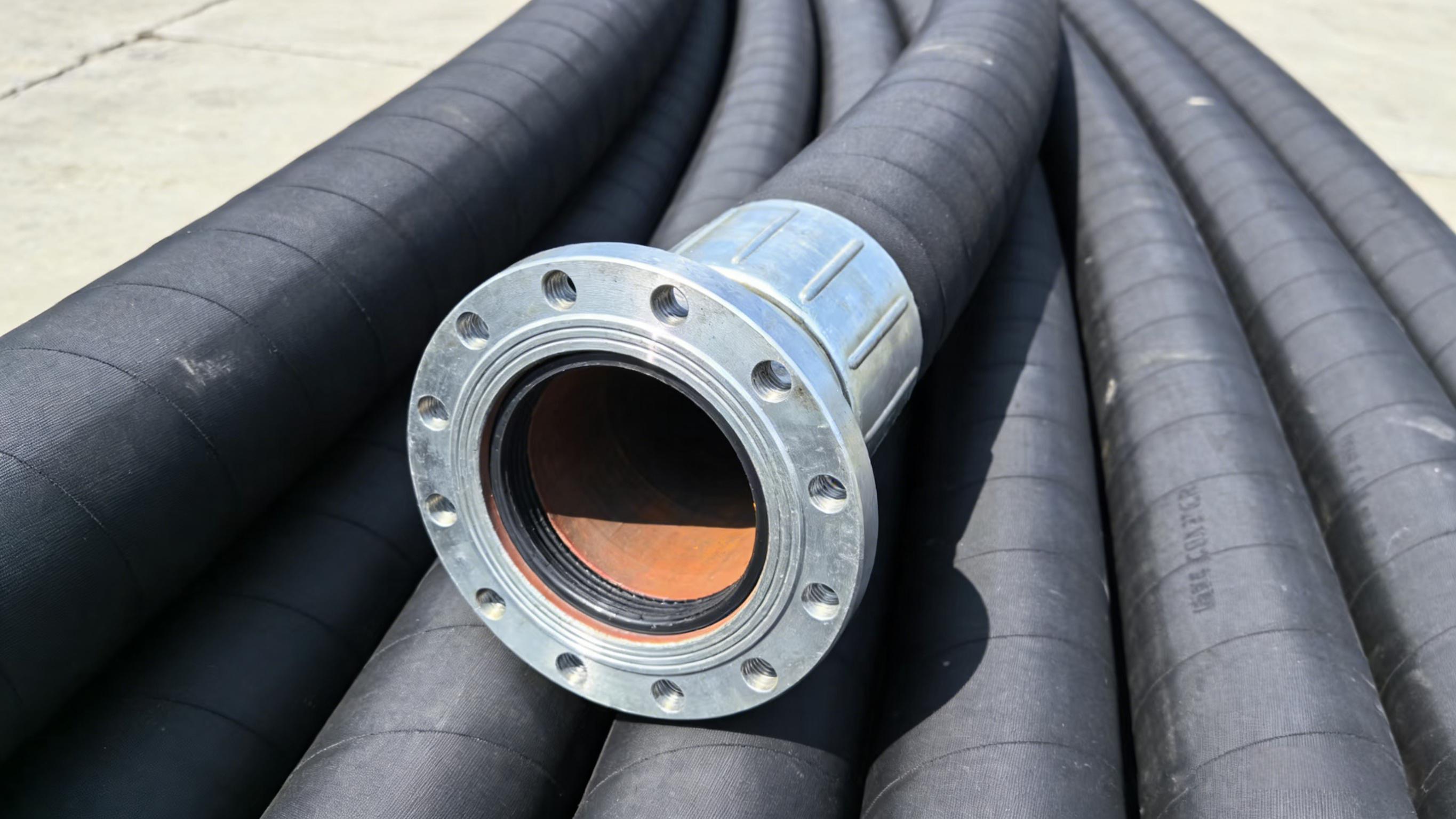
Despite varying application scenarios, the core construction of API 16D BOP well control hoses remains highly consistent across land and sea. The inner tube is made of NBR (Nitrile Butadiene Rubber), offering excellent oil resistance. The tube features a full-bore (full flow) design, ensuring smooth media transmission. The reinforcement layer consists of 4 spiral-wound high-strength super-flexible steel wires, providing exceptional pressure-bearing capacity. The outer cover is made of high-temperature and fire-resistant synthetic rubber. The protection layer is stainless steel armor, enhancing mechanical protection. The operating temperature range covers -45°C to +100°C.
It is this standardized construction that allows the same API 16D BOP hose to serve both onshore rigs and offshore platforms—with differences only in armor layer selection and fitting corrosion protection.
V. The Deep Logic Behind Standard Status
The reason API 16D BOP fire-resistant hoses have become standard equipment on all types of drilling platforms from land to sea is rooted in a profound logic.
First is the universality of the standard. API 16D establishes unified design standards for control systems of both land-based BOP stacks and subsea BOP stacks. Whether it's a desert land rig or a North Sea semi-submersible, the same specification is followed.
Second is the non-negotiability of safety. Failure of the well control system can be catastrophic. Though just a single component on the BOP, the API 16D BOP hose plays a role in engineering safety that cannot be overlooked. In extreme emergencies such as fires, qualified API 16D hoses must continue to transmit control media, ensuring normal BOP control functions.
Third is the authority of certification. Quality API 16D BOP hoses not only meet API standards but also pass rigorous third-party certification from authorities such as Lloyd's Register. The Lloyd's 1499 test requires maintaining pressure without loss under 1300°F flames. This multi-tier certification system provides a unified quality benchmark for drilling companies worldwide.
Conclusion
From onshore rigs to jack-up platforms, from semi-submersible drillships to deepwater operating systems, API 16D BOP fire-resistant hoses have transcended the category of "accessories" to become indispensable standard safety equipment in BOP systems across all types of drilling platforms. They connect not just hydraulic power units to BOP stacks, but also the solid guarantee of drilling safety and efficiency. In the realm of well control safety—where there is no room for compromise—API 16D BOP hoses have proven their standard status from land to sea through unified standards, reliable construction, and validated fire resistance. This is not a choice; it is a necessity.
