
In the field of construction machinery, the hydraulic system serves as the equipment's power hub, while high-pressure hoses act as the "neural network" connecting various hydraulic components. However, although excavators, cranes, and loaders all fall under the broad category of construction equipment, their operating conditions, load characteristics, and action frequencies are vastly different, leading to significant variations in high-pressure hose selection and matching strategies. Indiscriminate hose interchangeability not only shortens service life but can also trigger serious safety accidents. This article provides an in-depth comparison of high-pressure hose matching solutions for these three mainstream construction machine types across four dimensions: pressure rating, pulse frequency, bend radius, and abrasion resistance.
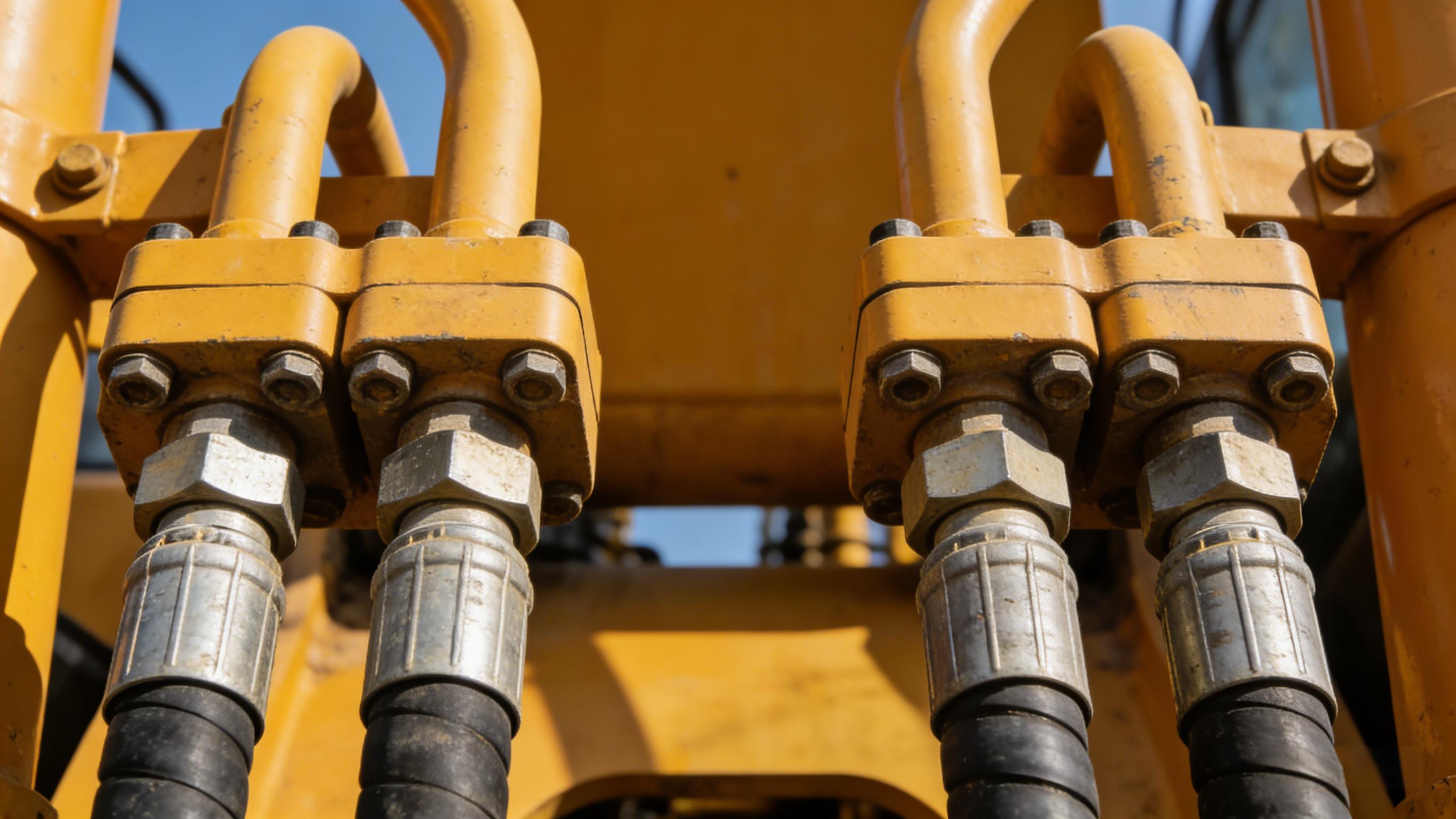
The most distinctive operational feature of an excavator is high-frequency reciprocating motion — bucket digging, boom lifting, and swing platform rotation can complete multiple cycles within a single minute. The hydraulic system peak pressure typically reaches 31.5~34.3MPa, with severe pressure pulsations inside the hoses. For matching solutions, excavator high-pressure hoses prefer four-layer or six-layer spiral wire reinforced constructions (R12 or R13 standards), which provide extremely high resistance to pulse fatigue. Additionally, since excavator lines need to bend at large angles along with the boom and arm, the dynamic bend radius must be sufficiently small, generally required to be no more than 20 times the hose outer diameter. For fittings, integral crimped couplings are recommended to prevent nut loosening caused by high-frequency vibration. Near the swing joint, multi-layer spiral hoses with enhanced twist resistance should be selected to avoid torsional stress concentration from upper structure rotation. After prolonged operation, the outer cover develops fine micro-cracks due to repeated stretching, followed by steel wire layer fatigue fracture, ultimately leading to hose bursts. Consequently, excavator hydraulic hose replacement cycles are typically shorter than for other machine types, recommended not to exceed 4 years.
Truck-mounted cranes and crawler cranes primarily perform hoisting, luffing, and telescopic boom actions. Their most notable characteristic is long-duration pressure holding with extremely heavy loads. The hoisting hydraulic motor and luffing cylinders must withstand loads approaching rated pressure for extended periods, and boom extension significantly changes line length. For cranes, the hydraulic system imposes extremely strict requirements on the volumetric expansion rate (i.e., volume swell under pressure) of high-pressure hoses. Excessive expansion causes unacceptable hook sinking after hoist braking (known as "load drifting"), directly threatening operational safety. Therefore, crane high-pressure hoses should adopt high-rigidity, low-expansion compact spiral hoses, with a working pressure rating that reserves at least 30% safety margin. For hydraulic lines inside telescopic booms, abrasion-resistant outer covers with anti-wear spring guards are mandatory, as boom telescoping causes intense friction between the hose and the inner boom wall. Additionally, luffing hoses must exhibit excellent static sealing retention to prevent creep leakage at fittings during prolonged pressure-holding states. For cranes with ultra-long booms, line pressure drop must be precisely calculated, and hose diameters are often one size larger than those for excavators at the same pressure rating to reduce flow resistance.
Loaders are commonly used in mines, aggregate yards, and construction sites, where dust concentrations are extremely high, accompanied by severe tire bouncing and bucket shock loads. Their working pressure typically ranges from 16~20MPa — lower than excavators — but weather resistance and abrasion resistance are the primary selection indicators. Loader high-pressure hoses must feature extra-thick, cut-resistant, ozone-resistant outer covers. Since loader steering cylinders and boom lines are often exposed beneath the chassis, they are highly susceptible to cuts from flying rocks. Selection should prioritize products with "L" grade abrasion-resistant marking on the cover. For the reinforcement layer, two-layer wire braided construction adequately meets pressure needs while being more cost-effective. For fitting protection, spiral guards or metal shields are recommended to prevent impact deformation from foreign objects. Loaders generate massive hydraulic shock peaks during the instant of bucket digging, often exceeding 1.5 times rated pressure. This requires hoses not only to withstand pressure but also to possess excellent transient impact toughness to prevent fitting blow-off at the moment of impact.
In terms of pressure rating, both excavators and cranes fall into the ultra-high pressure category, with rated pressures not less than 31MPa, while loaders are in the medium-high range, around 20MPa. Regarding core risks, excavators are most vulnerable to pulse fatigue causing steel wire layer fracture, cranes are most concerned about excessive expansion leading to load drifting and joint leakage, and loaders mainly face abrasion damage and impact blow-off. Therefore, the recommended hose constructions differ: excavators should use 4~6 layer spiral wire hoses (R12/R13), cranes require high-rigidity low-expansion spiral hoses, and loaders can use two-layer braided hoses with extra-thick covers (R2 or AT standard). In terms of protection focus, excavators need vibration-resistant fittings and small bend radius design, cranes must emphasize wear guards and pressure-holding seals, while loaders must strengthen cut-resistant covers and install spiral guards.
The final conclusion is that high-pressure hoses for construction machinery are by no means "universal parts." Excavators prioritize toughness, cranes prioritize rigidity, and loaders prioritize protection. When replacing or purchasing, strictly adhere to the OEM-specified pressure grades, construction layers, and crimping processes, and verify SAE or ISO certification marks on hose assemblies. A scientific matching strategy can reduce overall hydraulic system failure rates by over 45%, significantly improving machine availability and return on investment.
