
In hydraulic systems, a fitting is far more than a simple connecting component—it is the custodian of the entire circuit's sealing integrity. Choosing the wrong fitting type is equivalent to planting a time bomb in the system. Faced with four mainstream high-pressure fitting types—JIC 37° flare, ORFS face seal, SAE flange, and 24° cone seal—how do you make the right selection decision? This article provides a comprehensive comparison across five dimensions: standards, sealing principles, pressure ratings, installation methods, and applications.
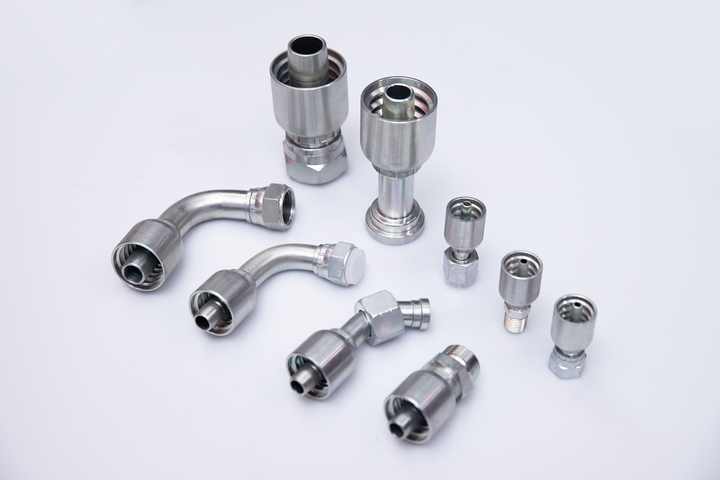
I. JIC 37° Flare Fittings — The World's Most Universal Hydraulic Connection
JIC (Joint Industry Council) fittings, officially designated as SAE J514 37° flare fittings, are the most widely used hydraulic connection worldwide. They feature a 37° flare sealing surface with parallel threads, with both male and female ends having 37° seats. Sealing is accomplished through metal-to-metal contact between the fitting nose and the flared tube or internal flare of a female fitting.
JIC fittings conform to SAE J514 and ISO 8434-2 standards and can be used with inch or metric tube. Their advantages include: the absence of an O-ring makes them desirable in high-temperature applications; they can be disconnected and reconnected repeatedly without deformation, making them very useful where equipment is frequently changed; and they offer a large variety of sizes, shapes, and materials, making them easily interchangeable and identifiable. JIC 37° flare fittings are standard on much North American and agricultural equipment, as well as in high-pressure hydraulic systems, construction machinery, and trucks.
Installation uses the Flats From Wrench Resistance (FFWR) method—hand-tighten first, then torque to specification. For example, a -6 (3/8") steel JIC fitting typically requires 18-20 ft-lbs of torque, while a -10 (5/8") fitting needs around 36-40 ft-lbs. Over-tightening can damage the flare—never use a cheater bar to stop a slight leak.
II. ORFS Face Seal Fittings — The "King of Static Seals" for Zero Leakage
ORFS (O-Ring Face Seal) fittings represent the evolution of sealing technology. They feature an O-ring groove on the face of the fitting, and sealing is accomplished when the O-ring is compressed between the fitting body and the formed tube or flat face of an ORFS female fitting, achieving 100% leak-free sealing through elastic deformation of the O-ring.
ORFS fittings conform to SAE J1453 and ISO 8434-3 standards. The rated working pressure of ORFS fittings can generally reach 6000 PSI (approximately 414 bar), with premium products capable of withstanding over 600 bar.
The advantages of ORFS include: excellent leak prevention and extreme resistance to shock and vibration; the O-ring absorbs structural shock, ensuring a "superior seal" ideal for systems where safety cannot be compromised; and they allow higher tightening torque. ORFS fittings are increasingly specified in new hydraulic system designs for their superior leak-free performance under vibration and pressure impulse conditions. They are widely used in applications with extremely high leak prevention requirements, such as construction machinery, aerospace, and high-pressure pump stations, as well as on excavators and compactors.
Installation uses the torque method—inspect the O-ring for damage, hand-tighten, then torque to specification. For example, a -8 (13/16-16 thread) ORFS fitting typically requires 27-33 ft-lbs of torque.
III. SAE Flange Fittings — The "Four-Bolt Fortress" for High-Flow, Ultra-High-Pressure Systems
SAE flange fittings are heavy-duty connection solutions designed for high-flow, ultra-high-pressure applications. They use four bolts to fix a flat flange against the also-flat work port on a pump, motor, cylinder, or valve. The ported surface offers an entirely flat area to accept the O-ring situated inside a machined groove on the flange, with four bolts providing the means to compress the polymer seal.
SAE flange fittings conform to SAE J518 standards. Two pressure capacity ratings are defined under the SAE J518 standard: Code 61 (standard pressure series) provides a connection suitable for everything 3000 psi or less, with maximum working pressure of 210-420 bar; Code 62 (high-pressure series) provides a leak-free connection up to 6000 psi, with all sizes rated at 6000 psi. Code 61 and Code 62 flanges differ in flange dimensions, bolt sizes, and overall thickness.
The advantages of SAE flanges include: legendary high-pressure capacity; the split flange design allows technicians to rotate the hose end in any direction before tightening; and they are easily integrated with traditional and existing hydraulic plumbing packages. SAE flange fittings are suitable for high-flow, ultra-high-pressure applications, commonly used on gear pump and motor ports, compact HPU connections, and connecting hose lines to large bore SAE split flange ports on pumps and motors.
During installation, inspect the sealing surface and O-ring groove for visible damage, then gradually tighten the socket head screws in small increments in a diagonal sequence to the appropriate torque level.
IV. 24° Cone Seal Fittings — The European "Heavy-Duty Pressure" Standard
24° cone seal fittings originate from the German DIN 2353 standard and are the core hydraulic connection solution in European industrial systems. They are available in Light series (L) and Heavy series (S), achieving metal-to-metal sealing through a ferrule or cutting ring on a 24° cone surface. Some designs additionally incorporate an O-ring at the cone for dual soft and hard sealing.
24° cone seal fittings conform to DIN 2353 and ISO 8434-1 standards. The Light and Heavy series are distinguished by different pressure ratings and sizes. Working pressure can reach up to 40MPa or more, with some products rated up to 500 bar or even 800 bar.
The advantages of 24° cone seal fittings include: high sealing等级 and extremely strong resistance to vibration and impulse; suitability for high-pressure, frequent impact applications; and they are the solution of choice for fixed industrial hydraulics, machine tools, and the earthmoving sector in Europe. 24° cone seals are widely used in European and international hydraulic systems, suitable for high-pressure, frequent impact applications such as metallurgical hydraulics and high-pressure oil pipes, as well as fixed industrial hydraulics and machine tools.
For installation, the ferrule or bite ring first needs to be preset onto the tube and inspected, and then final assembly is completed using the turns method.
V. Selection Comparison and Decision Guide

Selection Recommendations: ORFS and SAE flanges are the top choices for ultra-high-pressure and high-impulse systems; JIC and 24° cone seals are suitable for conventional high-pressure systems. Specifically—for conventional high-pressure systems, prioritize JIC 37° flare; for demanding conditions with high vibration, high impulse, and zero-leak requirements, ORFS is the first choice; for high-flow ultra-high-pressure applications (such as pump and motor ports), choose SAE flanges; for European equipment or metric tubing systems, select 24° cone seals. Always ensure the fitting's working pressure rating is not lower than the system pressure, and that the thread form matches the equipment interface exactly.
