
In a fully mechanized coal mining face, every movement of the hydraulic support—raising, lowering, advancing, and side shielding—depends on high-pressure hoses to transmit power. These hoses function as the “blood vessels” of the support's hydraulic system, and whether they are correctly selected directly affects the reliability of support operations and underground safety. However, many procurement teams focus only on price or a single parameter while overlooking the matching relationship among diameter, pressure, and fittings, leading to frequent issues such as hose swelling, leakage, and fitting pull-out during operation. This article systematically examines the three core elements of hydraulic support hose selection from an engineering practice perspective.
The inner diameter of a hose must be determined based on system flow rate and allowable pressure loss. An undersized hose increases the flow velocity of the medium, causing system overheating, reduced efficiency, and excessive pressure drop that affects overall system performance. An oversized hose not only increases cost but also makes installation difficult in the narrow spaces underground due to a larger outer diameter.
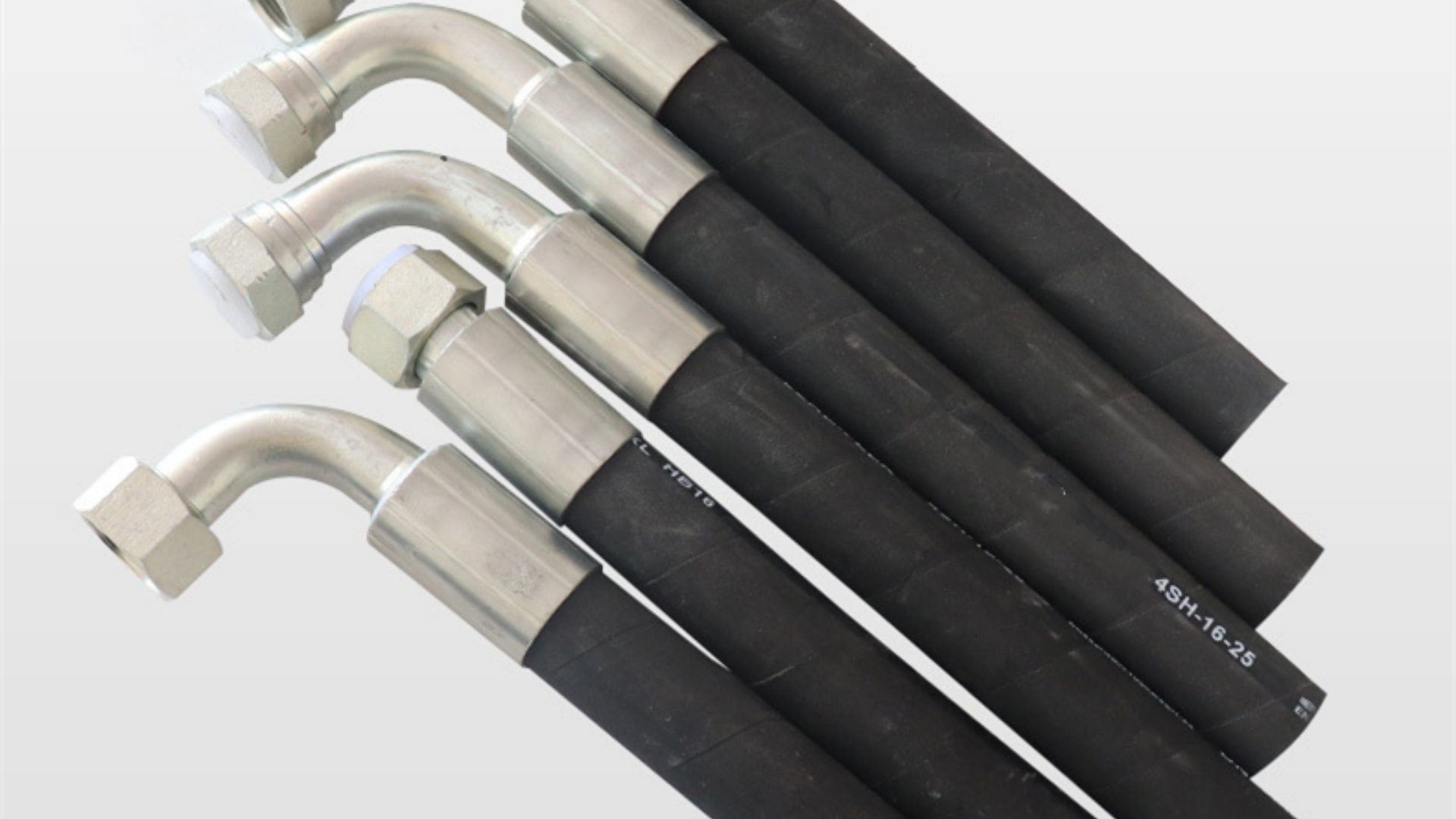
The common nominal diameters for hydraulic support hoses range from DN10 to DN51. Pilot lines between supports typically use DN10 and DN13, main supply lines commonly use DN25, and main return lines use DN32. When selecting, special attention must be paid to the hose outer diameter—when hoses are secured with clamps or pass through steel plates and other spacers, the outer diameter directly determines installation feasibility.
Another easily overlooked parameter is the minimum bend radius. For multi-layer spiral-wound hoses, the bend radius increases with the number of winding layers. If the underground installation space cannot accommodate the required bend radius, forced bending will deform the reinforcement wires and create early failure points. Therefore, diameter selection must verify the bend radius as a parameter equally important to the inner diameter.
The pump station pressure of the main supply system for hydraulic supports typically ranges from 25 to 31.5 MPa, with some large mining height supports requiring even higher pressure in the main supply circuit. The columns and jacks also generate pressure spikes during the initial support and load-bearing phases. During the advancing process, the hydraulic flow is frequently switched on and off, subjecting the hose to cyclic pressure impulses—pulse fatigue is one of the primary causes of hose failure.
According to safety factors specified in international standards, the recommended working pressure is generally one-quarter of the hose's minimum burst pressure. Selection should be based on the maximum design pressure of the hydraulic system, not merely the normal operating pressure.
Hydraulic support hoses are classified into wire braided and wire spiral types based on reinforcement structure. Wire braided hoses, commonly available in one, two, and three-layer configurations, have working pressure ranges typically between 20 and 40 MPa. They offer better flexibility and are suitable for applications involving frequent small-radius bending inside the support, such as connections to columns and advancing jacks. Four-layer wire spiral hoses can achieve working pressures above 28 MPa with burst pressures exceeding 70 MPa, and their pulse fatigue resistance is significantly superior to braided structures, making them ideal for main supply and return lines of large mining height supports.
The core principle of selection is: the rated working pressure of the hose assembly shall be the lower of the hose body and the two end fittings. Even if the hose body's burst pressure reaches four times the working pressure, if the fitting crimping strength is insufficient or the sealing structure does not match, the assembly's safety limit is still determined by the fitting.
Hydraulic support hose end fittings are primarily available in KJ series, DN series, and U-shaped pin quick couplings. KJ series fittings are widely used in domestic standard supports, while DN series fittings are more common in newer supports and export equipment. Fitting selection requires attention to three dimensions: connection method (threaded or quick coupling), specification matching (corresponding to hose inner diameter), and material (carbon steel or stainless steel).
Fitting crimping is the most critical process in hose assembly manufacturing. Excessive crimping force damages the inner rubber layer, allowing the medium to penetrate the reinforcement layer and cause wire corrosion; insufficient force may lead to fitting pull-out under pulse conditions. Among common hose failure modes in mining sites, leakage at crimped fittings and fitting pull-out account for a significant proportion. During procurement, suppliers should be required to provide crimping parameter records and pulse test reports to ensure that the fitting-to-hose match has been thoroughly verified.
Hose selection must also consider temperature range and chemical compatibility. The working temperature range for hydraulic support hoses is generally -40°C to +100°C. If special hydraulic media are used, it is essential to ensure that the hose inner layer, outer layer, and fitting seals are compatible with the medium.
In summary, hydraulic support hose selection is a systematic engineering task. Diameter determines flow efficiency and installation feasibility, pressure determines safety margin, and fittings determine connection reliability. None can be neglected—a deviation in any one element can lead to failure of the entire pipeline system. Procurement teams are advised to provide complete actual operating parameters to suppliers and require a comprehensive selection plan covering diameter, pressure rating, fitting specifications, and bend radius, thereby ensuring stable operation of the support hydraulic system from the source.
