
The failure of a standard rubber delivery hose in concrete pumping almost never comes from a single pressure spike. It comes from accumulated abrasion. Angular aggregate—quartz sand, crushed stone—is dragged along the inner wall under pumping pressure, progressively shaving the rubber surface, thinning the wall until the reinforcement becomes exposed and a bulge or burst follows. The reason a UPE ultra-wear-resistant hose can deliver several times—sometimes an order of magnitude—the service life of conventional rubber hose is not that it uses a “harder rubber.” It replaces the weakest link in the wear equation with a thermoplastic whose molecular weight runs into the millions.
Why rubber hose wears quickly
Rubber’s abrasion resistance relies on elastic deformation to absorb the impact energy of abrasive particles. That mechanism works under low-frequency, coarse-particle conditions. Concrete pumping, by contrast, is high-frequency sustained abrasion with sharp fine particles, and rubber’s elastic recovery cannot keep pace with the cutting action. The surface undergoes repeated deformation and eventually fatigue spalling. More critically, rubber has a pronounced tendency to adhere to concrete. Mortar lodges in microscopic surface irregularities, cures, and the next aggregate pass effectively grinds concrete against concrete. The short service life of standard rubber hose is the predictable outcome of a material that is elastic but not rigid enough, with a surface energy that invites sticking.
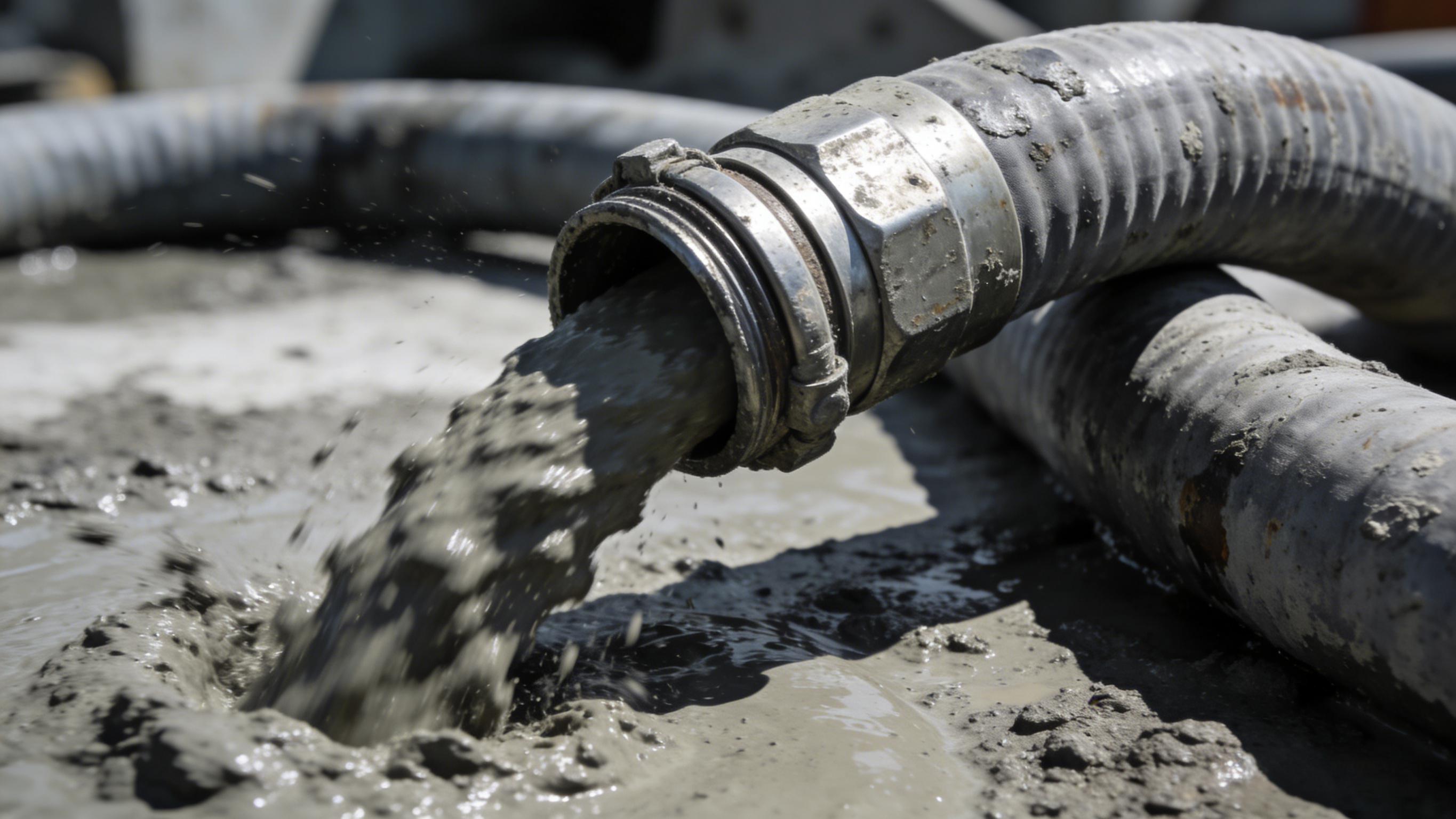
What UPE changes: molecular weight and surface energy
UPE (ultra-high molecular weight polyethylene) typically has a viscosity-average molecular weight above 3 million, with concrete-delivery grades reaching the 5 million range. The extremely long molecular chains form a highly entangled load-bearing network at the wear surface. An abrasive particle is no longer cutting through individual chain segments; it must disrupt an entangled architecture, and the wear rate drops accordingly. Under the SH/T 1818—2017 slurry abrasion test method for UHMWPE and the QB/T 2668 annex B comparison, UHMWPE shows markedly lower wear loss than HDPE and cross-linked polyethylene, and under coarse-sand conditions it also outperforms conventional wear-resistant rubber. At the same time, UPE’s very low friction coefficient gives the bore a self-lubricating character. Mortar struggles to cling to the wall, breaking the adhere–cure–scour cycle at its origin. The saturated molecular structure is also chemically inert toward the alkaline species and admixtures in concrete, removing the secondary damage that rubber suffers through aging and cracking in alkaline slurry.
How the multiple translates into the project ledger
The engineering significance of the life multiple is not the number itself. It is the way it resets the replacement calculus. A standard rubber hose on a boom end or mortar sprayer may need replacement on the order of a few hundred hours. A UPE-lined hose pushes that interval out several-fold; in tunnel wet-mix shotcrete, UPE linings have logged continuous service beyond 800 hours. Fewer replacements cut three categories of hidden cost simultaneously: labor and downtime for hose changes, safety and cleanup exposure from burst risk, and secondary wear on quick couplings and seals from repeated disassembly. Under high-grade concrete, steel-fiber mixes, or sharp aggregate, the gap widens further—the harsher the abrasion, the more pronounced UPE’s advantage over standard rubber becomes. Choosing a UPE concrete delivery hose is, in essence, trading a lower material-level wear rate for a more predictable pumping cycle with fewer interruptions.
