
In industrial cleaning, 3000bar (approximately 43500psi) ultra-high-pressure water jet technology is widely used for ship hull paint removal, concrete demolition, heat exchanger tube bundle cleaning, and steel surface rust removal. Under such extreme pressure, ordinary rubber hoses or wire braid hoses are simply incapable – they either expand excessively under pressure causing energy loss, or their liners wear out quickly. Ultra-high-pressure thermoplastic hoses, with their unique thermoplastic materials and precision spiral construction, have become the dedicated solution for 3000bar cleaning operations.
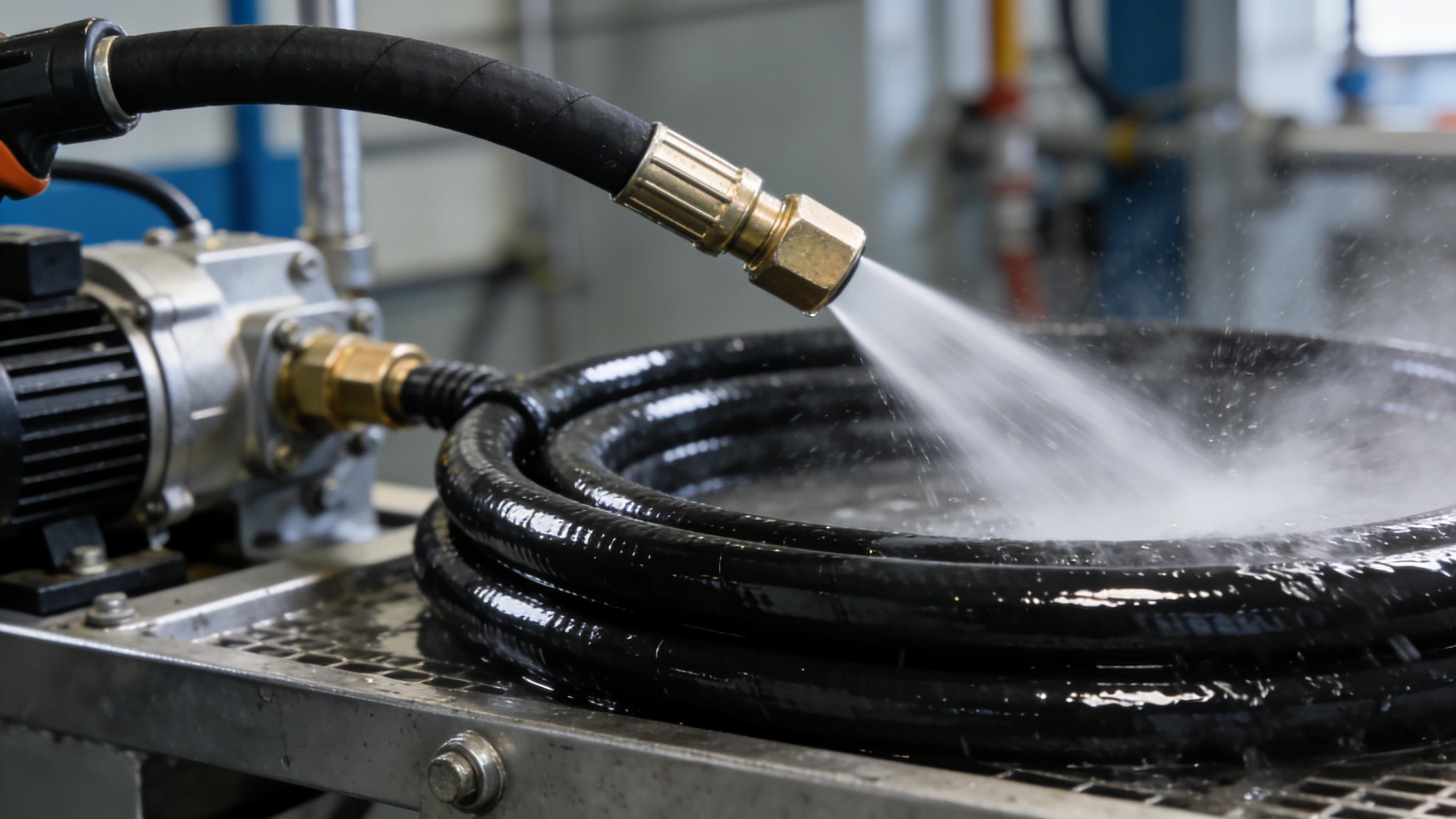
The core technical features of an ultra-high-pressure thermoplastic hose are embodied in its three-layer construction. The inner tube is typically made of High-Density Polyethylene (HDPE) or Nylon (polyamide). These thermoplastic materials have a very low coefficient of friction (approximately 0.1 to 0.3) and excellent hydrolysis resistance. At 3000bar, water velocity can exceed 200 meters per second, causing severe erosion on the tube wall. The abrasion resistance of an HDPE inner tube is 5 to 10 times that of ordinary rubber, and it is completely non-absorbent, preventing performance degradation due to water permeation. Additionally, the thermoplastic inner tube has extremely low permeability, effectively preventing “micro-leakage” of ultra-high-pressure water and ensuring stable pressure output.
The reinforcement layer is critical for withstanding 3000bar extreme pressure. Ultra-high-pressure thermoplastic hoses typically use multiple layers (generally 4, 6, or even 8 layers) of high-strength steel wire spiral. The steel wire is usually high-strength carbon steel or stainless steel, with tensile strength reaching over 2000MPa. The wire layers are wound at precisely calculated alternating spiral angles, resulting in minimal length change under high pressure (elongation controlled within ±1%) while effectively suppressing radial expansion and reducing pressure loss. Compared to ordinary wire braid hoses, the multi-layer spiral construction offers superior fatigue resistance, capable of withstanding frequent pressure pulses and bending cycles.
The cover layer protects the reinforcement and adapts to the working environment. Ultra-high-pressure cleaning sites often involve oil, chemical solvents, UV radiation, and mechanical abrasion. The cover is made of polyurethane or specially modified nylon, offering extremely high abrasion resistance, oil resistance, and weather resistance. The abrasion resistance of polyurethane is more than five times that of neoprene, allowing it to withstand repeated dragging on floors, decks, or metal edges.
In 3000bar cleaning operations, the hose inner diameter is typically small, with common sizes of 1/4 inch (approx. 6.4mm), 3/8 inch (approx. 9.5mm), and 10mm. Smaller inner diameters help reduce water hammer effects and reaction forces, improving operational safety. The operating temperature range is generally -20°C to +70°C, with some premium products reaching -40°C to +100°C.
Fittings are the weakest link in an ultra-high-pressure hose assembly. 3000bar-grade hoses must be equipped with dedicated forged ultra-high-pressure fittings, typically made of 316L stainless steel or high-strength alloy steel, with threaded lock or crimp connections. The fitting incorporates pull-out resistant structures and stress-relief tapered surfaces to prevent slippage or leakage under extreme pressure. Many products also feature self-tightening seals – the higher the pressure, the tighter the seal.
In practical applications, ultra-high-pressure thermoplastic hoses are widely used in: shipyard paint removal (2800-3000bar) with rotating nozzles for efficient stripping of old paint and marine growth; concrete demolition and surface preparation for road marking removal and bridge renovation; heat exchanger tube bundle cleaning to remove stubborn scale; and internal cleaning of petrochemical equipment where explosion-proof requirements demand flame-resistant, antistatic hoses.
Selection considerations: First, ensure the hose’s rated working pressure exceeds the pressure washer’s maximum output, with a recommended safety margin of at least 20%. Second, select the appropriate inner diameter based on flow requirements – for 3000bar, 1/4-inch or 3/8-inch is typical. Third, verify fitting compatibility with the gun and pump outlet – common interfaces include M22×1.5, NPT 1/4, and HP high-pressure connections. Fourth, pay attention to the bend radius – 3000bar hoses are relatively stiff with larger minimum bend radii, so sufficient space is needed during installation.
For routine maintenance, depressurize and drain the hose after each use to prevent freeze damage. Regularly inspect the cover for cuts, blisters, and the steel wire layer for exposed rust. Ultra-high-pressure hoses are high-value consumables; it is recommended to replace them every 1-2 years based on usage frequency or according to the manufacturer’s recommended impulse cycles.
In summary, the ultra-high-pressure thermoplastic hose is an irreplaceable component for 3000bar cleaning operations. Its combination of a thermoplastic inner tube, multi-layer steel wire spiral reinforcement, and polyurethane cover provides a safe, efficient, and durable delivery solution for extreme high-pressure water jets. Proper selection and regular maintenance significantly improve cleaning efficiency and ensure operator safety.
