
In dredging operations and drilling activities, mud conveying is a highly abrasive and demanding task. Whether it involves river channel desilting, port and waterway maintenance, or cuttings transport in oil drilling, the high concentration of solid particles such as sand, clay, and barite in the mud causes severe erosive wear on the delivery pipes. Ordinary rubber hoses often have very short service lives under such conditions, and frequent replacement not only increases costs but also causes operational interruptions. Specially designed high-abrasion resistant mud hoses, with their unique materials and construction, have become the ideal choice for both dredging and drilling mud transport.
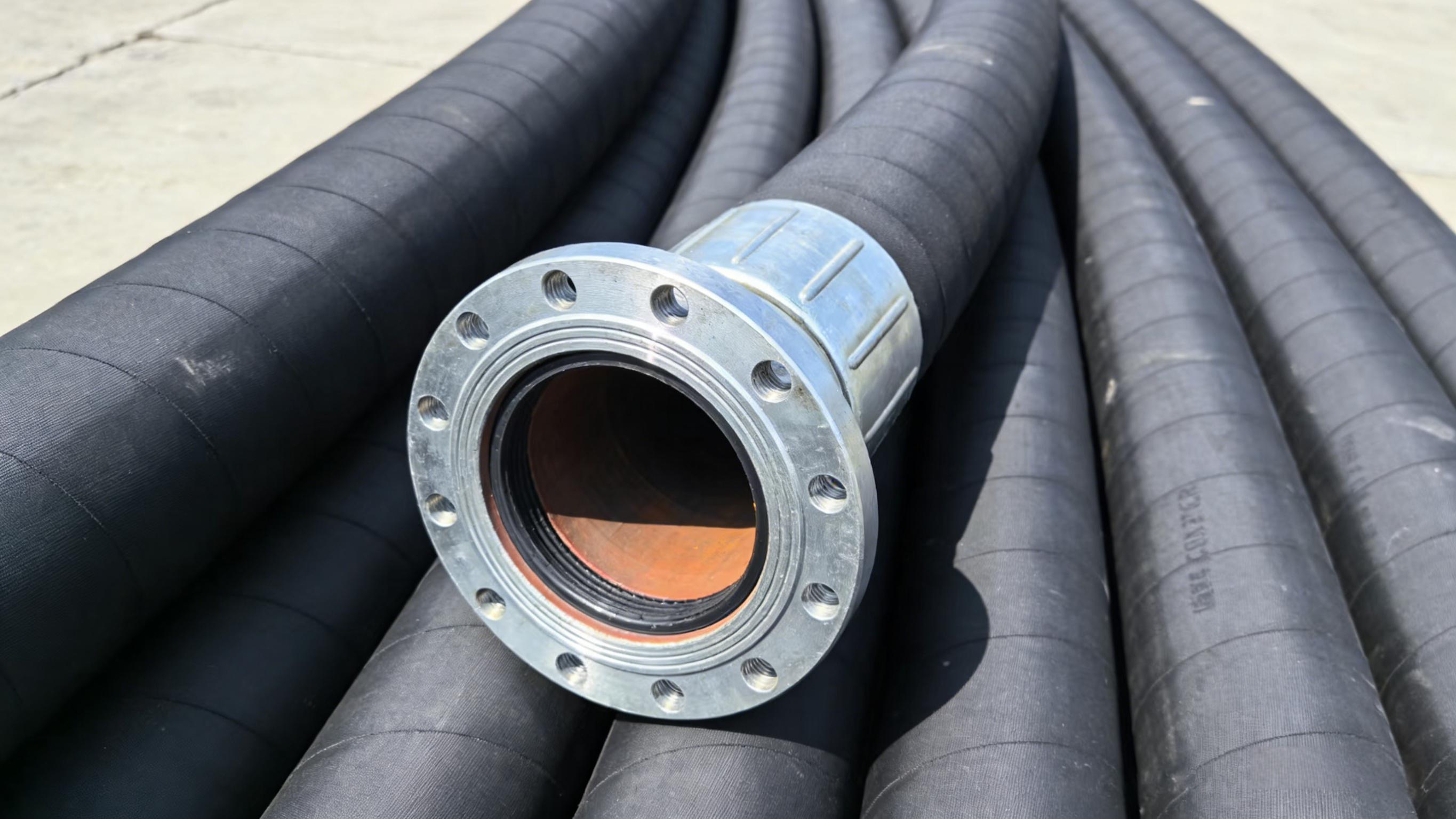
The core of a mud hose lies in the exceptional wear resistance of its inner tube. Unlike standard hydraulic hoses, the inner tube of a mud hose is in direct contact with mud containing 30% to 60% solids by weight. Particle flow velocities can reach 5 to 15 meters per second, and the wear mechanisms include impact erosion, cutting abrasion, and fatigue wear. High-quality mud hoses use a highly abrasion-resistant natural rubber or specialty SBR compound, with a Shore hardness typically between 60 and 70 A. This provides sufficient hardness to resist particle cutting while maintaining good elasticity to absorb impact energy. Some premium products incorporate wear-resistant reinforcing fillers (such as silica or short fibers) into the inner tube, reducing volume loss to less than one-third that of ordinary rubber. In dredging applications, the service life of a high-abrasion resistant mud hose can be more than four times that of a standard hose.
Regarding the reinforcement layer, mud hoses must withstand moderate to high delivery pressures. Dredging working pressures typically range from 10 to 20 bar (1 to 2 MPa), but the hoses have large diameters (typically 6 to 12 inches) and experience substantial tensile forces. Drilling mud delivery, on the other hand, requires pressures of 15 to 35 MPa. Therefore, the reinforcement of mud hoses uses multi-layer high-strength polyester textile braid or steel wire spiral construction. Large-diameter dredge hoses commonly use textile reinforcement for flexibility and vacuum resistance, while high-pressure drilling mud hoses require steel wire braid or steel wire spiral (e.g., four or six layers). The reinforcement design must also consider the hose’s resistance to kinking under bending, preventing fatigue failure of the reinforcement due to frequent movement.
The cover layer also faces harsh conditions. In dredging, mud hoses often float on water or are dragged across vessel decks, exposing them to sunlight, seawater corrosion, oil spills, and abrasion from deck edges. The cover layer is made of weather-resistant, ozone-resistant, oil-resistant, and abrasion-resistant synthetic rubber (such as neoprene or NBR blends), with a thickness 30% to 50% greater than standard hoses. Some products feature wear-resistant ribs or integral covers to extend service life under dragging conditions.
In dredging applications, mud hoses are primarily used to connect cutter suction dredgers’ discharge lines, trailing suction hopper dredgers’ offloading lines, and land-based reclamation pipelines. Typical inner diameters range from 4 inches to 24 inches, with working pressures typically between 10 and 20 bar, and they must have good vacuum resistance to prevent collapse under suction. For drilling mud delivery, mud hoses connect mud pumps to standpipes or rotating control heads, with inner diameters ranging from 2 to 6 inches and working pressures up to 35 to 52 MPa, requiring compliance with API 7K and similar standards.
When selecting a mud hose, several key points should be considered. First, choose the inner tube abrasion resistance grade based on the hardness and particle size of the solids – ultra-wear-resistant compounds are necessary for high quartz sand content. Second, ensure the working pressure matches the hose’s rated pressure, with a recommended safety factor of at least 2.5 times. Third, for large-diameter dredge hoses, pay attention to the minimum bend radius and tensile strength to accommodate surface curvature and anchoring positioning. Fourth, fitting type is critical: dredging applications commonly use flanged connections or quick couplings (such as Victaulic clamps); drilling mud hoses use integral union connections (e.g., Fig 1502, Fig 206). Fifth, for floating mud hoses, select buoyant hose designs with density lower than water or attach external floats. Sixth, consider the ambient temperature to ensure the hose operates reliably from -30°C to +80°C.
In terms of maintenance, flush the hose with clean water after each operation to prevent sediment buildup. Periodically inspect the cover for cuts, blisters, or exposed reinforcement, and check fittings for leaks. Mud hoses are high-wear consumables, so a scheduled replacement plan based on usage intensity is recommended to avoid burst accidents due to overdue service.
In summary, high-abrasion resistant mud hoses are essential equipment for dredging and drilling mud conveying. By properly selecting the hose – matching the inner tube abrasion grade, reinforcement pressure rating, fitting type, and environmental adaptability – you can significantly improve operational efficiency and reduce total operating costs.
