
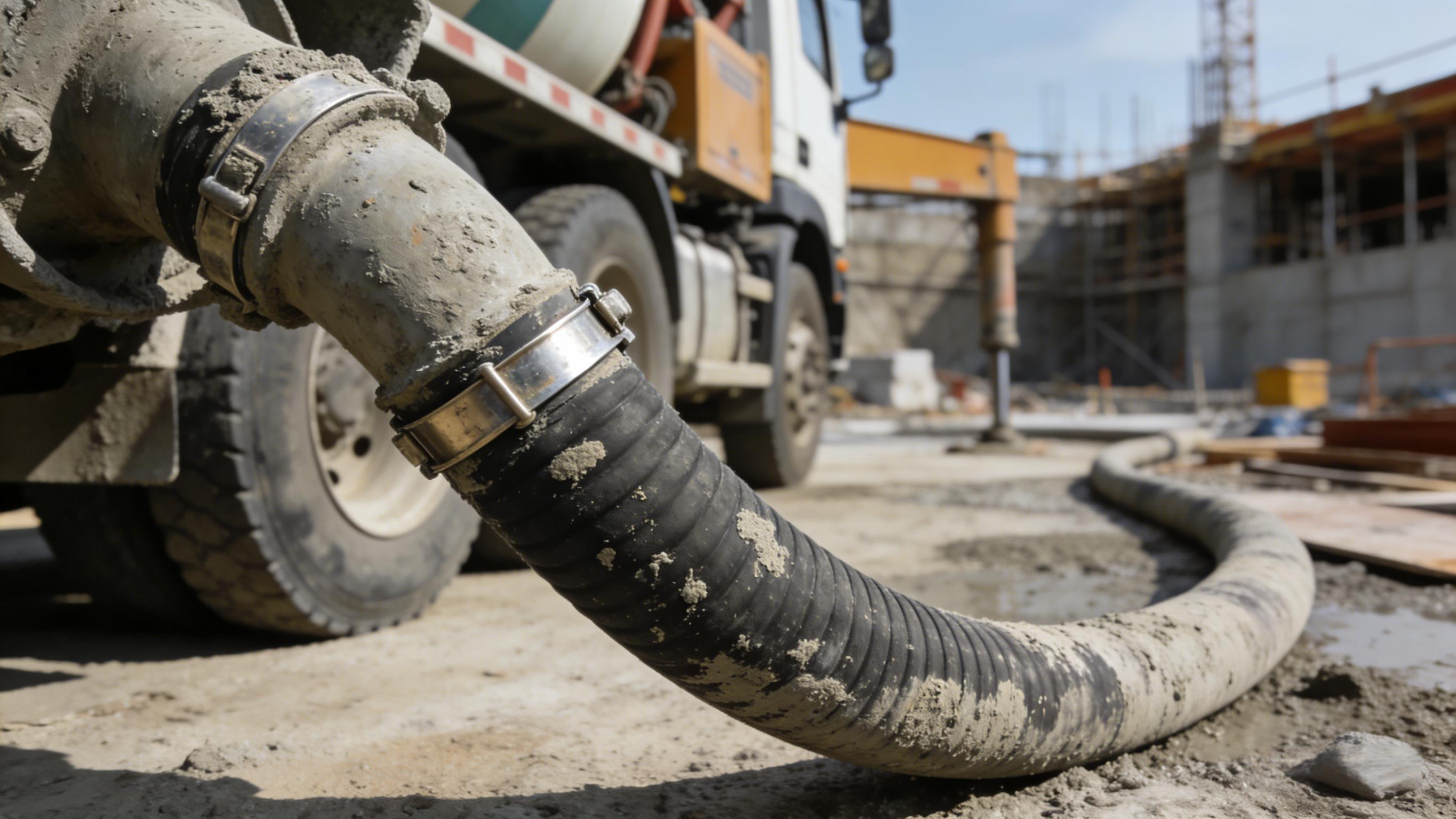
In tunnel engineering, slope shotcrete, mine support, and building construction, the cement shotcrete hose is a core component of concrete spraying equipment. It must not only withstand high delivery pressures but also resist the high-speed erosion of sand and gravel particles in the cement mortar. Choosing the wrong shotcrete hose leads to frequent replacements, project delays, and even burst accidents causing personal injury. This article provides a comprehensive analysis of shotcrete hose selection from three core dimensions: pressure rating, inner diameter, and wear layer thickness.
I. Pressure Rating: Match System Output and Maintain Adequate Safety Margin
The working pressure of a cement shotcrete hose depends on the associated spraying equipment. Dry-mix and wet-mix processes have different pressure requirements. According to industry technical parameters, the working pressure range for common shotcrete hoses is 0.4MPa to 2.0MPa (approximately 4-20 bar), with burst pressure typically about four times the working pressure. For example, the PZ-5 shotcrete machine operates at approximately 0.2-0.4MPa, and the matching 51mm ID hose has a burst pressure of 1.6MPa. Manufacturers such as Letone produce wire-reinforced shotcrete hoses with working pressures up to 2.0MPa and burst pressures four times that.
When selecting, note that the hose’s rated working pressure must exceed the spraying equipment’s actual output pressure, with a recommended safety factor of no less than 2.5 times. For large concrete pumping equipment (such as wet-mix shotcrete rigs), working pressures may exceed 4.0MPa, requiring higher-pressure-rated wire spiral hoses. Additionally, pay attention to impulse pressure – spraying operations involve intermittent material delivery that creates pressure fluctuations. Quality shotcrete hoses should withstand at least 500,000 pressure cycles without failure.
II. Inner Diameter: 51mm and 64mm Are Mainstream – Matching the Machine Is Key
The inner diameter of a cement shotcrete hose must match the shotcrete machine’s discharge port and spray gun size. The two most mainstream sizes on the market are 51mm (2 inches) and 64mm (2.5 inches). The 51mm hose is primarily used for PZ-5 concrete shotcrete machines, with a conveying capacity of approximately 5.5m³/h and a maximum conveying distance of up to 200 meters. The 64mm hose is used for larger-capacity equipment such as the PZ-7. Smaller sizes including 25mm, 32mm, and 38mm are available for small-scale spraying or repair work.
Choosing an inner diameter that is too small increases delivery resistance and pressure loss, potentially causing blockages. A diameter that is too large makes the hose heavy and difficult to handle. The correct approach is to calculate the required ID based on the shotcrete machine’s delivery rate and conveying distance. Generally, for conveying distances within 50 meters, a 51mm ID is sufficient; for distances exceeding 100 meters, a 64mm or larger diameter is recommended. Regarding hose length, common specifications include 16 meters, 18 meters, and 20 meters, with custom lengths available based on job site requirements.
III. Wear Layer Thickness: The Inner Tube Is the “Life Core” of the Shotcrete Hose
The inner tube of a cement shotcrete hose is in direct contact with high-velocity sand and cement particles, and its wear resistance determines the hose‘s overall service life. According to industry standards, high-quality shotcrete hoses use highly abrasion-resistant natural rubber (NR) or styrene-butadiene rubber (SBR) compounds for the inner tube, with some products incorporating nano wear-resistant additives. Abrasion volume loss can be controlled below 70±5mm³ (conforming to ISO 4649). For the reinforcement layer, to meet high-pressure requirements, mainstream shotcrete hoses use wire braid or wire spiral construction. Single-layer wire braid is suitable for medium-to-low pressure applications; double-layer or multi-layer wire braid is used for high pressure and frequent bending applications; heavy-duty shotcrete hoses may incorporate a spiral wire core in the reinforcement layer to enhance vacuum resistance.
The cover layer must be weather-resistant, ozone-resistant, and abrasion-resistant. Shotcrete job sites are often wet and muddy – cover layer aging can lead to reinforcement rust and hose failure. Quality products use SBR/NR blend rubber, some with pin-prick designs to release internal moisture.
IV. Fitting Types and Selection Recommendations
Common fittings for cement shotcrete hoses include flanged connections, clamp couplings, and quick couplings. Flanged connections offer reliable sealing and high pressure capacity, suitable for fixed piping. Clamp couplings (such as Victaulic) are easy to install and suitable for frequent disassembly. Quick couplings are used for connections between the spray gun and hose, facilitating nozzle changes. When selecting, ensure that the fitting material (typically cast steel or ductile iron) is compatible with the hose and that the crimping process meets specifications.
Summary
To select the right cement shotcrete hose, follow these steps: First, confirm the spraying equipment’s working pressure and delivery rate, and choose a hose with a matching pressure rating. Second, select the appropriate inner diameter (51mm or 64mm) based on the machine model, ensuring compatibility with the discharge port and spray gun. Third, focus on the inner tube’s wear resistance grade, prioritizing wire-reinforced, highly wear-resistant products. Fourth, choose the appropriate cover material and fitting type based on the operating environment. Correct selection not only extends shotcrete hose life but also ensures construction safety and efficiency.
