
In the field of construction machinery, excavators, loaders, and cranes are the three most widely used equipment types with hydraulic systems. However, their working loads, motion frequencies, and operating conditions differ significantly, leading to different requirements for steel wire braided hydraulic hoses. Selecting the correct hose type ensures safe equipment operation, extends hose service life, and reduces maintenance costs. This article analyzes the hydraulic hose specification points for each of these three equipment types.
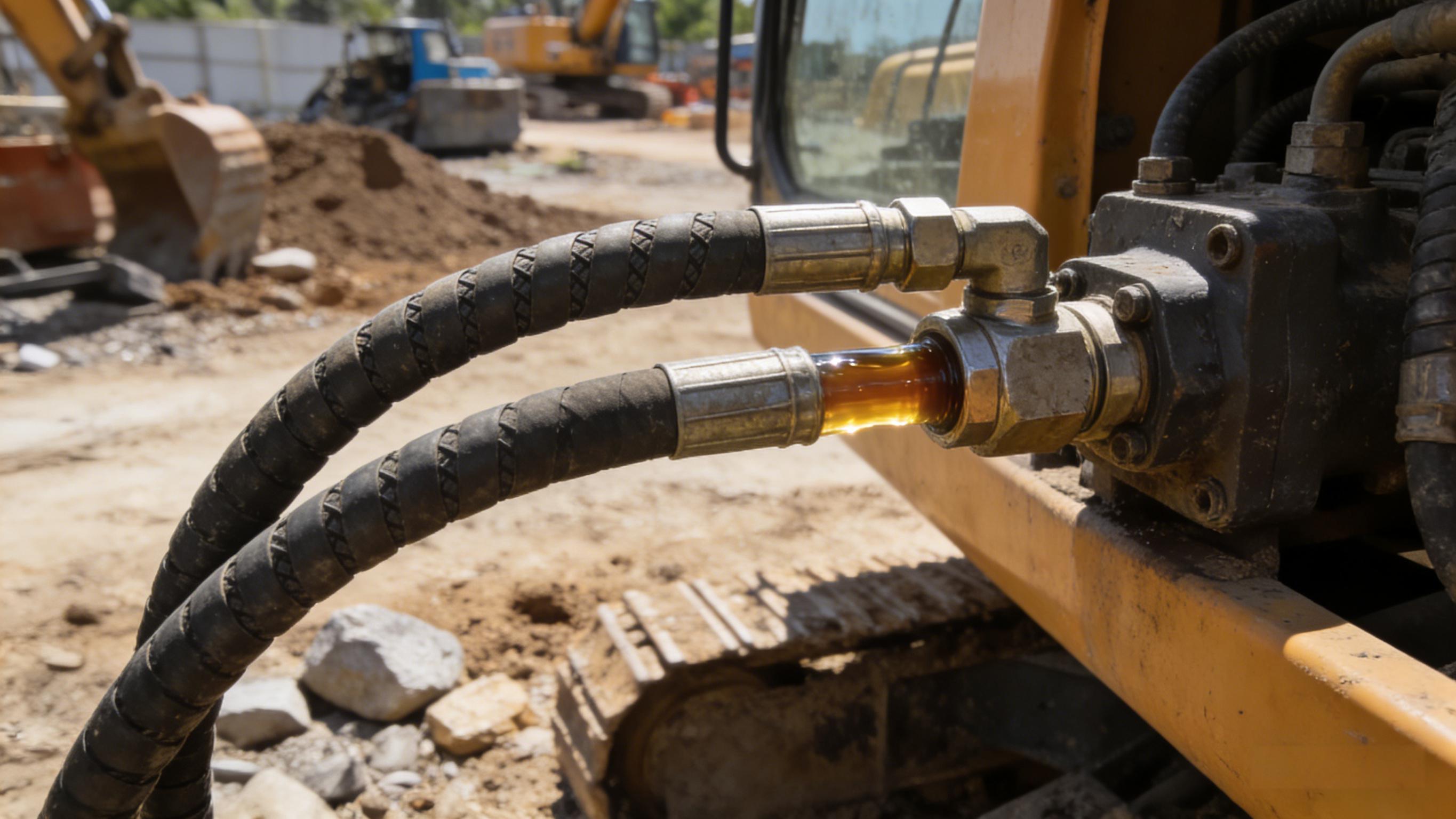
Excavators: Spiral Hoses for Main Circuits, Braided Hoses for Pilot Circuits
Excavator hydraulic systems are characterized by frequent motions, severe pressure fluctuations, and high vibration impacts. Boom raising/lowering, arm extension/retraction, bucket tilting, and slewing all generate pressure pulses in the lines. Modern excavators typically operate at system pressures of 35MPa to 42MPa, with larger models reaching even higher.
For excavator main pressure lines—such as from the main pump to the control valve, and from the control valve to the boom, arm, and bucket cylinder supply/return lines—multi-layer steel wire spiral hoses such as SAE 100R12, R13, or R15 are generally used, rather than ordinary braided hoses. This is because excavators operate at high pressures with frequent impulses; spiral hoses maintain better structural stability under high-frequency pressure shocks. SAE 100R12, for example, has a working pressure of up to 28MPa with a burst pressure four times that, sufficient to cover the pressure requirements of excavator main circuits such as boom cylinders. For ultra-large excavators above 40 tons, SAE 100R13 (42MPa grade) or SAE 100R15 (up to 51MPa / 7500psi) six-spiral hoses are required.
Excavator pilot control systems operate at lower pressures (typically 3-5MPa) with dense hose routing, demanding high flexibility. These circuits can use SAE 100R2AT two-wire braid hoses or even lightweight SAE 100R7 thermoplastic hoses. For inner diameters, pilot circuits commonly use 1/4 inch (approx. 6.3mm); main circuits range from 1/2 inch (12.7mm) to 1.5 inches (38mm) depending on machine size. For fittings, excavators widely use ORFS face seal fittings, which offer superior vibration and loosening resistance compared to threaded seals, making them better suited for high-vibration conditions.
Loaders: Braided Hoses Are Mainstream, Abrasion Resistance Is Key
Loader hydraulic systems primarily control bucket lift, tilt, and steering. Compared to excavators, loaders experience relatively gentler pressure fluctuations but operate in harsher environments. Loaders often work in mines, sand and gravel yards, and construction sites with high dust levels and severe abrasive conditions, making cover abrasion resistance a critical selection factor.
For loader main circuits such as boom lift cylinders and steering cylinders, working pressures typically range from 25 to 35MPa. SAE 100R2AT two-wire braid hoses meet the requirements for most models. Because loaders have lower motion frequency and impulse intensity than excavators, braided hoses provide adequate pressure capacity while offering better flexibility for routing at the articulation point between the front and rear frames. For large loaders above 50 tons or heavy-duty rock-handling applications, main circuits still require SAE 100R12 four-spiral hoses.
The key consideration for loader hoses is cover protection. During operation, hoses frequently rub against rocks, gravel, and steel structures. Once the cover wears through, the steel wire reinforcement quickly rusts and fails. It is recommended to add spiral guards or abrasion-resistant nylon sleeves on vulnerable areas, and select hoses with high cover abrasion resistance grades. Return lines and pilot circuits can use single or two-wire braid hoses, with inner diameters commonly ranging from 1/2 inch to 1 inch. For fittings, the articulation areas of loaders experience high vibration, so fittings with anti-loosening designs should be prioritized, and thread-locking compound may be used when necessary.
Cranes: Spiral Hoses Preferred, Bending Fatigue Resistance Is Critical
Crane hydraulic systems control boom extension/retraction, luffing cylinder raising/lowering, and slewing. Among these, boom extension/retraction causes hoses to bend repeatedly inside the boom structure. This dynamic bending cycle is a primary cause of hose fatigue failure.
Therefore, bending fatigue resistance should be the top priority when specifying crane hoses. SAE 100R12 steel wire spiral hoses excel in low-bending fatigue performance. Their multi-layer spiral construction effectively distributes bending stress and reduces localized stress concentration damage. Test data shows that R12 hoses can withstand thousands or even tens of thousands of low-bending cycles without leakage. For locations inside the boom requiring small-radius bending, SAE 100R19 compact two-wire braid hoses offer a smaller bend radius than same-size spiral hoses, making them more suitable for confined spaces.
Crane main circuit working pressures typically range from 25 to 35MPa. The supply lines for extension cylinders and luffing cylinders should use SAE 100R12 four-spiral hoses. Return lines and pilot circuits can use SAE 100R2AT two-wire braid hoses. For inner diameters, the limited space inside the telescopic boom means hose outer diameter should not be excessive; a balance must be struck between flow requirements and installation space. During installation, it is especially important to ensure the bend radius does not fall below the hose‘s specified minimum, avoiding reinforcement damage from excessive bending.
Summary
The differences in steel wire braided hydraulic hose specifications for excavators, loaders, and cranes can be summarized as follows: excavators prioritize impulse resistance, requiring multi-layer spiral hoses for main circuits; loaders prioritize abrasion resistance, with cover protection being critical; cranes prioritize bending resistance, favoring SAE 100R12 or compact braided hoses inside the boom. SAE 100R2AT two-wire braid hoses are suitable for pilot circuits and medium-to-low pressure returns on all three types, while SAE 100R12 four-spiral hoses are a common choice for main circuits across all three. Correct specification allows hoses to perform optimally under each machine‘s demanding conditions, ensuring safe and efficient equipment operation.
