
In hydraulic piping systems, when dealing with large diameters (typically over 2 inches) and high pressures (working pressure exceeding 25MPa), the choice of fitting assembly directly affects system safety, installation cost, and long-term maintenance convenience. Flange straight fittings and threaded fittings are two mainstream options, but they differ significantly in construction, sealing principles, pressure capacity, and installation requirements. Making the wrong choice can lead to leaks, bursts, or difficult repairs. This article compares them from five perspectives—pressure rating, diameter range, sealing reliability, installation convenience, and maintenance cost—to help you make the right decision.
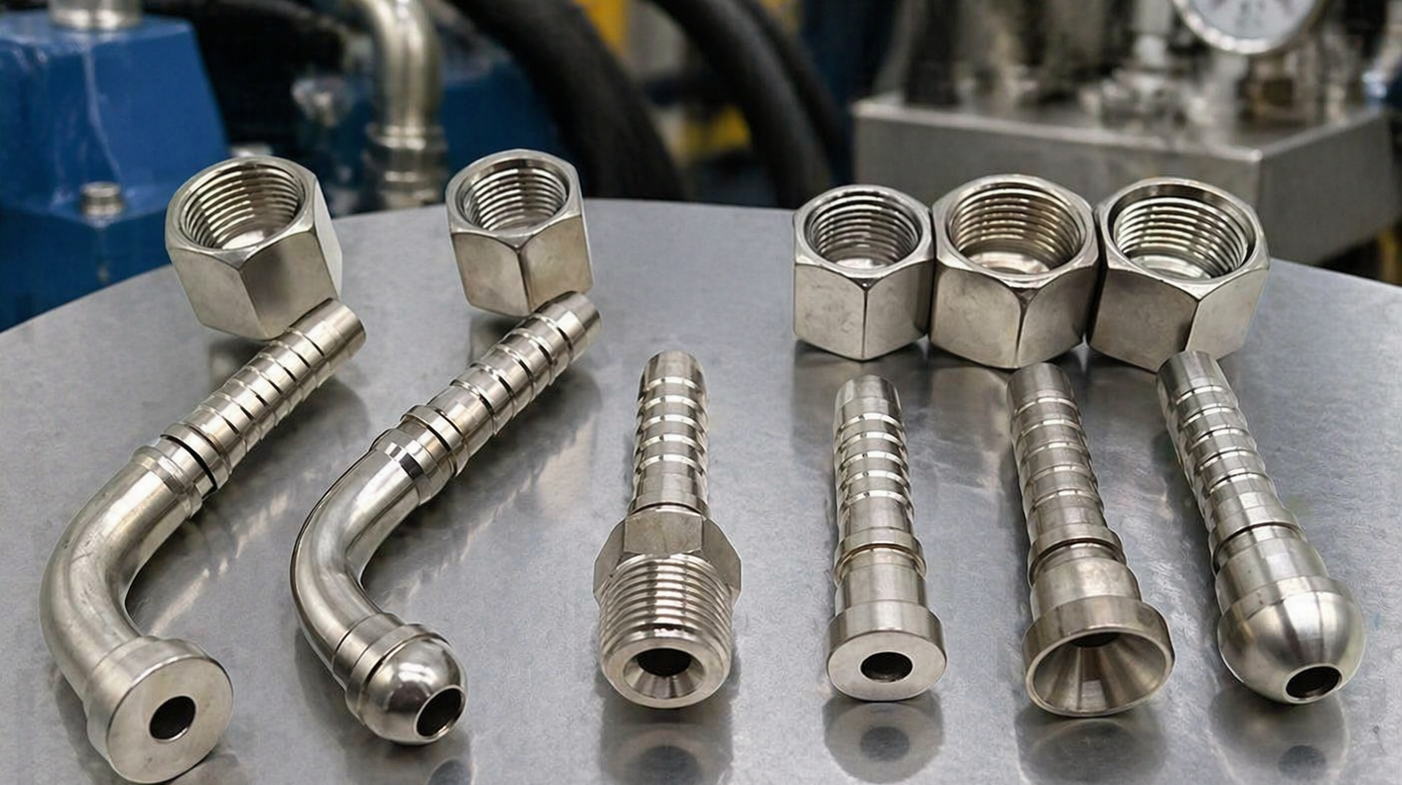
Structural Differences and Sealing Principles
A flange straight fitting consists of two flanges, bolt/nut assemblies, and a sealing gasket (or O-ring). During connection, the flanges are welded or slipped onto the ends of steel pipes, with a seal placed between them. Bolts apply preload to compress the flanges, creating the seal. Common sealing faces include flat face (with O-ring or gasket), raised face, and tongue-and-groove. The number of bolts increases with diameter (e.g., 4-hole, 8-hole, 12-hole), providing uniform and high clamping force.
Threaded fittings rely on direct tightening of male and female threads. Seal types include tapered threads (NPT, R threads) and straight threads with O-rings or combination washers. Large-diameter threaded fittings typically range from 2 inches to 3 inches or larger, with thick walls requiring substantial torque for tightening.
Pressure Capacity at Large Diameter and High Pressure
Under high-pressure conditions, flanged fittings have a distinct advantage. Bolts can provide very high preload, creating uniform and controllable contact pressure on the sealing face, easily withstanding working pressures above 35MPa and even reaching 100MPa. For ultra-high-pressure large-diameter piping (e.g., main supply lines for mining hydraulic roof supports, large press oil lines), flanged connections are the standard choice.
Threaded fittings face challenges at large diameters and high pressures. As diameter increases, stress concentration at thread roots intensifies, making crack initiation more likely. Additionally, the torque required to tighten large-diameter threads is extremely high, making accurate field control difficult. Under-tightening causes leakage; over-tightening may crack the fitting body or damage threads. Therefore, threaded fittings are rarely used for diameters above 2 inches and pressures exceeding 30MPa, except for special heavy-duty threads (e.g., UNS) used with hydraulic torque wrenches.
Sealing Reliability Differences
Flanged fittings use flat-face sealing with O-rings or spiral-wound gaskets, providing very stable sealing performance. The O-ring elastically deforms under bolt preload, compensating for minor flange surface irregularities and thermal distortion. Spiral-wound gaskets are suitable for high-temperature and high-pressure media. Under pressure fluctuations and vibration, the sealing reliability of flanged fittings is far superior to threaded fittings.
Threaded fitting sealing effectiveness is highly dependent on thread machining precision, installation torque, and sealing surface condition. Tapered thread seals require Teflon tape or sealant, have poor vibration resistance, and are unsuitable for high-pressure impulse conditions. Straight threads with O-rings are more reliable, but at large diameters, the O-ring is prone to cutting or extrusion during installation.
Installation and Maintenance Convenience
Flanged fittings require aligning flange holes, inserting bolts, and tightening nuts to specified torque, which is time-consuming and requires access on both sides. However, disassembly and maintenance are very convenient—simply loosen the bolts to separate the line, and seals are easy to replace.
Threaded fittings are relatively quick to install—simply screw the male thread into the female thread and tighten with a wrench. However, tightening large-diameter threaded fittings is extremely laborious, often requiring extended lever arms or hydraulic torque wrenches. Moreover, threads may gall or become damaged during disassembly. After disassembly, threads and sealing surfaces may be compromised, reducing reliability for subsequent use.
Selection Guidelines
Based on the above analysis, the following selection recommendations apply for large-diameter, high-pressure applications:
Working pressure >30MPa and diameter >2 inches: Prioritize flanged straight fittings. Flanged connections provide uniform clamping force, reliable sealing, and excellent vibration/impulse resistance. Typical applications include main supply lines for mining hydraulic roof supports, large press hydraulic systems, and marine propulsion hydraulics.
Working pressure 25-30MPa, diameter 2-3 inches: Both types are possible, requiring trade-offs. If installation space is limited and quick assembly/disassembly is needed, heavy-duty threaded fittings (e.g., SAE straight thread O-ring seal) can be used, but a hydraulic torque wrench is essential for precise torque control. For higher sealing life and long-term reliability, flanged fittings are still recommended.
Diameter >4 inches and pressure >20MPa: Flanged fittings are the only reasonable choice. Threaded fittings are practically impossible to install and maintain reliably at this scale.
Special conditions: For lines requiring frequent disassembly, flanged fittings have lower maintenance costs. For high-vibration environments requiring lock protection, flange bolts can use lock washers. For space-constrained locations where flanges cannot fit, split-flange or clamp-type fittings may be considered.
Summary
In large-diameter, high-pressure hydraulic systems, flanged straight fittings are superior to threaded fittings in sealing reliability, pressure capacity, and long-term maintenance. Although threaded fittings offer faster installation, they suffer from torque control difficulties, stress concentration, and sealing instability at large diameters and high pressures. Therefore, when working pressure exceeds 30MPa or diameter exceeds 2 inches, flanged fittings are the clear choice. For moderate pressures or small diameters, threaded fittings retain advantages in cost and convenience. Correct selection ensures safe, long-lasting operation of hydraulic piping under demanding high-flow, high-pressure conditions.
