
In high-pressure hydraulic systems, hose selection directly impacts equipment safety and operational efficiency. EN 856 is the authoritative European standard for spiral wire reinforced hydraulic hoses, covering four common types: 4SP, 4SH, R12, and R13. Though similar in construction, they differ significantly in pressure rating, temperature resistance, and application scenarios. This article provides a systematic comparison.
1. EN 856 Standard Overview
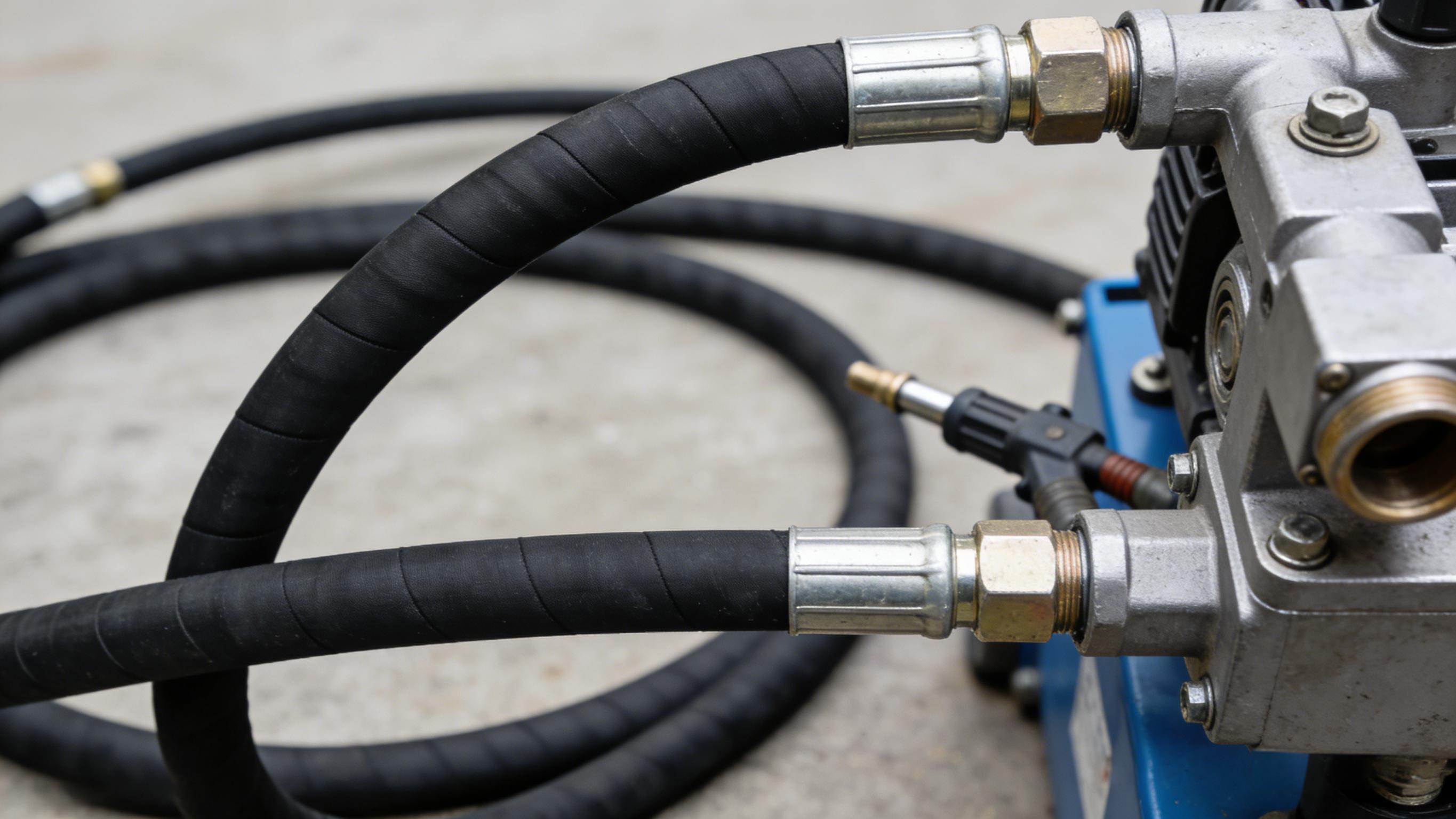
EN 856 specifies requirements for four types of rubber-lined spiral wire reinforced hydraulic hoses with nominal inside diameters from 6 to 51 mm: Types 4SP, 4SH, R12, and R13. The standard does not cover end fittings. Hoses consist of an oil- and water-resistant synthetic rubber liner, alternating-direction steel wire spiral layers, and an oil- and weather-resistant rubber cover. Each wire layer is separated by an insulating rubber layer.
2. Core Differences Among the Four Types
Pressure Rating
Pressure capability from lowest to highest: R12 ≈ 4SP < R13 ≈ 4SH, with variations by size:
4SP: 4-wire spiral, medium-pressure. DN10: working pressure 445 bar, burst 1,780 bar.
4SH: 4-wire spiral, extra-high-pressure. DN19: working pressure 420 bar, burst 1,680 bar.
R12: 4-wire spiral, medium-pressure high-temperature. DN10: working pressure 280 bar.
R13: Multi-wire spiral, high-pressure high-temperature. DN19: working pressure 350 bar, burst 1,400 bar.
Temperature Range
4SP & 4SH: -40°C to +100°C.
R12 & R13: -40°C to +120°C – suitable for high-temperature conditions.
Impulse Fatigue Life (per EN ISO 6803)
4SP & 4SH: Tested at 100°C, impulse pressure at 133% of working pressure, minimum 400,000 cycles.
R12 & R13: Tested at 120°C; R12 at 133%, R13 at 120% of working pressure; minimum 500,000 cycles. R12/R13 offer longer life at higher temperatures.
Length Change (per EN ISO 1402 at working pressure)
4SP & 4SH: +2% to -4%.
R12 & R13: +2% to -2% – better dimensional stability.
3. Application Scenarios
4SP: Construction machinery, agricultural equipment, industrial vehicles, and general high-pressure hydraulic systems; widely used in metallurgy and mining as high-pressure oil transmission lines.
4SH: Extra-high-pressure hydraulic systems such as heavy construction machinery main circuits.
R12: Medium-pressure systems operating in high-temperature environments.
R13: High-pressure systems in high-temperature environments such as metallurgical equipment and die-casting machines.
4. Quick Selection Guide
4SP: Medium pressure, ≤100°C, standard impulse fatigue → General hydraulic applications
4SH: Extra-high pressure, ≤100°C → Ultra-high-pressure systems
R12: Medium pressure, ≤120°C, higher impulse life → High-temperature medium-pressure systems
R13: High pressure, ≤120°C, higher impulse life → High-temperature high-pressure systems
Summary
Select based on working pressure, ambient temperature, and impulse frequency. For high-temperature conventional applications, choose R12/R13. For high-pressure ambient-temperature applications, choose 4SP. For extra-high-pressure ambient-temperature applications, choose 4SH. For high-temperature high-pressure applications, prioritize R13. Always consult a professional supplier with your specific operating conditions.
