
In the daily operations of excavators, every boom lift, arm extension and retraction, and bucket tilt depends on precise and efficient power transmission from the hydraulic system. The hydraulic lines that bear the highest pressure and most frequent impulse shocks are precisely the ultra-high pressure steel wire spiral hoses—they serve as the "aorta" of construction machinery, continuously delivering hydraulic power from the main pump to every actuator.
I. What Is an Ultra-High Pressure Steel Wire Spiral Hose?
An ultra-high pressure steel wire spiral hose is a high-pressure-resistant hose that uses steel wire spiral layers as its reinforcement skeleton, primarily composed of an inner tube, reinforcement layers, and an outer cover. Unlike braided hoses, the reinforcement layers of spiral hoses consist of multiple layers of steel wire arranged in tight helical windings, with thin rubber layers between them for isolation, and each layer wound in alternating directions.
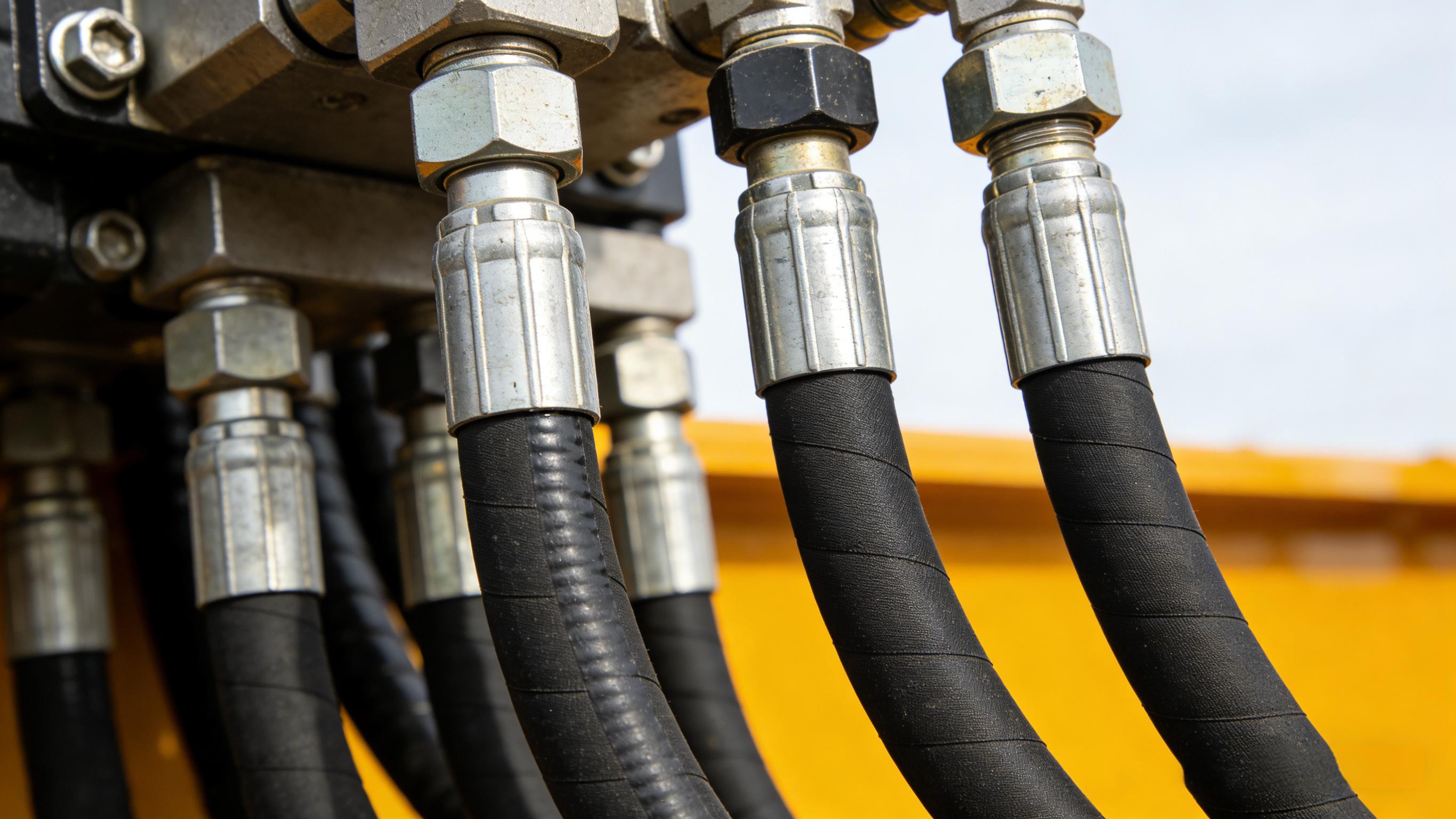
To visualize the difference: a braided hose is like ancient "chainmail"—wires cross over each other, flexible but with numerous friction points; a spiral hose, on the other hand, is like tightly wound tape around a water pipe—layer upon layer, forming a solid "steel shell." This structural difference determines the unique advantages of spiral hoses under ultra-high pressure and high-impulse conditions.
II. EN 856 4SH Standard: The Standard for Excavator Ultra-High Pressure Circuits
In excavator hydraulic systems, the EN 856 4SH hose is one of the most widely used ultra-high pressure steel wire spiral hose models. 4SH represents a four-layer alternating spiral steel wire construction, with an operating temperature range of -40°C to +100°C and impulse life far exceeding that of ordinary braided hoses.
Key technical parameters of 4SH hoses:
Working Pressure: Varies by bore size—42MPa for 3/4 inch, 38MPa for 1 inch, 32.5MPa for 1-1/4 inch
Burst Pressure: 4 times the working pressure, with an exceptionally high safety factor
Minimum Bend Radius: For example, 460mm for DN32
Impulse Life: Premium 4SH hoses can achieve over 600,000 impulse cycles
In terms of construction, the 4SH hose features an oil-resistant synthetic rubber (NBR) inner tube, four alternating layers of high-strength steel wire for reinforcement, and an abrasion-resistant, weather-resistant synthetic rubber outer cover. Compared to 4SP under the same EN 856 standard, 4SH offers higher braid density, thicker walls, and a 30% thicker outer cover, providing superior abrasion resistance and mechanical impact resistance.
III. Application Scenarios in Excavator Hydraulic Systems
The hydraulic system of an excavator covers five major actions—boom, arm, bucket, travel, and swing—with different circuits imposing varying pressure and flexibility requirements on the hoses.
The boom main cylinder circuit is one of the highest-pressure and most impulse-intensive circuits in the entire machine. During boom lifting and lowering, the hose withstands continuous cyclic pressure fluctuations. With its four-layer steel wire spiral construction, the 4SH hose maintains stability under frequent bending and high-pressure impacts, making it the standard specification for large excavator boom main cylinders.
The hydraulic breaker main line faces high-frequency impacts and sudden pressure changes. Ordinary braided hoses suffer severe wire cross-friction under high-frequency impulses, significantly shortening service life; the 4SH spiral hose, with its non-crossing spiral structure, easily withstands over one million impulse cycles, supporting continuous breaking operations without bursting or leaking.
The travel motor line endures long-term high-frequency vibration, where the 4SH hose's anti-twist performance and impulse resistance make it a reliable choice for travel circuits.
IV. Spiral vs. Braided: Key Selection Considerations
In construction machinery hydraulic line selection, spiral hoses and braided hoses each have their applicable scenarios:
Braided hoses (such as SAE 100R1, R2) offer better flexibility, smaller bend radii, and lower cost, making them suitable for medium-to-high-pressure circuits in conventional excavators and loaders.
Spiral hoses (such as EN 856 4SH, SAE 100R15) are designed for ultra-high-pressure applications. Their impulse fatigue life is typically 3 to 5 times that of braided hoses. Although they are approximately 20% to 30% heavier and more expensive, their service life is usually over 2.5 times that of braided hoses, resulting in lower total long-term cost of ownership.
For impact-type equipment such as breakers and hydraulic impact drills, spiral hoses offer better cost-effectiveness; for ultra-high-pressure hydraulic systems, spiral hoses are mandatory. SAE 100R15 is currently one of the highest pressure-rated series and is widely recognized as the "gold standard" for ultra-high-pressure equipment such as giant mining excavators and tunnel boring machines.
V. Conclusion
The ultra-high pressure steel wire spiral hose is called the "aorta" of construction machinery not only because it carries hydraulic pressure of tens of megapascals, but also because its spirally wound steel wire skeleton ensures stable, safe hydraulic power delivery through every pressure impulse and every mechanical bend. From the powerful boom lift of an excavator to the high-frequency impact of a breaker, the 4SH spiral hose—with its four layers of steel wire providing layer upon layer of protection—embodies the ultimate pursuit of reliability in core components of construction machinery.
