
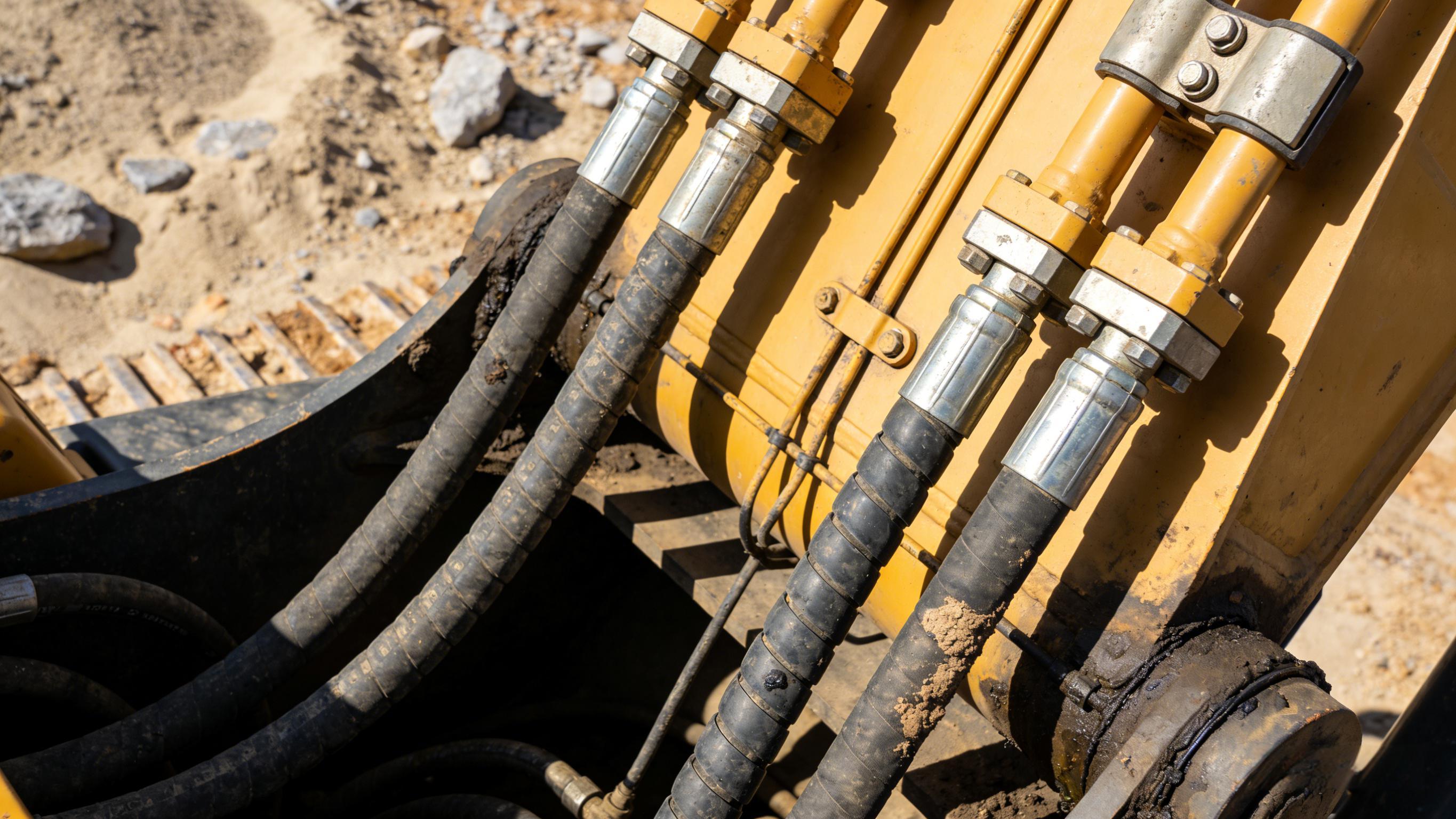
Within the confined chassis space of an excavator or the complex articulation points of mining machinery, routing hydraulic hoses often presents a dilemma: an excessively large bend radius leads to installation difficulties and interference/wear with components, while forcing a tight bend angle drastically weakens the hose's pressure-bearing capacity, causing bulging or bursts. So, is there a solution that is both "flexible" for easy installation and "tough" to withstand high pressure? This article delves into the secrets behind achieving this technical balance.
Traditionally, the "flexibility" and "toughness" of hydraulic hoses have been seen as a contradiction. To withstand high pressure, multiple layers of robust steel wire reinforcement are needed, which often makes the hose "stiffer" and increases its minimum bend radius. Conversely, pursuing softness and easy bendability can come at the cost of pressure rating and pulse life. This contradiction is particularly acute in harsh working environments like construction and mining equipment, where hoses must navigate tight spaces (low bending) while also enduring continuous high-pressure surges and pulse counts in the millions (high pressure, long life).
The core of achieving "low bending" lies in enabling the hose to bend easily without damage while under immense internal stress. The remarkable claim in the provided materials—"bend radius reduced by 50% compared to DIN EN853 standard"—stems from two key technical supports:
Reinforcement Layer Revolution: "Four-layer wound high-strength, super-flexible steel wire"
"High-strength" ensures the tensile strength of the steel wire itself, forming the foundation for high-pressure capability.
"Super-flexible" is the key to achieving a small bend radius. Through special steel treatment processes and winding techniques, the wire maintains high strength while possessing excellent flexibility. The precise four-layer wound structure allows the layers to slide smoothly relative to each other during bending, dispersing stress and avoiding localized stress concentration that leads to wire fatigue failure.
Holistic Optimization: Synergistic Rubber Layers
The inner tube, cover, and reinforcement must be optimized in unison. The oil-resistant synthetic rubber inner tube needs good pliability to conform to the bending deformation of the wire layers without delamination.
The wear-and-weather-resistant cover not only provides protection; its formulation must also ensure it doesn't crack under frequent bending. This integrated design ensures all components work in harmony even under extreme bending.
While achieving "flexibility," the materials indicate a 30%-40% increase in pressure performance over the DIN EN853 standard. This "toughness" originates from more robust defense and more reliable sealing.
The "Armor" Effect of the Reinforcement: The winding angle and density of the four-layer super-flexible steel wire are precisely calculated. Under pressure, this creates an optimal force distribution network, converting radial fluid pressure into tensile force within the wires, thereby significantly increasing burst pressure and the limit of working pressure. This is the structural foundation for the pressure increase.
The Fitting: The Decisive "Strategic Point": No matter how strong the hose body is, it's all for nothing if the fitting is weak. The materials detail the fitting's robust construction:
Stem: 45# Steel, Nut: 35# Steel, Ferrule: 20# Steel: This combination ensures the mechanical strength and fatigue resistance of the fitting body itself.
Hydrogenated Nitrile Rubber (HNBR) Seal: With a resistance to aging of over 10 years, it far surpasses ordinary nitrile rubber, guaranteeing a stable seal interface even under long-term pressure pulses and temperature changes, eliminating leakage. This is the core enabler behind the promise: "Using LETONG dedicated one-piece hose fittings, pulse life >= 1 million cycles."
Advantage of One-Piece Fittings: Compared to reusable fittings, dedicated one-piece hose fittings are precision-assembled in the factory, eliminating potential errors from field assembly. They integrate with the hose body to form a true "single unit," allowing high-pressure fluid to flow through the fitting area with smoother pressure transfer, free from turbulence and dead spots. This极大地 (greatly) enhances the pulse life and pressure ceiling of the entire pipeline system.
Technical excellence requires measurement against standards and backing by commitments.
ISO 18752-CC Standard: Compliance with this international standard means the product has undergone rigorous testing and certification for comprehensive performance in pulse, burst, oil resistance, ozone resistance, etc. It is the foundation for the credibility of the "flexibility" and "toughness" performance data.
5-Year Weather Resistance, 3-Year Warranty: This data pair offers a clear quality expectation. The 3-year warranty demonstrates the manufacturer's strong confidence in the product's long-term reliability across a broad temperature range (-40°C to +100°C) when conveying water-glycol, petroleum-based, and biodegradable hydraulic fluids.
The "flexibility" and "toughness" of high-pressure hydraulic hoses are not mutually exclusive. Through systematic innovation—featuring an intelligent wound structure of high-strength, super-flexible steel wire, synergistic inner/outer rubber formulations, and one-piece fittings made from quality steel with HNBR seals—modern hose technology can achieve exceptional performance: a 50% reduction in bend radius coupled with a 30%-40% increase in pressure capability. Choosing a product that complies with the ISO 18752-CC standard and offers a long warranty means choosing spatial layout freedom and durable reliability for your construction, mining, or agricultural machinery in harsh environments. It fundamentally resolves the long-standing contradiction between high pressure and space constraints.

Leave A Comment