
In hydraulic hose assemblies, the connection quality between the fitting and the hose directly determines system reliability, safety, and maintenance costs. Currently, two mainstream connection methods dominate the market—one-piece (integral no-skimming) fittings and traditional crimp (two-piece) fittings—and they differ significantly in structural design, assembly processes, and long-term durability. Based on actual 1,000,000 impulse test data, this article provides an in-depth comparison of these two fitting types to help you make a better selection decision.
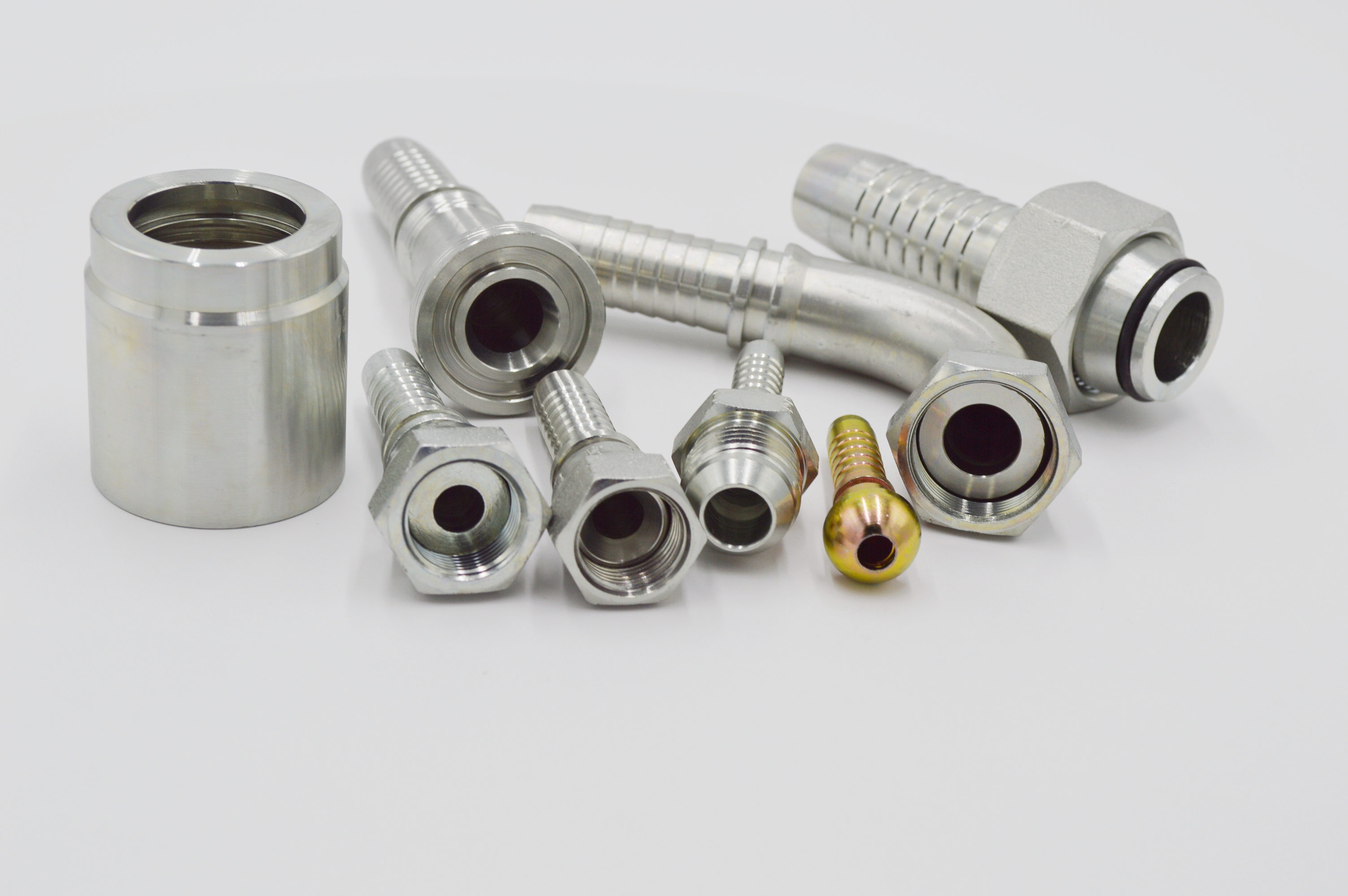
I. Structural Differences Between the Two Fittings
A traditional crimp fitting is a two-piece structure typically consisting of three separate components: an insert, a ferrule, and a coupling piece. During assembly, the ferrule is first slipped over the hose, the insert is pushed into the hose end, and then a dedicated crimping machine applies high pressure to compress the ferrule‘s serrated grooves into the hose’s inner tube and steel wire reinforcement, creating a permanent connection. The advantages of this structure include compact size, light weight, high reliability, and high production efficiency. However, its disadvantages are also evident: the fitting cannot be reused, and assembly typically requires skiving (removing) the hose cover layer, making the process more complex and demanding higher operator skill.
A one-piece fitting, by contrast, features an integral design where the insert and coupling piece are combined into a single component, and the ferrule is part of the fitting body. During assembly, there is no need to disassemble the fitting into multiple parts, nor is any hose skiving required. The hose is simply inserted into the fitting and crimped. This structural design greatly simplifies the assembly process and eliminates crimping issues caused by excessive or insufficient skiving.
II. The 1,000,000 Impulse Test: A Clear Life Gap
The impulse test is a core test method for evaluating the durability of hydraulic hose assemblies under repeated pressure cycles. In the test, the hose assembly is bent to 90° or 180°, connected to a test rig with high-temperature test fluid, and subjected to cyclic pressure at a certain frequency. The test continues until leakage, bursting, or other failure occurs, and the number of cycles completed is recorded.
One-piece fittings perform exceptionally well in impulse testing. Taking a well-known hydraulic hose manufacturer‘s Super Hercules low-bend series hoses as an example, this series uses one-piece no-skimming fittings, and the entire hose range achieves impulse counts of over 1,000,000 cycles. This means that under standard operating conditions, hose assemblies with one-piece fittings have significantly longer service lives than traditional crimp fittings, enabling stable long-term operation in high-pressure, high-frequency hydraulic systems.
In contrast, traditional crimp fittings have clearance gaps between multiple components, and if the skiving process is not properly controlled during crimping, the inner tube and steel wire reinforcement are easily damaged, resulting in impulse lives significantly shorter than those of one-piece designs. In actual impulse tests, many traditional crimp hose assemblies develop leakage at the fitting or hose pull-out failures after 500,000 to 800,000 cycles.
III. Core Advantages of One-Piece Fittings
The superior impulse test performance of one-piece fittings is attributed to several key factors. First, the no-skimming design completely eliminates human error in the skiving process, avoiding insufficient sealing in the crimp area due to excessive skiving or damage to the steel wire layer due to insufficient skiving. Second, the integral structure of a one-piece fitting has no weld points, eliminating leakage risks caused by welding defects. Third, when combined with HNBR seals, one-piece fittings achieve sealing performance approaching zero leakage. Additionally, one-piece fittings offer advantages such as easy installation, labor savings, and the ability to use one fitting type with multiple hose constructions, effectively reducing inventory costs and management complexity.
IV. Selection Recommendations and Summary
In summary, if your hydraulic system demands high reliability, long service life, and installation efficiency, one-piece fittings are the superior choice. Particularly in harsh operating environments such as construction machinery, mining equipment, and agricultural machinery—where maintenance is difficult—one-piece fittings significantly reduce equipment downtime and maintenance costs. Traditional crimp fittings remain suitable for cost-sensitive applications, limited assembly conditions, and lower-pressure industrial scenarios.
The gap revealed by the 1,000,000 impulse test is not merely a difference in numbers—it is a direct reflection of reliability and safety. Choosing a one-piece fitting means choosing longer service life, lower leakage risk, and a more efficient assembly experience.
