
In metal surface treatment, ship rust removal, bridge maintenance, and pipe cleaning, sandblasting and high-pressure water jet rust removal are two mainstream processes. Both impose extremely demanding requirements on high-pressure hoses—the hose must not only withstand very high pressures but also resist high-speed abrasive particle erosion or repeated ultra-high-pressure water jet impacts. Choosing the wrong hose leads not only to frequent bursts and work interruptions but also to serious safety accidents. This article provides a detailed analysis of key hose selection points for sandblasting rust removal and high-pressure water jet rust removal.
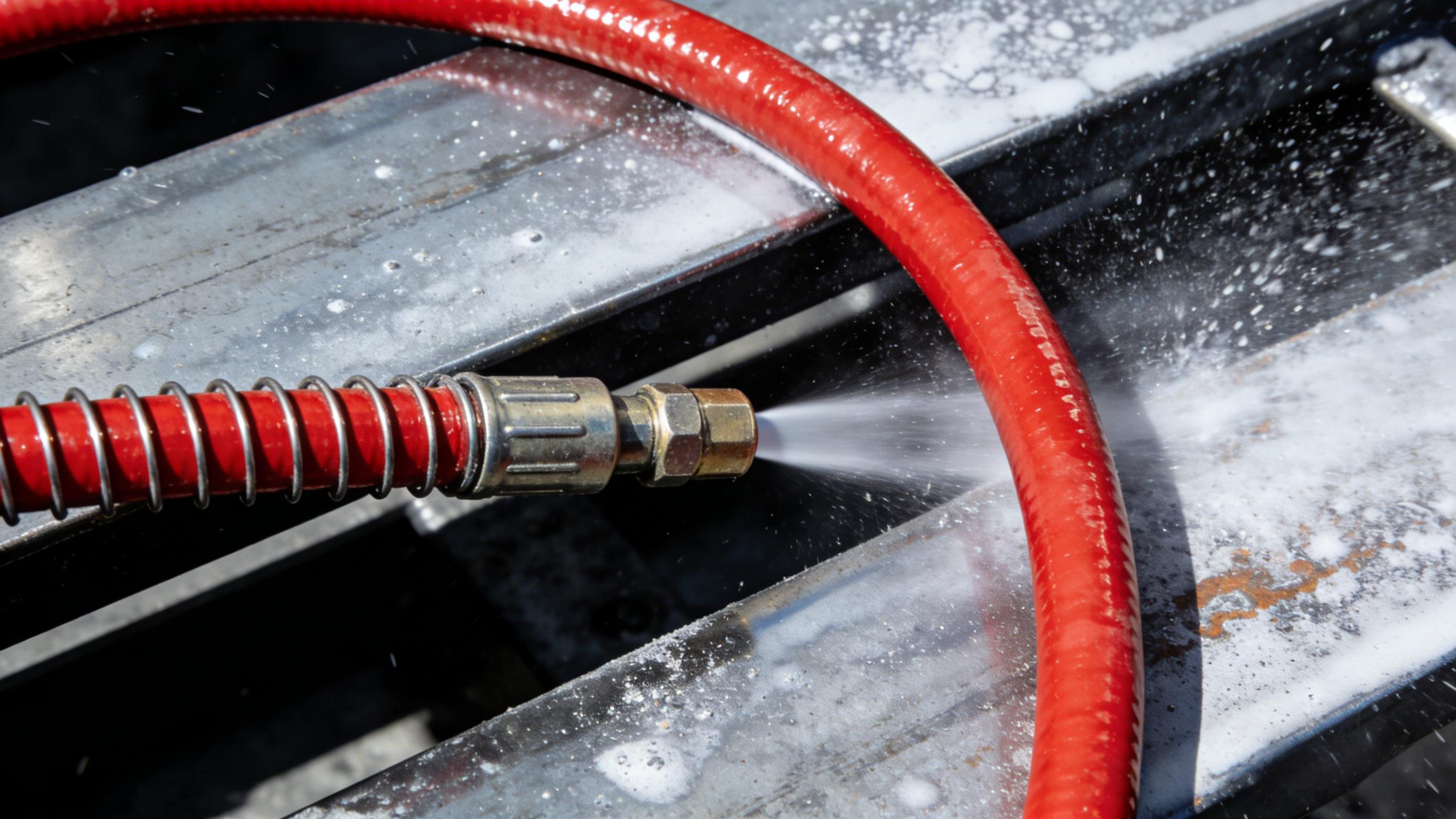
I. Sandblasting Rust Removal Hoses: Wear Resistance and Pressure Resistance Are Both Essential
Sandblasting rust removal uses compressed air to accelerate abrasives such as silica sand, steel shot, or copper slag onto a workpiece surface, removing rust and scale through impact energy. Under these conditions, the hose must withstand not only moderate air pressure (typically 6 to 12 bar) but also severe internal erosion from high-speed abrasive particles. Ordinary compressed air hoses often wear through within hours in sandblasting service.
The key selection points for sandblasting rust removal hoses are as follows. First, the inner tube must have extremely high abrasion resistance. Dedicated sandblasting hoses use natural rubber or special polyurethane formulations with a Shore hardness of 60 to 70A, combined with good elasticity to absorb impact energy. Second, the reinforcement must provide adequate pressure strength. Although sandblasting pressure is not extremely high, air impulse shocks and abrasive flow add dynamic loads—two or four layers of textile braid or spiral wrap are recommended. Third, the cover should be oil-resistant, weather-resistant, and ozone-resistant, as rust removal sites often involve oil mist, water spray, and UV exposure. Fourth, the bend radius should be as small as possible for easy maneuverability on complex surfaces. Additionally, fittings should be dedicated internal-expanding or external-crimp sandblast couplings, with smooth transitions between fitting and hose IDs to avoid abrasive accumulation and localized wear. Common inner diameters are 1 inch, 1.25 inches, 1.5 inches, and 2 inches, chosen based on the blast nozzle size and material feed line diameter.
II. High Pressure Water Jet Rust Removal Hoses: Balancing Ultra-High Pressure and Flexibility
High pressure water jet rust removal uses water pressurized to over 1000 bar (up to 3000 bar) through a specialized rotating nozzle, creating a water knife that strips rust and old paint. This process generates no dust, is environmentally friendly and efficient, but places extreme demands on hoses. The hose must maintain reliable sealing under extreme pressure while offering good flexibility for manual handling.
Selection points include the following. First, the working pressure rating must exceed the equipment’s maximum output pressure with a substantial safety margin. Typical ultra-high pressure water jet hoses are rated at 1400 bar, 2000 bar, or even 2800 bar, with burst pressures of at least 2.5 times the working pressure. Second, inner diameters are generally small—common sizes are 1/4 inch, 3/8 inch, or 10 mm—because smaller IDs reduce water hammer effects and reaction forces. Third, the reinforcement uses multiple layers of high-strength steel wire spiral (e.g., 4, 6, or even 8 layers) to ensure dimensional stability and fatigue resistance under ultra-high pressure. Fourth, the inner tube material is typically high-density polyethylene or nylon, which have extremely low permeability and do not react with pure water or additives. Fifth, the cover must be abrasion-resistant, hydrolysis-resistant, and UV-resistant, as water jet environments are wet and hoses are frequently dragged on the ground. Sixth, fittings must be forged ultra-high pressure couplings with threaded lock or crimp connections, capable of withstanding repeated pressure surges.
III. Comparison of the Two Hose Types and General Recommendations
Sandblasting hoses prioritize inner tube abrasion resistance, operate at moderate pressures, have relatively thick walls but larger bend radii. Ultra-high pressure water jet hoses prioritize ultra-high pressure resistance and low permeability, with very thick walls but specially engineered flexibility that allows very small bend radii. The two types are not interchangeable: using a sandblast hose for ultra-high pressure water jet will cause immediate burst; using a water jet hose for sandblasting will quickly wear through the inner tube.
For either type, pay attention to the manufacturer’s impulse test data, fitting fatigue life, and safety factor. Purchase from reputable brands and request factory test reports. Before each use, inspect the cover for cuts, blisters, and fittings for leaks. High pressure hoses are consumables—replace them when they reach the recommended service life; never use them beyond their safe working life.
In summary, for sandblasting rust removal, prioritize wear-resistant inner tubes with textile reinforcement. For high pressure water jet rust removal, you must select ultra-high pressure steel wire spiral hoses with low-permeability liners. Correct selection is the first line of defense for safe operation.
