
In offshore oil and gas field development, hose assemblies play a critical role. From mud circulation in deepwater drilling operations to crude oil offloading from FPSOs and safety protection in platform fire-fighting systems, various specialized hose assemblies form the “vascular system” of offshore energy extraction. This article analyzes the technical requirements and application characteristics of hose assemblies across the full process from drilling to production.
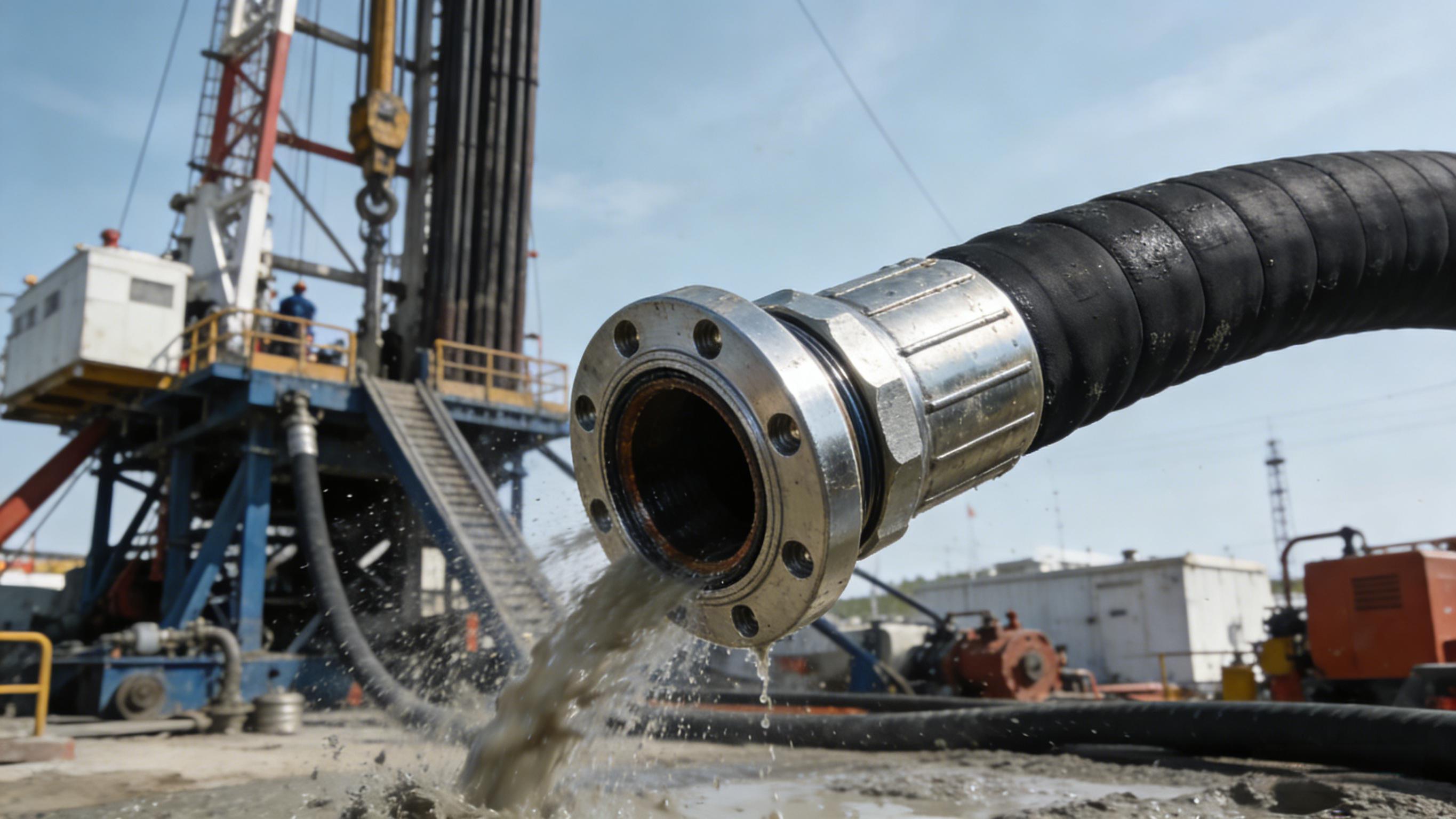
Drilling Stage: High-Pressure Wear Resistance and Motion Compensation
During drilling operations, hose assemblies must withstand high pressure, high flow velocity, and strong corrosion. The inner tube of mud delivery hoses often uses a composite of HNBR and PTFE. The former provides excellent oil resistance while the latter reduces the friction coefficient to 0.04, significantly mitigating erosion of the tube wall by drilling fluid. In conveying drilling fluid with 12% sand content, the wear rate is only 0.015mm per thousand hours, extending service life by five times compared to traditional liners. For the reinforcement layer, API 7K standard hoses commonly adopt a composite structure of “double-spiral high-carbon steel wire plus stainless steel braid”, providing a burst pressure of ≥20MPa while resisting external impacts from sharp objects. Fittings are dual-certified to API 7K and DNV GL, using forged carbon steel flanges with metal wound gaskets and O-rings for double sealing. For the dynamic compensation needs of semi-submersible drilling platforms, tensioner hoses (compliant with API Spec 7K/API Spec 17K) are used to compensate for drill string heave, typically requiring flame-resistant hydraulic hoses to ensure stable delivery of fire-resistant hydraulic fluids under extreme conditions.
Production and Transfer Stage: Corrosion Resistance and Fatigue Resistance
The production stage presents dual challenges of sour crude oil and seawater corrosion. Jumper hoses serve as the critical link between FPSOs and single-point mooring systems for crude oil transfer, earning the title of “subsea lifeline”. API 17K standard dynamic hoses are specifically designed for high-intensity offshore engineering scenarios. Their inner tube uses UHMWPE or PTFE with a thickness of up to 4.0mm, capable of resisting H₂S, CO₂, chlorides, and various chemical agents present in oil and gas, fundamentally solving the problem of corrosion and swelling common to traditional rubber liners. The reinforcement layer uses a high-strength extra-flexible copper-plated steel wire braided/spiral structure. The high-strength steel wires provide the strength to withstand thousands of psi of internal pressure, while the “extra-flexible” property ensures the hose maintains the dynamic bending performance necessary to absorb wave and current-induced motion. The cover layer is combined with stainless steel armor to resist deepwater hydrostatic pressure and protect against external impacts such as fishing net snags and falling objects. For long-term offshore transfer, API 17K bonded flexible hoses offer an ultra-wide temperature range of -29°C to +121°C, capable of long-term transfer of complex corrosive media including seawater, H₂S, and CO₂, with a service life exceeding 20 years.
Well Control and Safety: Fire Resistance and Blowout Prevention
Well control safety is paramount for offshore platforms. BOP control lines connect the drilling rig to the subsea BOP stack, carrying hydraulic control signals. API 16D fire-resistant hoses are specifically designed for drilling equipment control systems. They can withstand flame temperatures exceeding 700°C for several minutes without failure, ensuring that well control systems remain operational during a fire. These hoses feature a multi-layer construction – the inner tube is made of stainless steel or high-grade alloy, the reinforcement layer uses high-strength steel wire braid to withstand external pressure, and the exterior is coated with an advanced fire-resistant coating. Additionally, flexible choke and kill hoses (API 16C standard) serve as flexible connections for choke and kill manifolds, adapting to platform movement and displacement in complex offshore operating environments while stably delivering hazardous oil-gas mixtures and various kill fluids.
Platform Operation and Maintenance: Stringent Certification and Full-Scenario Adaptation
Offshore platforms demand extremely high reliability and safety from hose assemblies. Classification society certification is a core benchmark of product quality – international authorities including ABS, DNV, LR, and CCS require hoses to undergo rigorous pressure testing, impulse testing, and fire resistance testing. Major international brands such as Gates and Alfagomma, as well as leading domestic manufacturers, have obtained multiple certifications including API, ABS, and DNV, with products widely used in drilling rigs, FPSOs, and subsea hydraulic circuits. For platform operation and maintenance, hoses must also provide flame resistance, abrasion resistance, UV resistance, and salt spray resistance to withstand continuous erosion from the marine environment. Hose assembly selection must precisely match the actual operating conditions – including media, pressure, temperature, and corrosion environment – to ensure safe and efficient offshore energy extraction.
