
In the oil & gas drilling and offshore engineering sectors, the safety of hose assemblies directly impacts well control safety, operational efficiency, and human lives. The three major hose standards established by the American Petroleum Institute (API)—API Spec 7K, API Spec 16C, and API Spec 17K—correspond respectively to drilling operations, well control systems, and subsea oil & gas transfer. Together, they form a comprehensive certification system for hose assemblies in oil drilling and offshore platforms. Understanding the scope and technical requirements of these three standards is the first step toward correct selection and engineering safety assurance.
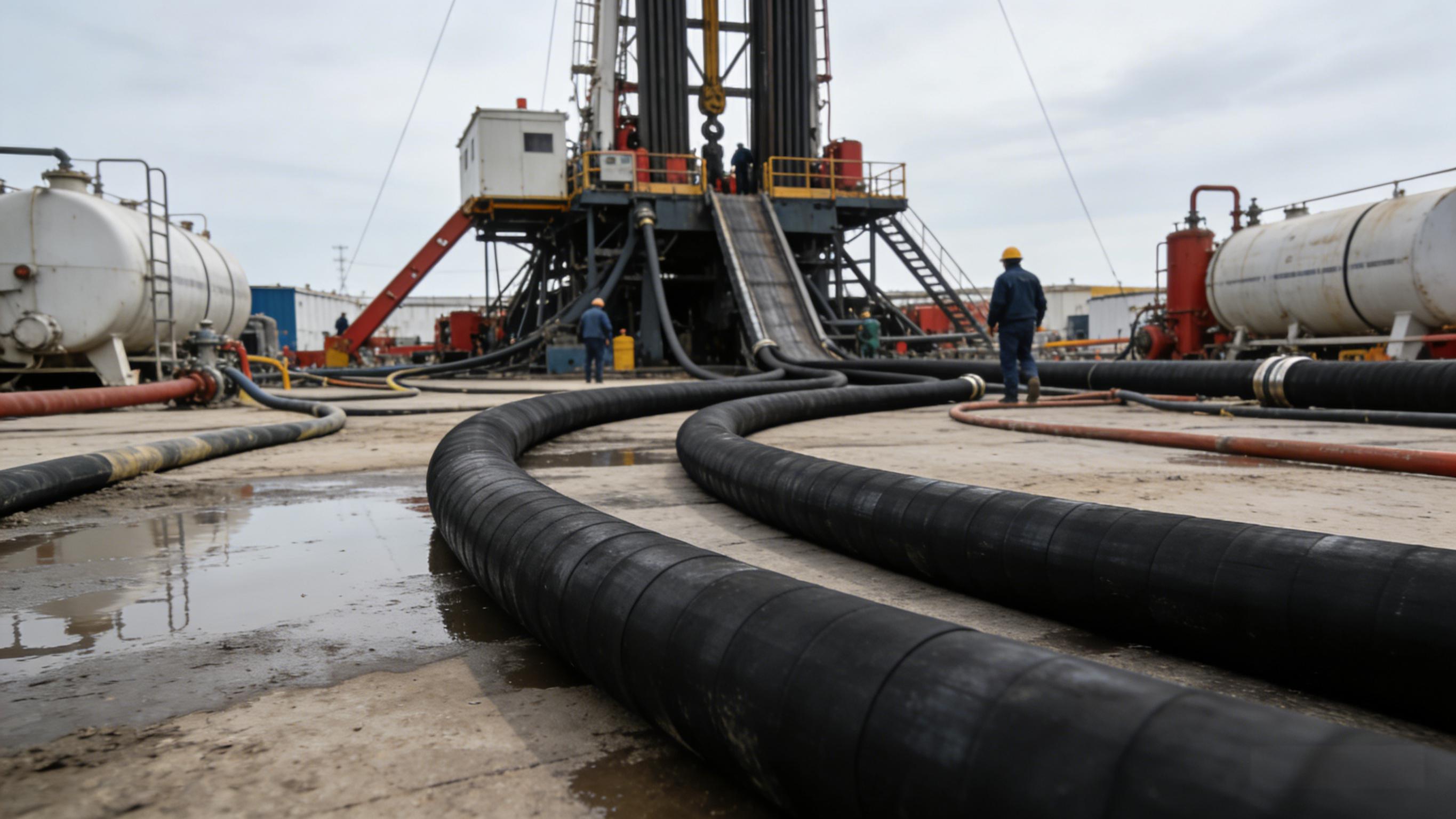
I. API Spec 7K: The “Load-Bearing Wall” of Drilling Equipment
API 7K is the foundational specification for rotary drilling equipment, covering drilling rotary hoses, high-pressure cement hoses, shock-absorbing hoses, and related products. This standard specifies comprehensive requirements for the design, materials, manufacturing, and testing of hoses, including oil-resistant and chemically resistant inner tube performance, reinforcement wire strength and toughness, and key tests such as pressure testing, impulse testing, and bend testing. In terms of technical parameters, API 7K hoses have a working pressure range of 1500 to 15000 PSI, inner diameters from 2 to 6 inches, and an operating temperature range of -20℃ to 121℃, with some low-temperature variants capable of withstanding -50℃. Burst pressure is no less than 2.5 times the working pressure. This standard applies to flexible connections in drilling and workover operations between the standpipe and top drive, and between the pump and standpipe, for high-pressure mud pumping. API 7K certification requires hoses to pass a burst test at 2.5 times the rated working pressure, with test parameters 20% higher than international standards, creating a high technical barrier.
II. API Spec 16C: The “Firewall” of Well Control Safety
API 16C is specifically designed for flexible choke and kill system hoses, serving as the core defense line for well control safety. The most distinctive feature of this standard is the introduction of the FSL (Fire Severity Level) classification system, which divides hose fire resistance into four levels from FSL 0 to FSL 3. FSL 0 has no fire resistance requirement; FSL 1 and FSL 2 require the hose to maintain pressure during and after fire exposure; FSL 3, the highest fire resistance level, requires the hose to maintain pressure during and after fire exposure and also withstand a validation pressure after cooling, making it suitable for high-risk areas such as offshore drilling platforms and sour oil and gas fields. API 16C hoses can withstand 704℃ open flame for 30 minutes without failure. The cover uses high-temperature and fire-resistant synthetic rubber that forms a hard ceramic char layer at high temperatures, effectively blocking heat transfer. In terms of media compatibility, API 16C specifically emphasizes the hose‘s ability to withstand hazardous media such as hydrogen sulfide (H₂S), requiring materials to possess resistance to sulfide stress corrosion cracking, and uses integral unions or flanges for high sealing integrity.
III. API Spec 17K: The “Vascular System” of Deepwater Engineering
API 17K is the international standard for bonded flexible pipes, applicable to deepwater oil & gas transfer, water injection, gas injection, gas lift, and subsea production systems. Unlike the unbonded flexible pipes specified in API 17J, hoses under API 17K have all layers bonded together, providing higher structural integrity and fatigue resistance. The technical requirements of this standard are extremely stringent: hoses must withstand working pressures up to 600 MPa, ensuring no bursting or deformation in high-pressure deepwater environments thousands of meters below the surface. In terms of construction, API 17K hoses feature an inner tube of UPE or PTFE with a thickness of up to 4.0 mm, providing strong chemical inertness to resist H₂S, CO₂, and seawater corrosion. The reinforcement layer uses a composite of multiple layers of high-strength extra-flexible copper-plated steel wire and polyester fiber braid. The cover layer is combined with stainless steel armor, forming a robust external shield. The standard also specifies requirements for the hose’s service life under dynamic loads, fatigue cycles, and chemical corrosion environments, with a design life of several decades in deepwater conditions.
IV. Certification System and Standard Synergy
The certification systems of the three standards complement each other. API 7K and API 16C hoses typically also require classification society certifications such as ABS, DNV, CCS, and BV. For example, tensioner hoses comply with both API Spec 7K and API Spec 17K standards while also meeting the API Spec 16C requirement of 704℃×30 minutes fire resistance, achieving synergistic coverage across all three standards.
V. Selection Guidelines
In practical engineering, the appropriate standard should be selected based on equipment specifications and operational scenarios: choose API 7K for rotary drilling and mud transfer; choose API 16C for choke and kill systems, with FSL level determined by fire risk level—FSL 3 with classification society certification is the priority for offshore drilling platforms; choose API 17K for deepwater oil & gas transfer and subsea production systems. Understanding the core differences and applicable scenarios of these three standards is the foundation for correct selection and safe operation assurance in oil drilling and offshore engineering.
