
In high-pressure hydraulic systems, the fitting seal type directly determines leakage risk and maintenance frequency. Cone seal fittings (such as JIC 37° flare and metric 24° cone ferrule) and O-ring face seal fittings (such as ORFS) are the two most widely used types in high-pressure applications. They differ significantly in sealing principles, pressure ratings, vibration resistance, and maintainability. This article compares their actual performance under high-pressure conditions to determine which seal type is more reliable.
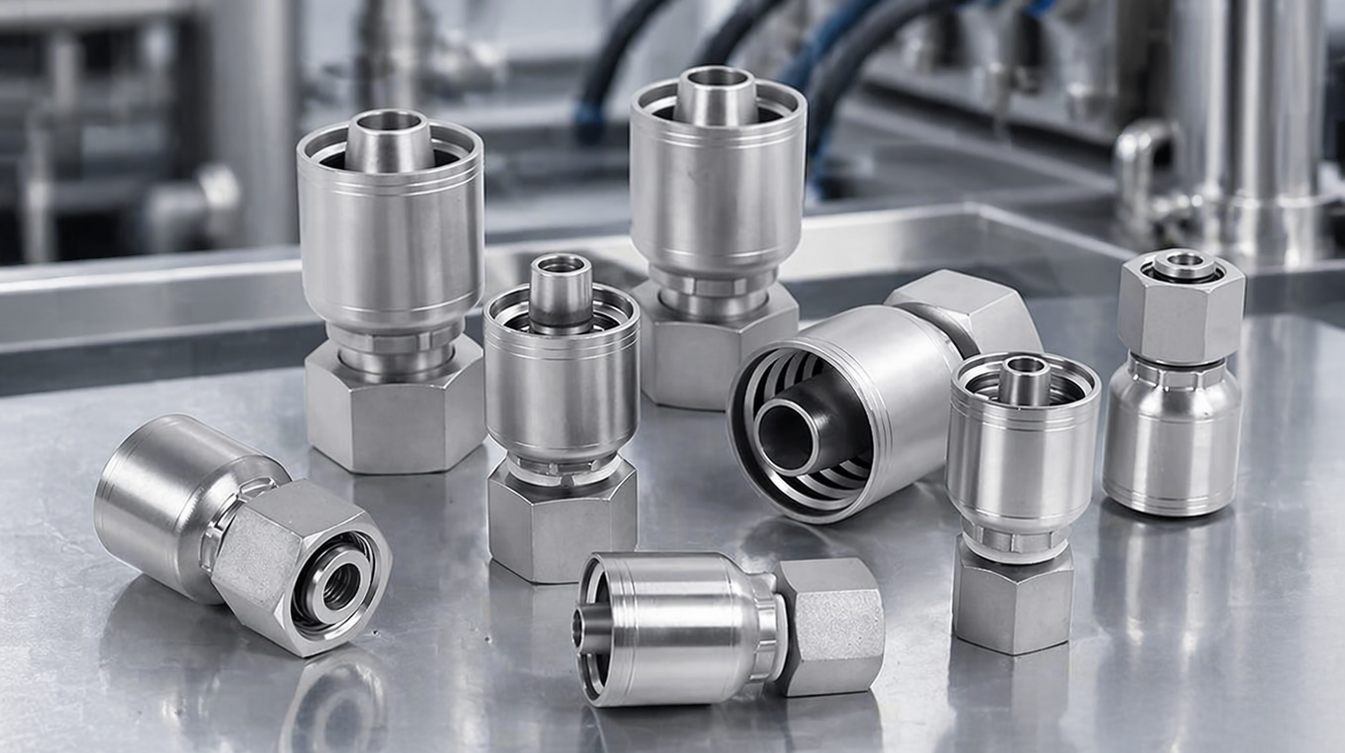
Fundamental Differences in Sealing Principles
Cone seal fittings rely on metal-to-metal hard sealing. For JIC 37°, the male cone contacts the female cone directly, and the tightening torque creates contact pressure that causes microscopic deformation of the metal surfaces to form a seal. For metric 24° cone ferrule fittings, the ferrule‘s cutting edge bites into the tube’s outer wall while the ferrule‘s outer cone mates with the fitting body’s 24° inner cone. These seals have no elastic compensation elements; sealing effectiveness depends entirely on machining precision, surface finish, and tightening torque.
O-ring face seal fittings use elastomeric sealing. On an ORFS fitting, the male end has an O-ring groove. When tightened, the O-ring is compressed between the male and female flat faces, creating an elastic seal. The O-ring‘s deformation compensates for minor surface irregularities and assembly errors.
Sealing Reliability Under High Pressure
Under static high-pressure conditions, both types can achieve reliable sealing. However, as pressure increases, cone seals become highly sensitive to tightening torque. Under-tightening causes insufficient contact pressure and leakage; over-tightening may damage the cone, causing irreversible plastic deformation. Additionally, cone seals are very sensitive to contamination—a tiny particle or scratch can create a leak path.
O-ring face seals perform more consistently under high pressure. The O-ring exhibits a “self-sealing effect”—the higher the system pressure, the more the O-ring is forced against the groove side, increasing sealing contact stress. As long as the O-ring material is compatible and not extruded, sealing reliability is very high. Test data shows that ORFS fittings are generally rated up to 6,000 PSI (approximately 414 bar), with premium products capable of withstanding over 600 bar—equivalent to or better than cone seals.
Reliability Under Vibration and Impulse
This is where the two types differ most significantly. The metal contact surfaces of cone seals are prone to fretting wear under high-frequency vibration. Long-term vibration causes wear marks on the sealing surfaces, leading to leakage. In high-vibration environments such as construction machinery and mining equipment, cone fittings commonly experience loosening and leakage, requiring periodic torque checks.
O-ring face seals, with their elastic O-ring, effectively absorb vibration energy, maintaining constant compression on the sealing faces. Therefore, ORFS fittings offer far superior long-term reliability under high-vibration, high-impulse conditions. This is why many manufacturers of excavators, loaders, and other mobile equipment prefer ORFS for critical hydraulic circuits.
Temperature and Media Compatibility
Cone seals, containing no rubber components, have greater tolerance for extreme temperatures. Stainless steel cone fittings can be used in environments exceeding 500°C and are also suitable for cryogenic liquid nitrogen applications. O-ring face seal reliability is limited by the O-ring material. Standard NBR or FKM O-rings operate within -40°C to +120°C; beyond this range, special seal materials are required.
In terms of media compatibility, cone seals are suitable for almost all fluids. O-rings must be compatible with the media. Phosphate ester hydraulic fluids require EPDM O-rings; otherwise, swelling and failure will occur.
Installation and Maintenance Reliability
Cone seals have very demanding installation requirements. Tightening torque must be precisely controlled—over- or under-tightening can cause leakage. After disassembly, the cone surfaces often have indentations, reducing sealing reliability if reused; replacement is typically recommended. Additionally, damaged cone surfaces are difficult to repair and require fitting replacement.
O-ring face seals are more forgiving during installation. Even if tightening torque varies slightly, the O-ring‘s elasticity maintains the seal. After disassembly, simply replacing the O-ring restores sealing performance, resulting in low maintenance costs. However, care must be taken to avoid twisting or cutting the O-ring.
Conclusion: O-Ring Face Seals Are More Reliable Under High Pressure
In summary, for demanding high-pressure, high-vibration, and high-impulse applications, O-ring face seals (ORFS) offer significantly better reliability than cone seals. Their elastic compensation capability, self-sealing effect, and vibration resistance make them the preferred choice for mobile equipment, mining machinery, marine hydraulics, and similar fields. Cone seals (JIC, metric 24°) remain valuable for extreme temperatures, cost-sensitive applications, and situations where rubber materials are unsuitable. For high-pressure hydraulic systems seeking long-term leak-free operation, O-ring face seals are the more reliable choice.
