
In hydraulic systems, threaded fittings are among the most common connection methods, and their sealing performance directly determines whether leaks occur. However, when faced with oil seepage, many users simply blame “poor seal quality” or “aging fittings,” overlooking the root causes of failure. In fact, the vast majority of threaded fitting seal failures can be traced to three core factors. This article analyzes these three root causes from the perspective of sealing principles and provides targeted preventive measures.
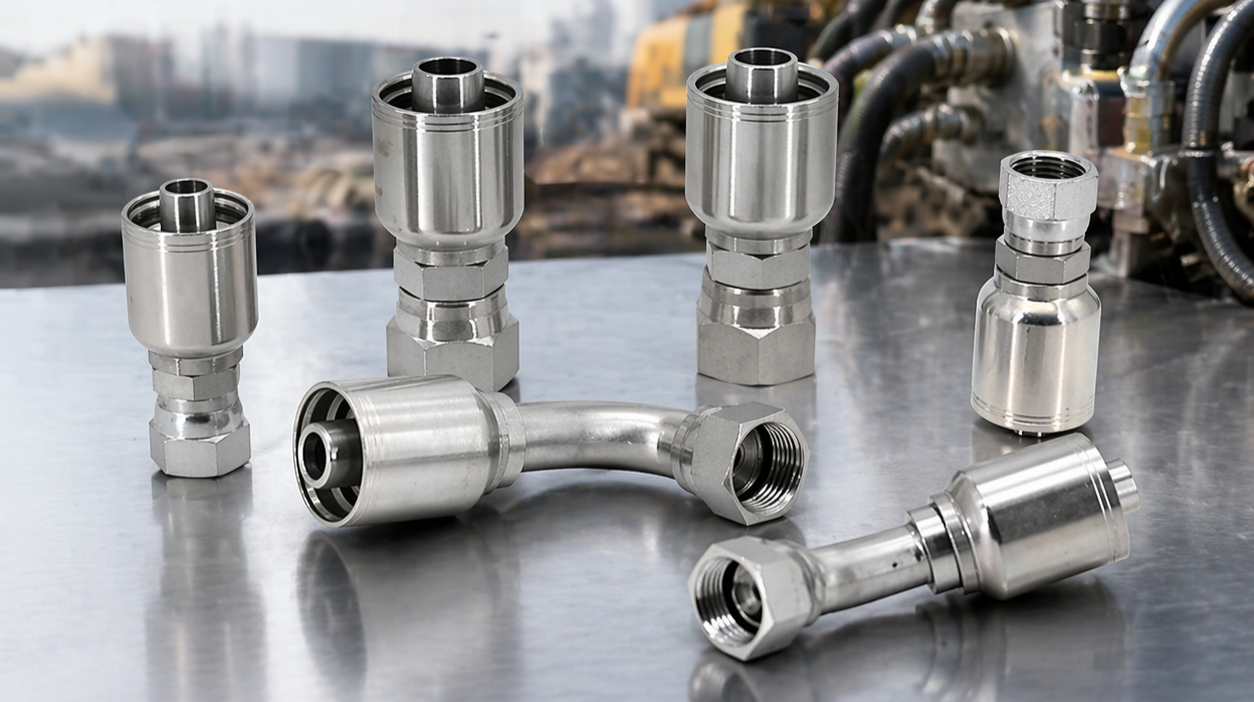
Root Cause 1: Damaged or Contaminated Sealing Surfaces
Threaded fittings employ various seal types, including cone seals (JIC 37°, metric 24°), face seals (ORFS O-ring face), and tapered thread seals (NPT, R threads). Regardless of the type, the integrity of the sealing surface is a prerequisite for achieving a seal.
Cone seals rely on metal-to-metal contact for hard sealing, requiring extremely high surface finish and geometric precision. In practice, sealing surfaces are easily scratched—during installation, fittings may bump into each other; residual metal chips or sand particles may be present in the line; tools may scratch surfaces during disassembly. These minor defects become leak paths under high pressure. Additionally, cone seals are highly sensitive to contamination—even a hair-thin metal particle embedded on the sealing surface will cause continuous oil seepage.
Face seals with O-rings also suffer from sealing surface damage. Although O-rings can compensate for minor surface irregularities, if the mating faces have deep scratches, corrosion pits, or rough machining marks, the O-ring will be extruded into these defects under high pressure, leading to shear damage or permanent deformation. Tapered thread seals (such as NPT) rely on interference between thread flanks. If the threads have nicks, rust, or burrs, sealing effectiveness is compromised.
Preventive measures include: inspect sealing surfaces carefully before installation, using a magnifying glass or fingernail to detect scratches or dents; clean all fittings and ports to remove metal chips, sand, and other contaminants; use protective caps on fittings until the moment of installation; replace rather than attempt to repair damaged sealing surfaces.
Root Cause 2: Improper Thread Fit or Dimensional Deviation
The sealing performance of threaded fittings depends on proper mating of male and female threads. Common failure causes include incorrect thread selection, mismatched thread precision, and thread wear.
Incorrect thread selection is the most common basic mistake. For example, forcing a metric M22×1.5 fitting into an imperial G7/8 port—while the first few threads may engage, the different thread angles (60° for metric, 55° for imperial) prevent proper centering of the sealing surfaces, making leakage inevitable. Similarly, mixing NPT tapered threads with BSPT tapered threads causes sealing failure due to differences in pitch and thread angle.
Mismatched thread precision is also common. Hydraulic fittings typically use precision threads of 6H/6g or higher. However, equipment ports or adapters may have insufficient machining accuracy (rough cutting marks, out-of-roundness), resulting in insufficient contact area or uneven load distribution on the threads, preventing uniform transmission of sealing pressure.
Thread wear from long-term use also leads to seal failure. Frequent assembly and disassembly gradually wear the thread flanks, increasing clearance. After tightening, the initial contact pressure between sealing surfaces decreases, eventually causing leakage.
Preventive measures include: use thread gauges or calipers to accurately measure thread specifications; never rely on “feel” when trial-fitting; purchase precision fittings conforming to standards (SAE, ISO, DIN); replace fittings or equipment ports when threads are worn.
Root Cause 3: Improper Installation Torque (Over- or Under-Tightening)
Torque is the most critical operational factor affecting the sealing effectiveness of threaded fittings. Both under-tightening and over-tightening cause seal failure.
Under-tightening fails to generate sufficient contact pressure between sealing surfaces. O-ring compression or cone face compression is inadequate, and under system pressure fluctuations, hydraulic oil seeps through micro-gaps. Cone seals are particularly sensitive to torque—under-tightening directly causes leakage.
Over-tightening is equally harmful. For cone seals, excessive torque plastically deforms the cone, potentially crushing the flare or ferrule, causing irreversible damage. For O-ring face seals, over-tightening may extrude the O-ring out of its groove or crack the fitting body. Additionally, over-tightening stretches the threads, reducing preload and actually accelerating loosening.
In practice, many maintenance personnel tighten by “feel” without using a torque wrench. Torque requirements vary significantly with different sizes and materials, making it easy to make mistakes based on experience.
Preventive measures include: use a torque wrench set to the manufacturer‘s specified torque value; for cone seals, the turn-of-nut method (e.g., tighten to contact, then rotate 1/4 turn) can be used as a supplement; maintain a torque log and calibrate torque wrenches regularly.
Summary
The three root causes of seal failure in threaded hydraulic fittings can be summarized as: damaged or contaminated sealing surfaces, improper thread fit or dimensional deviation, and improper installation torque. These three factors cover the entire process from component quality and selection matching to installation practices. By rigorously controlling each step—using undamaged sealing surfaces, selecting correct thread specifications, and using a torque wrench set to standard values—the vast majority of leakage problems can be prevented.
