
In foundation engineering, tunnel grouting, and building construction, large bore hoses are essential for mud transport and mortar spraying. Whether the diameter matches between the pump truck outlet and the spraying machine inlet directly affects conveying efficiency, equipment life, and safety. This guide provides a complete selection methodology covering diameter calculation, pressure rating, abrasion resistance, and coupling types.
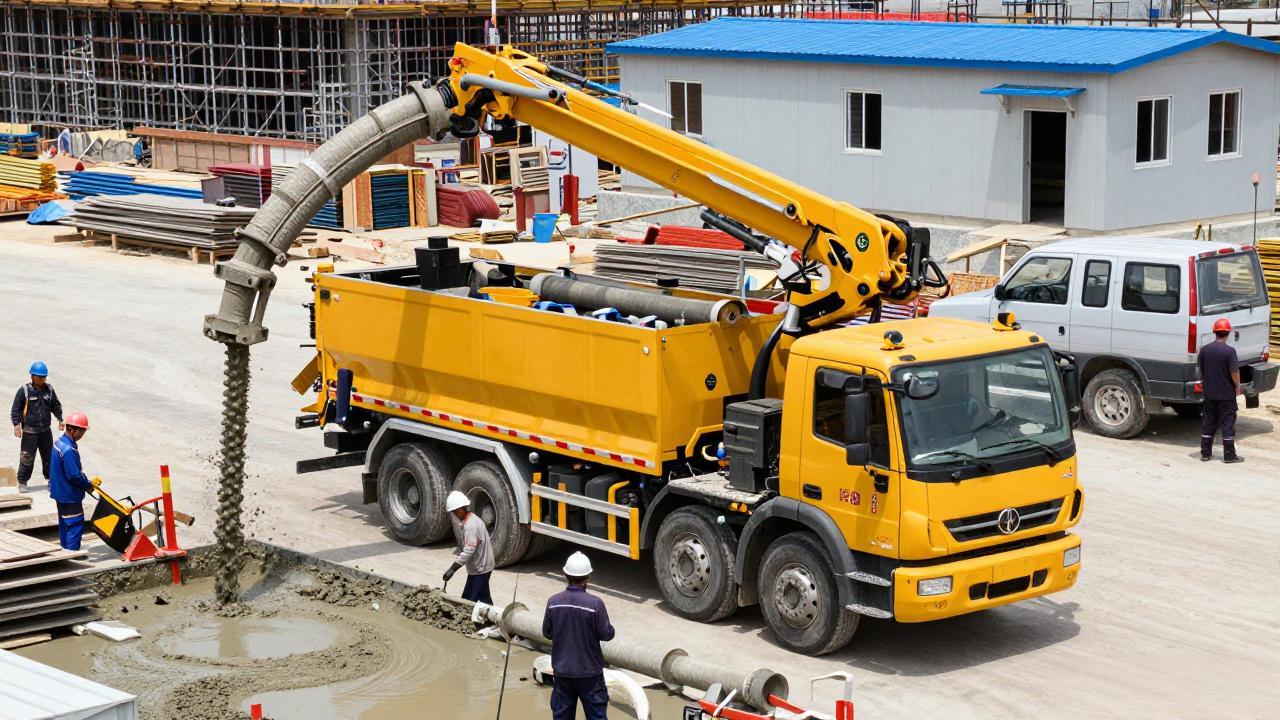
Why Diameter Matching Matters
The conveying capacity of a pump truck or mortar spraying machine is expressed in cubic meters per hour (m³/h). Too small an inner diameter causes excessive flow velocity, high resistance, accelerated liner wear, and even burst. Too large a diameter reduces velocity, allowing aggregate settling and blockage, while the equipment cannot build sufficient pressure. The optimal flow velocity range is 1.5–3.0 m/s. Therefore, the first step is to back-calculate the proper inner diameter based on equipment output and job site distance.
Common Diameters for Pump Trucks and Spraying Machines
Pump truck discharge ports typically use 3 in (76 mm), 4 in (102 mm), 5 in (127 mm), and 6 in (152 mm). Small pump trucks or grout pumps use 3 in; medium pump trucks prefer 4 in; large mud transport requires 5 or 6 in.
Mortar spraying machines (piston or screw type) have smaller inlet ports: 1.5 in (38 mm), 2 in (51 mm), and 2.5 in (64 mm). Small sprayers for indoor plastering use 1.5 in; medium units for large wall mortar use 2 in; large shotcrete machines for tunnels or slopes use 2.5 in.
When a pump truck feeds mortar into a spraying machine hopper, the connecting hose diameter should match the pump truck outlet, but a reducer is normally needed near the spraying machine inlet. For example, a 4‑in pump outlet feeding a 2‑in sprayer inlet requires a 4‑in to 2‑in reducer hose or adapter, placed as close as possible to the spraying machine to minimize high velocity upstream.
Core Selection Parameters
For large bore mud hoses, consider inner diameter, working pressure, burst pressure, minimum bend radius, and liner thickness.
Inner diameter should equal or slightly exceed the equipment outlet diameter. If the pump outlet is 102 mm, select 102 mm hose. For distances over 100 m, one size larger (114 mm) reduces resistance.
Working pressure: mud pumping pressure is typically 0.5–2.5 MPa; mortar sprayers work at 1.0–3.0 MPa. Hose rated working pressure should be ≥1.25× system maximum pressure. For long distance or high lift, choose steel wire spiral reinforced hose (working pressure up to 4–6 MPa).
Abrasion resistance is critical. Mud often contains sand and gravel that wear the liner rapidly. Select a liner of high‑abrasion natural rubber or polyurethane with DIN abrasion ≤100 mm³. For coarse aggregate mortar, liner thickness should be ≥8 mm.
Bend radius depends on site layout. For large bore hoses, minimum bend radius is typically 10–12× outer diameter. In tunnels or tight spaces, choose a suction/discharge hose with a steel spiral wire carcass, allowing bend radius down to 6–8× OD while handling vacuum.
Diameter Matching Schemes
Scheme 1 – Direct match: When the pump outlet and sprayer inlet diameters are identical (e.g., both 2 in), use a hose of the same ID. Hose length should not exceed 15 m to avoid pressure loss.
Scheme 2 – Reducer connection: When pump outlet is larger (e.g., 4 in) and sprayer inlet is 2 in, use a combination of a short 4‑in hose + a 4×2 reducer coupling + a short 2‑in hose. Place the reducer near the sprayer end, and keep the reduced hose length under 5 m to minimize shock from sudden velocity change.
Scheme 3 – Manifold distribution: One large pump truck feeding multiple sprayers can use a main header (e.g., 5 in) splitting into branch hoses (each 2 in). The main header should be high-pressure rated, with ball valves on branches for flow control. Accurate hydraulic balancing is required.
Scheme 4 – Mixed hose/pipe: For long straight runs, use steel or ultra‑high molecular weight polyethylene pipe (low friction, high wear life). Use hoses only at both ends and at bends. This reduces hose cost and extends overall system life.
Coupling Types and Sealing
Common couplings for large bore mud hoses include grooved clamps (similar to fire hose couplings), threaded quick couplers, and flanges. Pump trucks typically use clamps or flanges; sprayers often use threaded quick couplers or grooved clamps. Verify both ends match – adapters may be required. Seals should be oil‑ and water‑resistant NBR or FKM, and always replace seals after each disassembly.
Common Selection Mistakes
Mistake 1: Focusing only on diameter, ignoring pressure rating. A low‑pressure hose used in a high‑pressure system will burst immediately. Mistake 2: Too thin a wear liner. Sandy mud can wear through a 3 mm liner in tens of hours. Mistake 3: Forcing a bend radius too small, causing liner tearing or wire exposure. Mistake 4: Ignoring temperature effects. In summer heat, hose pressure rating drops 10–15%.
Maintenance and Replacement
After each use, flush the hose with clean water to prevent mortar setting. Regularly inspect the cover for blistering, cracks, or wire protrusion. Measure liner wear: when the ID increases by more than 8% from original, replace the hose. Store hoses straight, avoid heavy stacking and direct sunlight.
In summary, selecting a large bore mud hose requires balancing diameter matching, pressure rating, abrasion resistance, and coupling type. Following the matching schemes above will significantly improve conveying efficiency and reduce blockage risks.
