
Concrete delivery hoses endure high‑pressure scouring and repeated bending during pumping. Even if the outside looks intact, the inside may already be near failure. Continuing to use a hose that has reached its replacement cycle can result in bursts, slurry spills, site contamination, or severe injury from high-pressure fluid. This article summarizes five field self‑check points that require no complex instruments, helping you quickly decide whether a hose needs replacement.
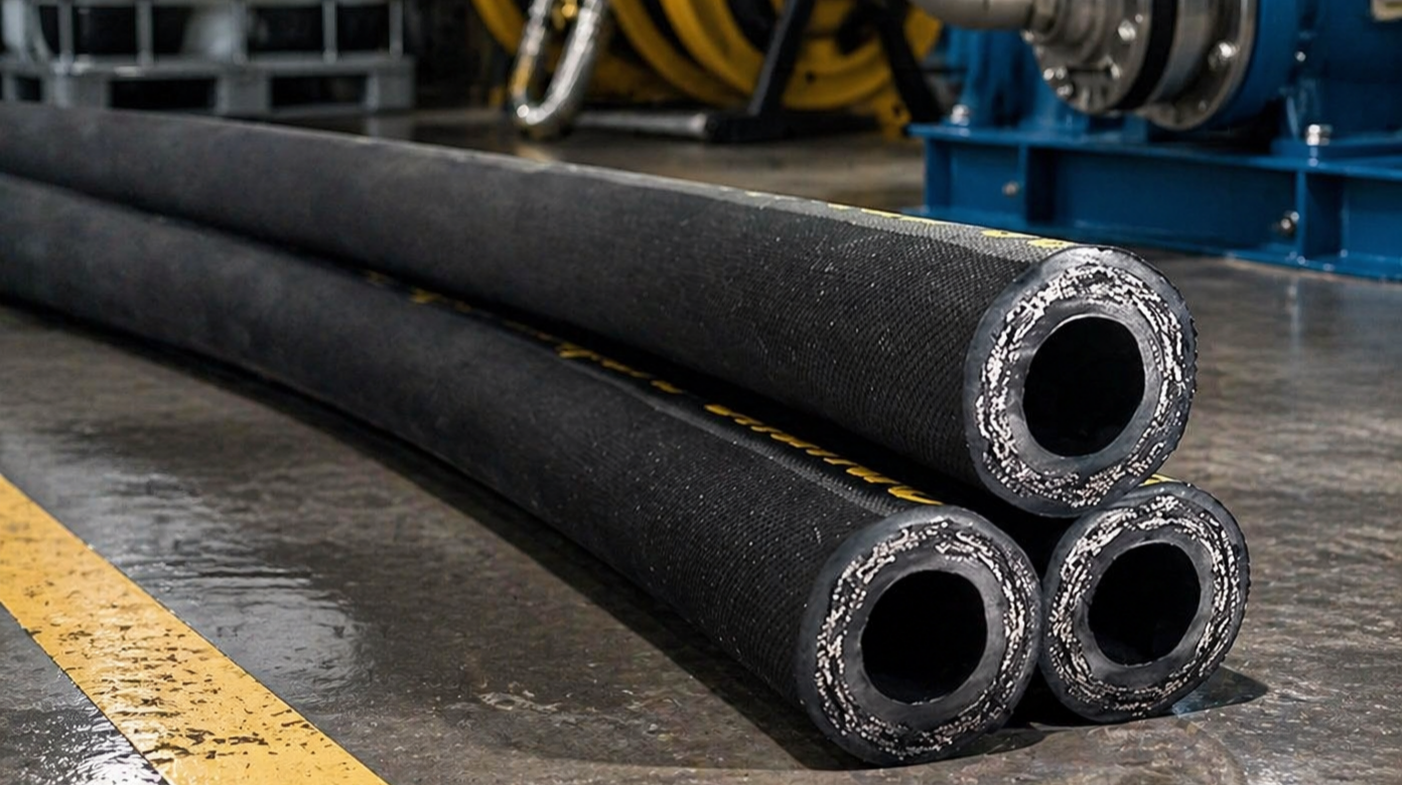
Point 1: Measure Outer Diameter Expansion
After fatigue of the steel wire reinforcement or liner wear, a concrete hose undergoes irreversible radial expansion under pressure. Self‑check method: after stopping the pump and relieving pressure, select three cross‑sections along the middle of the hose and measure the outer diameter with a vernier caliper or steel tape. Compare with the original out‑of‑box diameter or the last recorded baseline. If the measured outer diameter has increased by more than 8% to 10% compared to the new hose, the reinforcement layer is severely fatigued and a burst is imminent. Special attention: if any local bulge resembling a “gourd” appears, replace immediately. Outer diameter expansion is the most intuitive indicator and the easiest first step on any job site.
Point 2: Inspect the Cover for Cracks or Wire Exposure
The hose cover not only protects the internal steel wires but also serves as a window into the aging condition. During self‑check, bend the hose and observe the outer side of the bend area: fine, dense cracks (like alligator skin) indicate that the rubber has hardened and aged. If the cracks are deep enough to reveal inner wires or wires have already pierced through the cover, the hose must be scrapped. Also pay attention to the cover near the couplings, where stress concentrates during pumping, making cracking more likely. Once wires are exposed to wet concrete or rain, they corrode rapidly, and the resulting volumetric expansion further splits the cover, creating a vicious cycle. After cleaning the hose at the end of each shift, use a flashlight to inspect the entire length thoroughly.
Point 3: Feel the Liner Wear Level
Sand and stone particles in concrete gradually wear down the hose liner. When the rubber or UPE liner wears through to expose the steel wires, the wires will be cut quickly, leading to a burst. Since liner wear starts internally, the outside often shows no abnormality. A quick field method: after a pumping job, disconnect one end of the hose and insert a hand or finger inside to feel the inner wall. A high‑quality liner should feel smooth and even. If you feel distinct longitudinal grooves, wavy unevenness, or directly touch hard wire points, the wear has exceeded the limit. For large‑bore hoses (4 inches and above), use a small mirror or borescope to assist. For more precise judgment, measure the deepest wear with a depth gauge or caliper: when the remaining liner thickness is less than one‑third of the original, schedule a replacement. For UPE ultra‑wear‑resistant hoses, although wear is slower, replacement is still required once the liner is worn through.
Point 4: Check for Frequent Excessive Bending
Although not directly a wear measurement, this is an important indicator of whether the hose has suffered additional damage. If the hose is often bent to less than its specified minimum bend radius (for example, forcefully folding a large‑bore hose), the internal steel wires fatigue prematurely. During self‑check, look for “dead‑kink” marks – areas where the cover has turned white, the liner protrudes, or a permanent crease has formed. If such damage appears at multiple locations, the overall service life is already significantly reduced even if no leakage has occurred. Consider rerouting the line or switching to a suction/discharge hose with a steel spiral carcass that supports a tighter bend radius.
Point 5: Track Cumulative Pumped Volume and Service Time
There is no precise mandatory scrap life for concrete delivery hoses, but industry experience offers valuable references. Record the cumulative cubic meters pumped through each hose since its first use. Ordinary rubber hoses show significantly accelerated wear after 4,000 to 5,000 cubic meters, while UPE ultra‑wear‑resistant hoses can reach 20,000 to 30,000 cubic meters. If you don‘t have exact counts, estimate by time: for medium‑intensity use (200 to 300 cubic meters per day), ordinary hoses need replacement in 3 to 6 months, while UPE hoses can last 1 to 2 years. If a hose has already undergone more than 100,000 pressure pulses (equivalent to frequent pumping for 1 to 2 years), consider preventive replacement even if the outside looks acceptable. Also note the hose‘s manufacturing date. Even without any use, rubber hoses stored for more than 3 to 4 years will naturally age and are not recommended for high‑pressure pumping.
Comprehensive Judgment and Action Recommendations
Among the five self‑check points above, if any one shows significant abnormality, mark the hose as “to be replaced” and swap in a spare as soon as possible. If two or more moderate abnormalities appear simultaneously (e.g., 6% OD increase plus light cracking), replace after the current project ends. Special warning: never fall into the trap of “maybe one more use” – concrete hose failure is often sudden, and the higher the pumping pressure, the more severe the consequence of a burst. Maintaining a “one hose one record” log – documenting start date, cumulative volume, and results of each self‑check – is the best practice for scientific replacement cycle management. Taking five minutes for regular inspection is far better than cleaning up a truckload of spilled concrete.
