
In harsh industrial environments such as mines, quarries, steel mills, and construction sites, compressed air pipeline systems face multiple challenges: high temperatures, extreme cold, oil mist, ozone, UV radiation, and mechanical abrasion. Ordinary air hoses often perform poorly under these conditions, dramatically shortening their service life and even creating safety hazards. Steel wire braided hoses, thanks to their unique structural design and material advantages, have become the preferred solution for harsh environments. This article provides a comprehensive analysis of steel wire braided air hoses, covering construction principles, material selection, and key selection criteria.
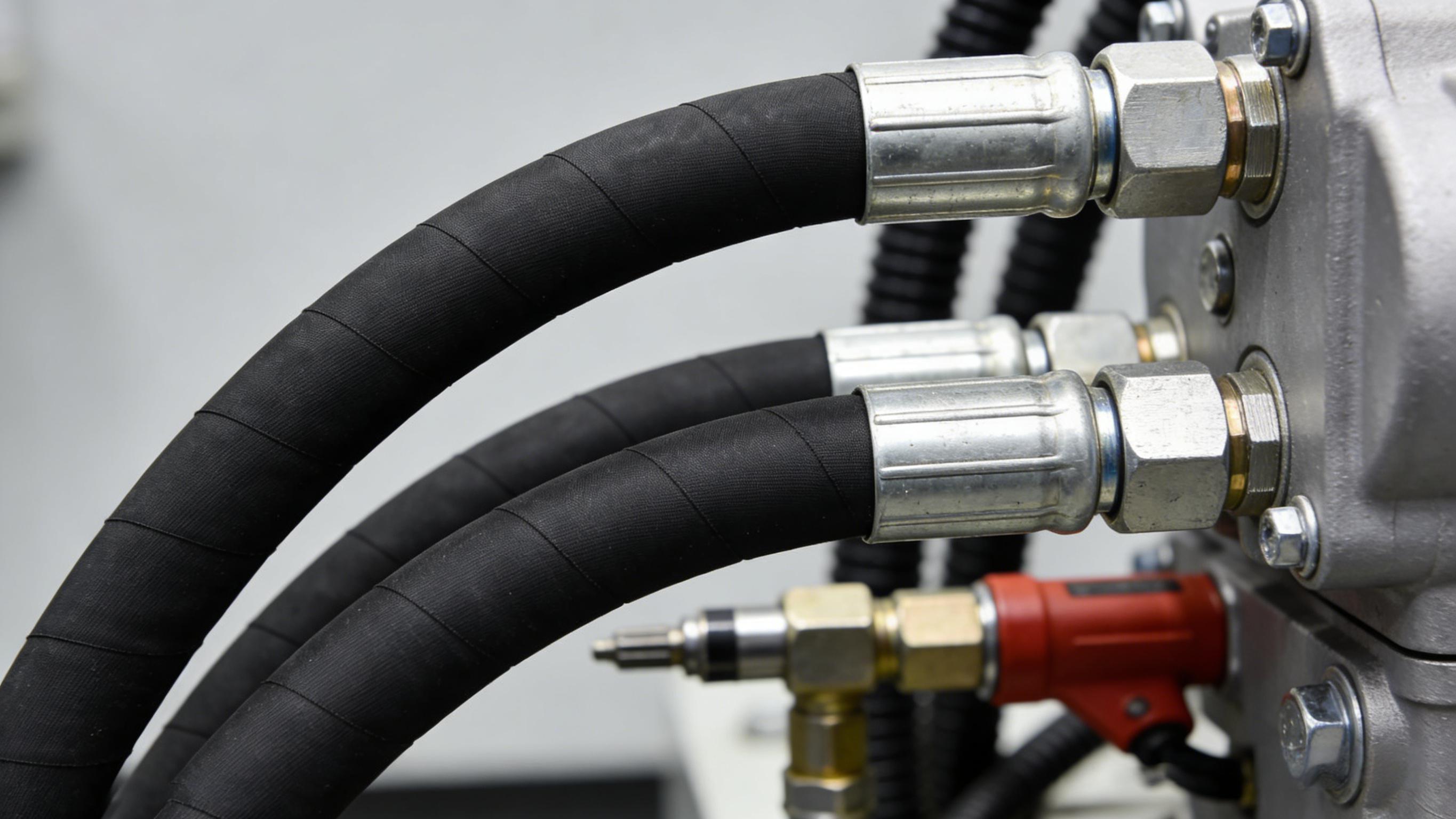
1. Structural and Performance Advantages of Steel Wire Braided Hoses
A steel wire braided air hose consists of three layers: an inner tube, a reinforcement layer, and a cover. The inner tube is made of oil-resistant, age-resistant synthetic rubber such as NBR or SBR, featuring a smooth surface to minimize airflow resistance and withstand oil mist attack. The reinforcement layer is the structural skeleton — high-strength steel wires precisely braided into a mesh, with a braiding angle of 45°±5° and a density of 6–8 strands per inch. This design ensures burst pressure up to 4 times working pressure, maintaining stability even under high pressure without breakage or deformation. The cover protects the internal structure from external attacks, using abrasion-resistant, oxidation-resistant, ozone-resistant synthetic rubber such as SBR, NBR or CR. In quarries and mining applications, the cover also resists rock impact and dust erosion, offering all-weather protection for the hose.
2. Addressing Specific Environmental Challenges
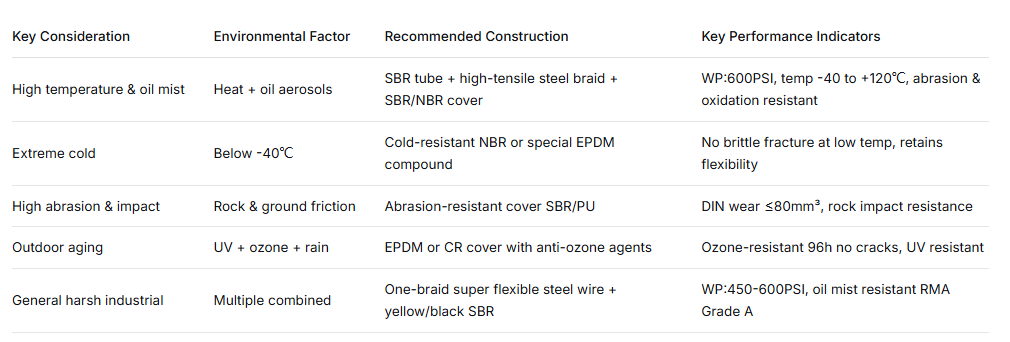
High temperature environments are common in steel mills, engine compartments, and summer outdoor operations, where temperatures often exceed 80℃ and can reach 150℃. Standard steel wire braided hoses operate from -30℃ to +82℃, but for high-temperature oil mist environments, special formulations are available: RMA Grade A SBR inner tube combined with an oxidation-resistant, fire-resistant SBR/NBR cover, achieving 600 PSI working pressure and a temperature range of -40℃ to +120℃. For extreme conditions above 150℃, EPDM hoses or armored heat-insulated hoses are recommended.
In extremely cold conditions, ordinary rubber becomes brittle and hard, leading to cracking. Prioritize hoses with a low-temperature rating of -40℃ or even -50℃ — special SBR+NBR compound covers remain flexible at -40℃ without brittle failure.
Oil mist environments directly attack the inner tube of the air hose. If the inner material is not oil-resistant, swelling, softening, and even collapse can occur. The correct strategy is to choose a steel wire braided hose with an NBR (nitrile rubber) inner tube, as NBR provides excellent resistance to mineral oils, fuels, and lubricating oils, preventing leakage and extending service life. Some models carry an RMA Grade A mark to guarantee oil mist resistance.
Abrasion and impact are daily challenges in mines, quarries, and construction sites — hoses frequently rub against rocks and ground, easily damaging the cover. Focus on two hard indicators: wear volume under DIN 53516 testing (the lower the better, with quality tubes achieving ≤80mm³); and cover material — SBR or NBR are excellent, and some products feature yellow or blue polyurethane (PU) coating specifically for high abrasion and impact resistance. UV and aging are hidden threats: outdoor exposure causes cover cracking and chalking. Ensure the cover includes anti-ozone agents and UV inhibitors, meeting ozone resistance of 50pphm for 96 hours without cracks.
3. Core Performance Parameters and Three-Step Selection
Step 1 – Determine working pressure: Steel wire braided hoses typically offer maximum working pressures between 300 PSI and 600 PSI (approx. 20 to 41 bar), with burst pressure 4 times working pressure (1200-2400 PSI or 83-165 bar). Apply a safety factor of 1.5 based on compressor outlet pressure.
Step 2 – Check minimum bend radius (MBR): Exceeding MBR causes steel wire fatigue and breakage. Specifications vary significantly — a 1-inch hose has an MBR of about 300mm, while a 4-inch hose needs 1300mm. For confined spaces, select high-flex “super flexible” series, some achieving an MBR of just 2.5 times the hose OD.
Step 3 – Specify couplings and length: The coupling is the most vulnerable failure point in harsh environments — use stainless steel or zinc-plated corrosion-resistant fittings with anti-pullout crimping technology. Steel wire braided hoses are commonly available in lengths from 20 to 100 meters, customizing is recommended to avoid excess pressure drop or tension.
4. Standards, Certifications, and Maintenance
Key standards for compressed air hoses include ISO 2398 (textile-reinforced rubber hoses in three types, three classes, two categories, max working pressure 25 bar, temperature range -40℃ to +70℃), and Chinese national standard GB/T 1186-2018 (steel wire coverage ≥95%, burst pressure factor 4:1). For harsh environments, also look for mining safety certification (MSHA), anti-static certification (surface resistance ≤1×10⁶Ω), and flame resistance ratings.
To extend service life, inspect every 2,000 hours for cover cracking or exposed steel wires. Never bend below the minimum bend radius. Regularly test couplings for air leaks with soapy water. After use, clean the inner wall and store in a dry, dark place.
5. Reference Selection Summary for Harsh Conditions
In harsh environments, ordinary air hoses often fail within a single quarter. A well-selected steel wire braided hose, with its combined resistance to high temperature, extreme cold, oil mist, abrasion, and aging, can easily serve for 2-3 years or more. Choose the right materials, calculate the safety factor properly, and strictly respect the minimum bend radius — then the steel wire braided hose becomes a reliable backbone for your compressed air system.
