
In the production of high-pressure spiral hose assemblies, crimping is the core process for connecting hoses to fittings. Two main technical routes exist: skive (removing the outer rubber layer) and non-skive (crimping over the outer cover). They differ significantly in structural integrity, sealing reliability, impulse resistance, and application scenarios. Choosing the correct crimping process directly affects the service life and safety of the hose assembly.
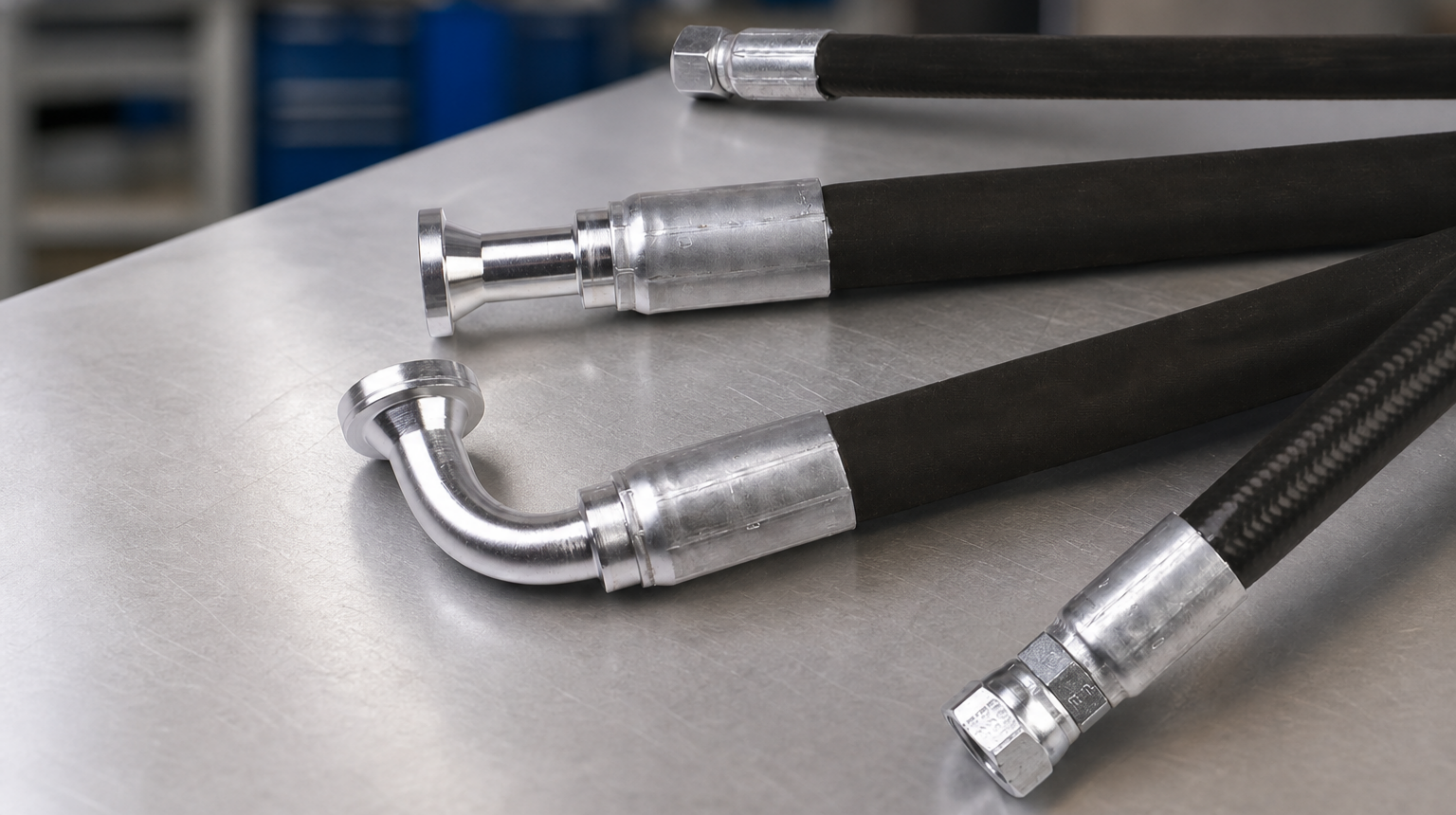
What are Skive and Non-Skive?
Skive process: Before crimping, a skiving machine removes a defined length of the outer rubber layer (and possibly intermediate layers) from the hose end, exposing the steel wire reinforcement. The fitting stem is inserted into the hose, and the ferrule is crimped directly onto the exposed wire layer.
Non-skive process: The outer rubber layer is left intact. The ferrule is crimped directly over the hose cover. The stem is inserted into the hose bore, and the crimping compresses the cover and reinforcement against the stem to create an interference fit.
Structural and Principle Comparison
Skive: Ferrule engages directly with steel wires – high pull-out resistance, excellent sealing, but risks wire damage if skiving is incorrect. Suitable for high and ultra-high pressures (R13, R15, 4SH).
Non-skive: Ferrule compresses the rubber cover, which then transfers force to the reinforcement – moderate pull-out resistance, no wire exposure risk, but cover creep may reduce crimp force over time. Suitable for medium to high pressures (R1, R2, some 4SP).
Advantages of Skive Process
Higher pull-out resistance: The ferrule bites directly into the steel wire layer, preventing blow-off even under high impulse pressures, ideal for >35 MPa and severe vibration.
Smaller crimped OD: After skiving, the assembly OD is close to the original hose OD, facilitating routing in tight spaces.
Long-term reliability: Eliminates concerns of cover aging or creep reducing crimp force.
Precautions for Skiving:
Skive length and depth must be precisely controlled. Over-length reduces tensile strength; over-depth cuts wires, drastically reducing burst pressure.
Exposed wires must be undamaged, evenly distributed, and free of kinks.
Always use a dedicated skiving machine with sharp blades – manual skiving is unacceptable.
Advantages and Limitations of Non-Skive Process
Advantages:
High production efficiency: One step fewer – directly crimp, ideal for high-volume production.
No wire damage risk: No exposed wires, eliminates operator error in skiving.
Better environmental protection: The intact cover provides additional corrosion and abrasion resistance.
Limitations:
Over time, rubber cover creep under high pressure/pulse can reduce crimp force, leading to loosening and leakage.
Lower pull-out resistance – unsuitable for ultra-high pressure or high-impact applications.
Larger crimped OD may be problematic in tight spaces.
How to Choose – Engineering Recommendations
Working pressure: For system pressure >35 MPa (5000 psi) or ultra-high pressure (R13/R15), prioritize skive. For medium-low pressure (≤25 MPa) with mild pulses, non-skive is adequate.
Environment: In wet, salt-spray, or chemically corrosive environments, non-skive retains the full cover for extra protection. For skive, ensure the exposed wire interface is sealed (e.g., with a cover ring or sealant).
Hose type: Spiral hoses (4SP, 4SH, R13, R15) with multiple wire layers are typically recommended for skive crimping to fully utilize their pressure potential. Braided hoses (R1, R2) generally use non-skive.
Certifications: Some standards (e.g., API 7K, ISO 18752) mandate skive crimping for specific pressure grades – always follow the specification.
Key Quality Control Points
Skive parameters: Skive length (typically 70-80% of ferrule length), remaining inner rubber thickness (ensures sealing), and perpendicularity of the skived face.
Non-skive parameters: Cover hardness (affects compression), crimp reduction (typically 15-25% of original cover thickness), and ferrule tooth design.
General: 100% proof testing at 1.5× working pressure after crimping, plus periodic burst and impulse tests per batch.
Summary
Skive and non-skive each have their place; neither is universally superior. Skive offers higher connection strength and reliability for high-pressure, high-impulse, long-life applications. Non-skive provides efficiency, low cost, and no wire damage for medium-pressure markets. Selection should consider pressure rating, environment, hose type, and production volume – consult a crimping specialist when uncertain.
