
In high-pressure cleaning, the thermoplastic hose is the critical link between the pump and the spray gun. Correct selection directly impacts cleaning efficiency, operational safety, and service life. Working pressures range from tens of MPa up to 1400 bar (20,300 psi), and selection is never simply “the more expensive, the better”. This guide systematically covers the core dimensions of thermoplastic hose selection for high-pressure washers, with an upper limit of 1400 bar.
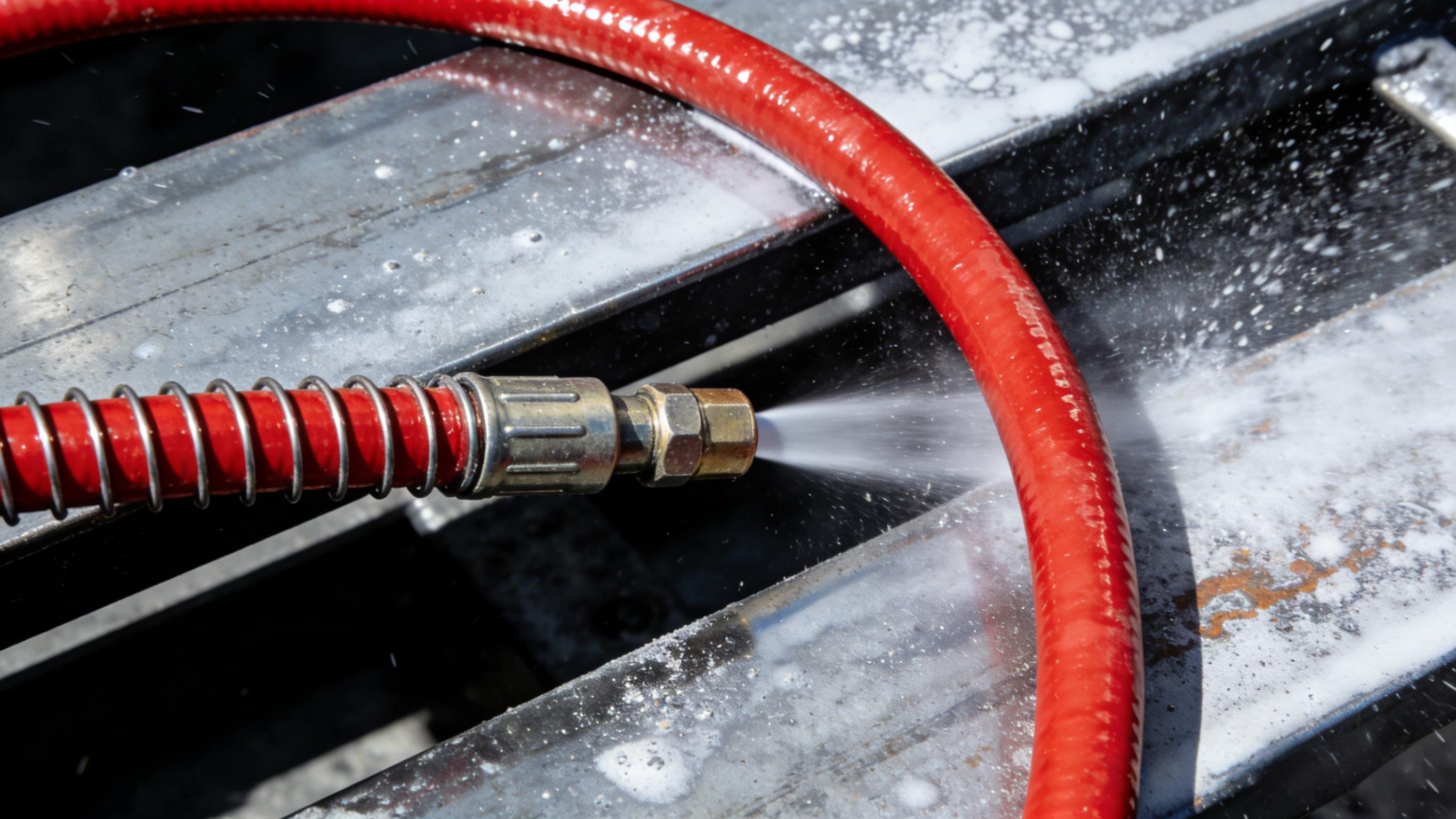
1. Selection by Working Pressure Grade
The rated working pressure of a high-pressure cleaning hose must be equal to or greater than the maximum working pressure of the cleaning system. Within the 1400 bar range, grades can be classified as follows:
30-50 MPa (4,350-7,250 psi) standard commercial grade: Suitable for building cleaning, vehicle washing, municipal sanitation. Typically polyester fiber-braided; economical. Inner diameter mostly 1/4 inch (6.4 mm).
50-100 MPa (7,250-14,500 psi) industrial high-pressure grade: Suitable for heat exchanger cleaning, industrial pipe descaling. Requires wire-braided or multi-layer wire spiral reinforcement with burst pressure ≥4× working pressure.
100-140 MPa (14,500-20,300 psi) ultra-high pressure grade: Typical applications include hydrodemolition, water jet guns, ship cleaning. Must use four or more layers of high-tensile steel wire spiral construction; working pressure directly up to 1400 bar. For example, Parker‘s 2440N series features a PA inner tube with four layers of high-tensile steel wire reinforcement, working pressure up to 1400 bar, design safety factor 2.5:1, complying with DIN EN 1829-2.
Above 1400 bar (>20,300 psi): Though above this guide’s limit, can be seen in special waterjet cutting, reaching up to 4000 bar (58,000 psi).
2. Matching Inner Diameter with Flow Rate
Inner diameter determines flow capacity and must match pump flow rate and nozzle orifice size. Common ID matching rules within 1400 bar:
1/4 inch (6.4 mm): Suitable for commercial washers with flow rates 40-60 L/min; the most common size on the market.
3/8 inch (9.9 mm): Suitable for industrial cleaning tasks with 80-120 L/min, such as large-area paint removal and hull cleaning.
1/2 inch (12.8 mm): Suitable for ultra-high pressure hydrodemolition with flow rates above 120 L/min. For example, the 2440N series with 1/2 inch (12.8 mm) ID directly corresponds to 1400 bar working pressure.
3/4 inch and above: For very high flow scenarios (multi-gun operation), pressure rating typically lower.
Excessively small IDs increase fluid resistance and pressure loss; excessively large IDs add weight and cost.
3. Selecting the Right Liner Material: PA vs UPE vs POM
The liner material determines media compatibility, wear resistance, and temperature range:
Polyamide (PA/nylon): High pressure strength, smooth bore, low volumetric expansion. Parker’s 2440N uses PA liner with four-layer high-tensile steel wire reinforcement, providing low volumetric expansion and stable ID change – the mainstream choice for 1400 bar cleaning hoses. However, PA is not resistant to strong acids/alkalis and should not convey chemical cleaning agents.
Ultra-High Molecular Weight Polyethylene (UPE): Wear resistance 5-10× that of PA, and resistant to strong acids/alkalis. Suitable for sand-laden wastewater, chemical equipment cleaning, etc., but with lower maximum temperature (approx. 80℃).
Polyoxymethylene (POM): Combines high rigidity and low friction coefficient; used as inner tube material in some ultra-high pressure hoses (above 1400 bar), but poor hydrolytic stability – not suitable for high-temperature humid conditions.
4. Safety Standards and Fitting Compatibility
High-pressure cleaning hoses must comply with international safety standards such as DIN EN 1829-2 (high-pressure water jet machine safety requirements), SAE J517, or ISO 18752. These standards specify burst pressure (typically 2.5-4× working pressure), impulse fatigue life, and manufacturing tolerances. For example, Parker 2440N series complies with DIN 1829-2, design safety factor 2.5:1. Always request third-party test reports from suppliers.
Regarding fittings, ultra-high pressure hoses typically use one-piece fitting stems (such as LX series or BL series) or custom assemblies. Fitting material should be stainless steel to prevent rust and galling. Assemblies must be crimped by professional manufacturers.
5. Five-Step Selection Process
Determine system maximum working pressure and peak pressure → select hose rated working pressure ≥ system peak.
Identify cleaning medium characteristics → use PA for clean water, UPE for corrosive media or solids.
Calculate flow rate and required ID → select corresponding bore size.
Confirm temperature range → PA type typically -40℃ to +100℃; above 1400 bar, upper limit drops to +70℃.
Verify standard certification and fitting compatibility → request test reports.
6. Common Selection Mistakes
Mistake 1: Using a hose with rated pressure slightly below pump outlet pressure. When actual pressure exceeds rated pressure by 1.25 times, hose life decreases by 50%.
Mistake 2: Focusing only on pressure, ignoring inner diameter and flow matching.
Mistake 3: Selecting the wrong liner material for the cleaning medium.
